

L
Liquid phase or permeate
V
Vapor phase or retentate
Superscripts
0
Ideal gas property
in, out Inlet, outlet
R
Residual property
V, L
Vapor, liquid or retentate, permeate
1 Introduction
Units for CO 2 removal from natural gas (NG) using
membrane-permeation (MP) technology are becoming
gradually more common in the context of large-scale gas
processing and gas purification systems (Baker 2004). This
is especially true, among several other applications, in
connection to offshore rigs that have to purify high flow rates
of CO 2 -rich raw NG streams (from 20 to 45 mol% CO 2 )
producing in the retentate exportation gas (from 3 to 5 mol%
CO 2 ) and, in the permeate, CO 2 -rich product streams (from
70 to 80 mol% CO 2 ) for enhanced oil recovery (EOR) destinations (Ebner and Ritter 2009; Arinelli et al. 2019). Ho
et al. (2006) and Bernardo et al. (2009) present complete
surveys on gas processing applications of membranepermeation technology.
Regarding decarbonation of CO 2 -rich NG, it is worthwhile to notice that the chemical absorption of CO 2 with
aqueous monoethanolamine (MEA) and aqueous
methyl-diethanolamine (MDEA) is very mature technologies
considered as benchmark options for such service (de
Medeiros et al. 2013a). Nevertheless, the membrane permeation with polymeric skin-dense membranes is growing
fast and it is being much more used than aqueous-amine
absorption for CO 2 -rich NG decarbonation at high-pressure
in some niches of applications, such as, in deep waters,
floating, production, storage, and offloading (FPSO) offshore
platforms, where space and weight are the major concerns,
and the modularity of MP units is an important advantage
(Araújo and de Medeiros 2017). Other advantages of MP
over aqueous amines for NG decarbonation services on
offshore platforms comprise: (i) MP is a simpler process
solution; (ii) MP units are smaller and lighter systems;
(iii) MP is a cleaner solution with no chemical additives;
(iv) MP has low fire or explosion hazards; (v) MP can
execute simultaneous removal of CO 2 , H 2 S, and H 2 O;
(vi) MP has less maintenance, lower capital, and operational
costs; and (vii) MP can treat NG at well-heads. On the other
hand, some major comparative disadvantages of MP to
aqueous-amines absorption are: (i) Decreasing CO 2 –CH 4
selectivity for increasing flux; (ii) inferior economic
competitiveness at higher scales; (iii) decreasing membrane
stability and resilience for increasing (T, P); (iv) degradation
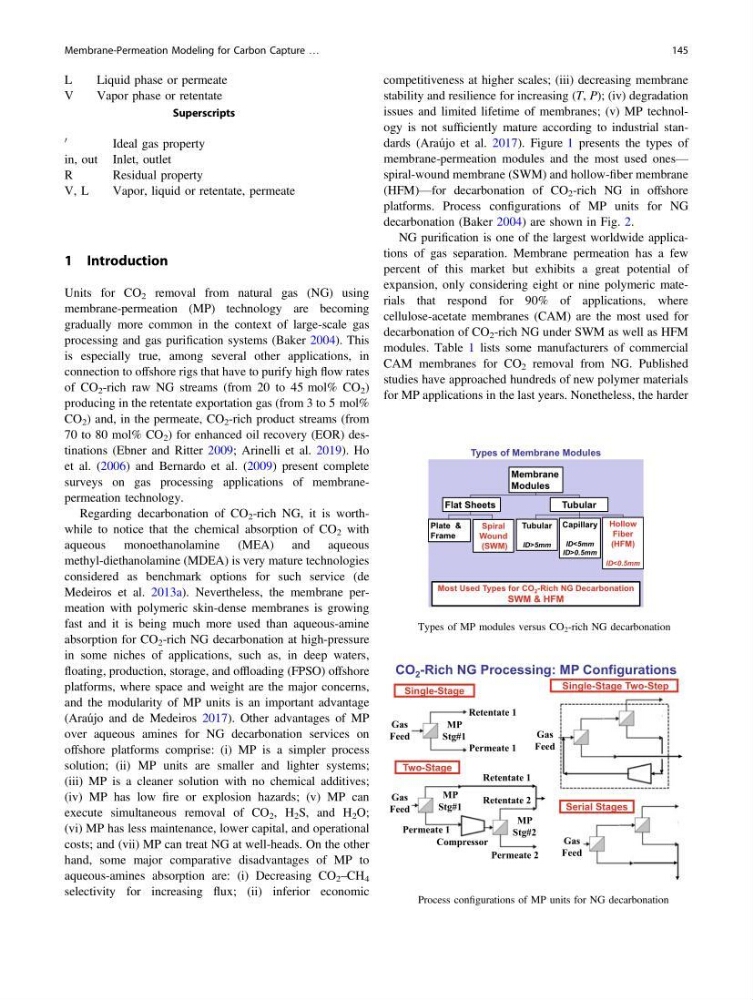
issues and limited lifetime of membranes; (v) MP technology is not sufficiently mature according to industrial standards (Araújo et al. 2017). Figure 1 presents the types of
membrane-permeation modules and the most used ones—
spiral-wound membrane (SWM) and hollow-fiber membrane
(HFM)—for decarbonation of CO 2 -rich NG in offshore
platforms. Process configurations of MP units for NG
decarbonation (Baker 2004) are shown in Fig. 2.
NG purification is one of the largest worldwide applications of gas separation. Membrane permeation has a few
percent of this market but exhibits a great potential of
expansion, only considering eight or nine polymeric materials that respond for 90% of applications, where
cellulose-acetate membranes (CAM) are the most used for
decarbonation of CO 2 -rich NG under SWM as well as HFM
modules. Table 1 lists some manufacturers of commercial
CAM membranes for CO 2 removal from NG. Published
studies have approached hundreds of new polymer materials
for MP applications in the last years. Nonetheless, the harder
J.L. de Medeiros - UFRJ
23
Types of Membrane Modules
Plate-and-frame Spiral modules
Flat sheets
Tubular
> 5 mm
Capillary
0.5-5 mm
Hollow fiber
< 0.5 mm
Tubular
Membrane
Modules
Membrane
Modules
Flat Sheets
Tubular
Plate &
Frame
Spiral
Wound
(SWM)
Tubular
ID>5mm
Capillary
ID<5mm
ID>0.5mm
Hollow
Fiber
(HFM)
ID<0.5mm
Most Used Types for CO 2 -Rich NG Decarbonation
SWM & HFM
Fig. 1 Types of MP modules versus CO 2 -rich NG decarbonation
CO 2 -Rich NG Processing: MP Configurations
Retentate 1
Permeate 1
Single-Stage
Gas
Feed
MP
Stg#1
Gas
Feed
Two-Stage
Retentate 1
Permeate 1
MP
Stg#1
Compressor
Permeate 2
Retentate 2
MP
Stg#2
Single-Stage Two-Step
Gas
Feed
Gas
Feed
Serial Stages
Fig. 2 Process configurations of MP units for NG decarbonation
Membrane-Permeation Modeling for Carbon Capture …
145
Liquid phase or permeate
V
Vapor phase or retentate
Superscripts
0
Ideal gas property
in, out Inlet, outlet
R
Residual property
V, L
Vapor, liquid or retentate, permeate
1 Introduction
Units for CO 2 removal from natural gas (NG) using
membrane-permeation (MP) technology are becoming
gradually more common in the context of large-scale gas
processing and gas purification systems (Baker 2004). This
is especially true, among several other applications, in
connection to offshore rigs that have to purify high flow rates
of CO 2 -rich raw NG streams (from 20 to 45 mol% CO 2 )
producing in the retentate exportation gas (from 3 to 5 mol%
CO 2 ) and, in the permeate, CO 2 -rich product streams (from
70 to 80 mol% CO 2 ) for enhanced oil recovery (EOR) destinations (Ebner and Ritter 2009; Arinelli et al. 2019). Ho
et al. (2006) and Bernardo et al. (2009) present complete
surveys on gas processing applications of membranepermeation technology.
Regarding decarbonation of CO 2 -rich NG, it is worthwhile to notice that the chemical absorption of CO 2 with
aqueous monoethanolamine (MEA) and aqueous
methyl-diethanolamine (MDEA) is very mature technologies
considered as benchmark options for such service (de
Medeiros et al. 2013a). Nevertheless, the membrane permeation with polymeric skin-dense membranes is growing
fast and it is being much more used than aqueous-amine
absorption for CO 2 -rich NG decarbonation at high-pressure
in some niches of applications, such as, in deep waters,
floating, production, storage, and offloading (FPSO) offshore
platforms, where space and weight are the major concerns,
and the modularity of MP units is an important advantage
(Araújo and de Medeiros 2017). Other advantages of MP
over aqueous amines for NG decarbonation services on
offshore platforms comprise: (i) MP is a simpler process
solution; (ii) MP units are smaller and lighter systems;
(iii) MP is a cleaner solution with no chemical additives;
(iv) MP has low fire or explosion hazards; (v) MP can
execute simultaneous removal of CO 2 , H 2 S, and H 2 O;
(vi) MP has less maintenance, lower capital, and operational
costs; and (vii) MP can treat NG at well-heads. On the other
hand, some major comparative disadvantages of MP to
aqueous-amines absorption are: (i) Decreasing CO 2 –CH 4
selectivity for increasing flux; (ii) inferior economic
competitiveness at higher scales; (iii) decreasing membrane
stability and resilience for increasing (T, P); (iv) degradation
issues and limited lifetime of membranes; (v) MP technology is not sufficiently mature according to industrial standards (Araújo et al. 2017). Figure 1 presents the types of
membrane-permeation modules and the most used ones—
spiral-wound membrane (SWM) and hollow-fiber membrane
(HFM)—for decarbonation of CO 2 -rich NG in offshore
platforms. Process configurations of MP units for NG
decarbonation (Baker 2004) are shown in Fig. 2.
NG purification is one of the largest worldwide applications of gas separation. Membrane permeation has a few
percent of this market but exhibits a great potential of
expansion, only considering eight or nine polymeric materials that respond for 90% of applications, where
cellulose-acetate membranes (CAM) are the most used for
decarbonation of CO 2 -rich NG under SWM as well as HFM
modules. Table 1 lists some manufacturers of commercial
CAM membranes for CO 2 removal from NG. Published
studies have approached hundreds of new polymer materials
for MP applications in the last years. Nonetheless, the harder
J.L. de Medeiros - UFRJ
23
Types of Membrane Modules
Plate-and-frame Spiral modules
Flat sheets
Tubular
> 5 mm
Capillary
0.5-5 mm
Hollow fiber
< 0.5 mm
Tubular
Membrane
Modules
Membrane
Modules
Flat Sheets
Tubular
Plate &
Frame
Spiral
Wound
(SWM)
Tubular
ID>5mm
Capillary
ID<5mm
ID>0.5mm
Hollow
Fiber
(HFM)
ID<0.5mm
Most Used Types for CO 2 -Rich NG Decarbonation
SWM & HFM
Fig. 1 Types of MP modules versus CO 2 -rich NG decarbonation
CO 2 -Rich NG Processing: MP Configurations
Retentate 1
Permeate 1
Single-Stage
Gas
Feed
MP
Stg#1
Gas
Feed
Two-Stage
Retentate 1
Permeate 1
MP
Stg#1
Compressor
Permeate 2
Retentate 2
MP
Stg#2
Single-Stage Two-Step
Gas
Feed
Gas
Feed
Serial Stages
Fig. 2 Process configurations of MP units for NG decarbonation
Membrane-Permeation Modeling for Carbon Capture …
145