

in removing colors from big effluent quantities and are cost
effective, such as chemical, biological or combined systems.
However, in order to guarantee the creation of an
eco-friendly technology, further research works are needed
to explore the toxicity of color degradation metabolites, and
the probable fate of the biomass used.
The goal of wastewater treatment plants in the textile
industry is to introduce techniques that provide minimum or
zero pollution of water. These wastewater treatment plants in
the textile industry are the most widely accepted approaches
to environmental safety. However, for all types of textile
effluents, no specific treatment procedures are suitable or
widely acceptable. Thus, the textile wastewater treatment is
performed by a combination of several techniques that
include physical, chemical and biological techniques
depending on the type and quantum of pollution load. This
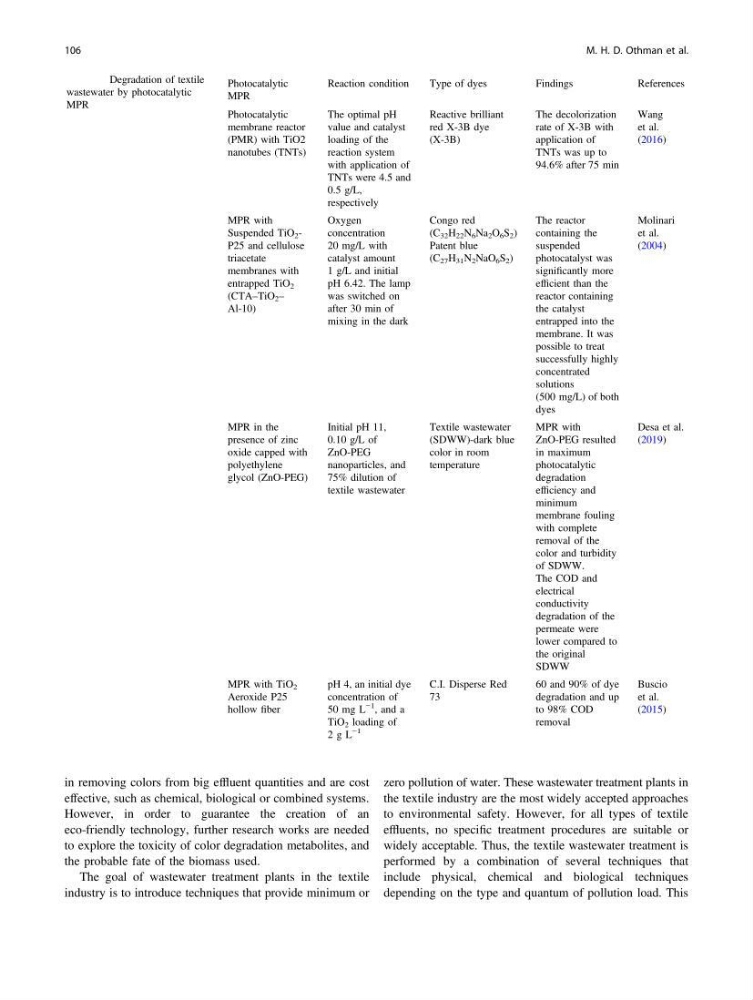
Table 8 Degradation of textile
wastewater by photocatalytic
MPR
Photocatalytic
MPR
Reaction condition
Type of dyes
Findings
References
Photocatalytic
membrane reactor
(PMR) with TiO2
nanotubes (TNTs)
The optimal pH
value and catalyst
loading of the
reaction system
with application of
TNTs were 4.5 and
0.5 g/L,
respectively
Reactive brilliant
red X-3B dye
(X-3B)
The decolorization
rate of X-3B with
application of
TNTs was up to
94.6% after 75 min
Wang
et al.
(2016)
MPR with
Suspended TiO 2 -
P25 and cellulose
triacetate
membranes with
entrapped TiO 2
(CTA–TiO 2 –
Al-10)
Oxygen
concentration
20 mg/L with
catalyst amount
1 g/L and initial
pH 6.42. The lamp
was switched on
after 30 min of
mixing in the dark
Congo red
(C 32 H 22 N 6 Na 2 O 6 S 2 )
Patent blue
(C 27 H 31 N 2 NaO 6 S 2 )
The reactor
containing the
suspended
photocatalyst was
significantly more
efficient than the
reactor containing
the catalyst
entrapped into the
membrane. It was
possible to treat
successfully highly
concentrated
solutions
(500 mg/L) of both
dyes
Molinari
et al.
(2004)
MPR in the
presence of zinc
oxide capped with
polyethylene
glycol (ZnO-PEG)
Initial pH 11,
0.10 g/L of
ZnO-PEG
nanoparticles, and
75% dilution of
textile wastewater
Textile wastewater
(SDWW)-dark blue
color in room
temperature
MPR with
ZnO-PEG resulted
in maximum
photocatalytic
degradation
efficiency and
minimum
membrane fouling
with complete
removal of the
color and turbidity
of SDWW.
The COD and
electrical
conductivity
degradation of the
permeate were
lower compared to
the original
SDWW
Desa et al.
(2019)
MPR with TiO 2
Aeroxide P25
hollow fiber
pH 4, an initial dye
concentration of
50 mg L
−1
, and a
TiO 2 loading of
2 g L
−1
C.I. Disperse Red
73
60 and 90% of dye
degradation and up
to 98% COD
removal
Buscio
et al.
(2015)
106
M. H. D. Othman et al.
effective, such as chemical, biological or combined systems.
However, in order to guarantee the creation of an
eco-friendly technology, further research works are needed
to explore the toxicity of color degradation metabolites, and
the probable fate of the biomass used.
The goal of wastewater treatment plants in the textile
industry is to introduce techniques that provide minimum or
zero pollution of water. These wastewater treatment plants in
the textile industry are the most widely accepted approaches
to environmental safety. However, for all types of textile
effluents, no specific treatment procedures are suitable or
widely acceptable. Thus, the textile wastewater treatment is
performed by a combination of several techniques that
include physical, chemical and biological techniques
depending on the type and quantum of pollution load. This
Table 8 Degradation of textile
wastewater by photocatalytic
MPR
Photocatalytic
MPR
Reaction condition
Type of dyes
Findings
References
Photocatalytic
membrane reactor
(PMR) with TiO2
nanotubes (TNTs)
The optimal pH
value and catalyst
loading of the
reaction system
with application of
TNTs were 4.5 and
0.5 g/L,
respectively
Reactive brilliant
red X-3B dye
(X-3B)
The decolorization
rate of X-3B with
application of
TNTs was up to
94.6% after 75 min
Wang
et al.
(2016)
MPR with
Suspended TiO 2 -
P25 and cellulose
triacetate
membranes with
entrapped TiO 2
(CTA–TiO 2 –
Al-10)
Oxygen
concentration
20 mg/L with
catalyst amount
1 g/L and initial
pH 6.42. The lamp
was switched on
after 30 min of
mixing in the dark
Congo red
(C 32 H 22 N 6 Na 2 O 6 S 2 )
Patent blue
(C 27 H 31 N 2 NaO 6 S 2 )
The reactor
containing the
suspended
photocatalyst was
significantly more
efficient than the
reactor containing
the catalyst
entrapped into the
membrane. It was
possible to treat
successfully highly
concentrated
solutions
(500 mg/L) of both
dyes
Molinari
et al.
(2004)
MPR in the
presence of zinc
oxide capped with
polyethylene
glycol (ZnO-PEG)
Initial pH 11,
0.10 g/L of
ZnO-PEG
nanoparticles, and
75% dilution of
textile wastewater
Textile wastewater
(SDWW)-dark blue
color in room
temperature
MPR with
ZnO-PEG resulted
in maximum
photocatalytic
degradation
efficiency and
minimum
membrane fouling
with complete
removal of the
color and turbidity
of SDWW.
The COD and
electrical
conductivity
degradation of the
permeate were
lower compared to
the original
SDWW
Desa et al.
(2019)
MPR with TiO 2
Aeroxide P25
hollow fiber
pH 4, an initial dye
concentration of
50 mg L
−1
, and a
TiO 2 loading of
2 g L
−1
C.I. Disperse Red
73
60 and 90% of dye
degradation and up
to 98% COD
removal
Buscio
et al.
(2015)
106
M. H. D. Othman et al.