

200 Susanne Bauer
a highly symbolic and significant act that almost immediately followed the
declaration of an independent Republic of Kazakhstan in December 1991.
With independence, USSR institutions were slowly fading from relevance,
sometimes revived, given up, or rebuilt and transformed to fit the new
Republic of Kazakhstan. As Alexei Yurchak noted, “everything was forever,
until it was no more.” 21 Visible and invisible infrastructures, institutions and
everyday routines were disrupted. The administration of the new independent state changed the cityscape by renaming streets and making more space
for Kazakh figures, such as 18th-century Kazakh warrior Kabanbai-batyr
or famous 19th-century poet Abai Kubanbayev (Abai Qunanbaiuly), born
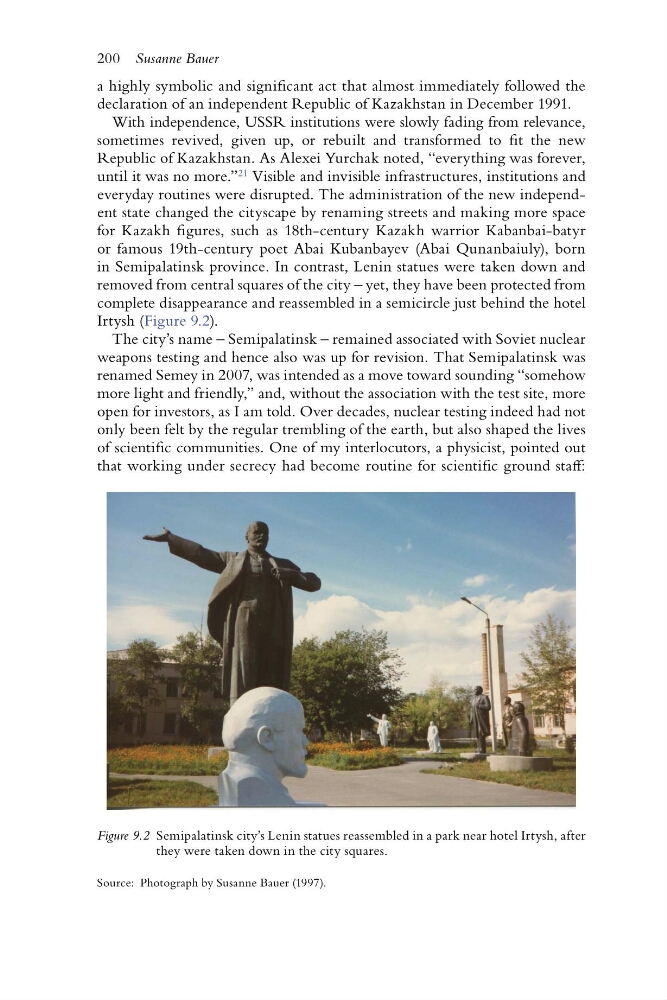
in Semipalatinsk province. In contrast, Lenin statues were taken down and
removed from central squares of the city – yet, they have been protected from
complete disappearance and reassembled in a semicircle just behind the hotel
Irtysh (Figure 9.2).
The city’s name – Semipalatinsk – remained associated with Soviet nuclear
weapons testing and hence also was up for revision. That Semipalatinsk was
renamed Semey in 2007, was intended as a move toward sounding “somehow
more light and friendly,” and, without the association with the test site, more
open for investors, as I am told. Over decades, nuclear testing indeed had not
only been felt by the regular trembling of the earth, but also shaped the lives
of scientific communities. One of my interlocutors, a physicist, pointed out
that working under secrecy had become routine for scientific ground staff:
Figure 9.2 Semipalatinsk city’s Lenin statues reassembled in a park near hotel Irtysh, after
they were taken down in the city squares.
Source: Photograph by Susanne Bauer (1997).
a highly symbolic and significant act that almost immediately followed the
declaration of an independent Republic of Kazakhstan in December 1991.
With independence, USSR institutions were slowly fading from relevance,
sometimes revived, given up, or rebuilt and transformed to fit the new
Republic of Kazakhstan. As Alexei Yurchak noted, “everything was forever,
until it was no more.” 21 Visible and invisible infrastructures, institutions and
everyday routines were disrupted. The administration of the new independent state changed the cityscape by renaming streets and making more space
for Kazakh figures, such as 18th-century Kazakh warrior Kabanbai-batyr
or famous 19th-century poet Abai Kubanbayev (Abai Qunanbaiuly), born
in Semipalatinsk province. In contrast, Lenin statues were taken down and
removed from central squares of the city – yet, they have been protected from
complete disappearance and reassembled in a semicircle just behind the hotel
Irtysh (Figure 9.2).
The city’s name – Semipalatinsk – remained associated with Soviet nuclear
weapons testing and hence also was up for revision. That Semipalatinsk was
renamed Semey in 2007, was intended as a move toward sounding “somehow
more light and friendly,” and, without the association with the test site, more
open for investors, as I am told. Over decades, nuclear testing indeed had not
only been felt by the regular trembling of the earth, but also shaped the lives
of scientific communities. One of my interlocutors, a physicist, pointed out
that working under secrecy had become routine for scientific ground staff:
Figure 9.2 Semipalatinsk city’s Lenin statues reassembled in a park near hotel Irtysh, after
they were taken down in the city squares.
Source: Photograph by Susanne Bauer (1997).