

178 Eva Castringius
destruction of the surroundings, although he had not been officially tasked with
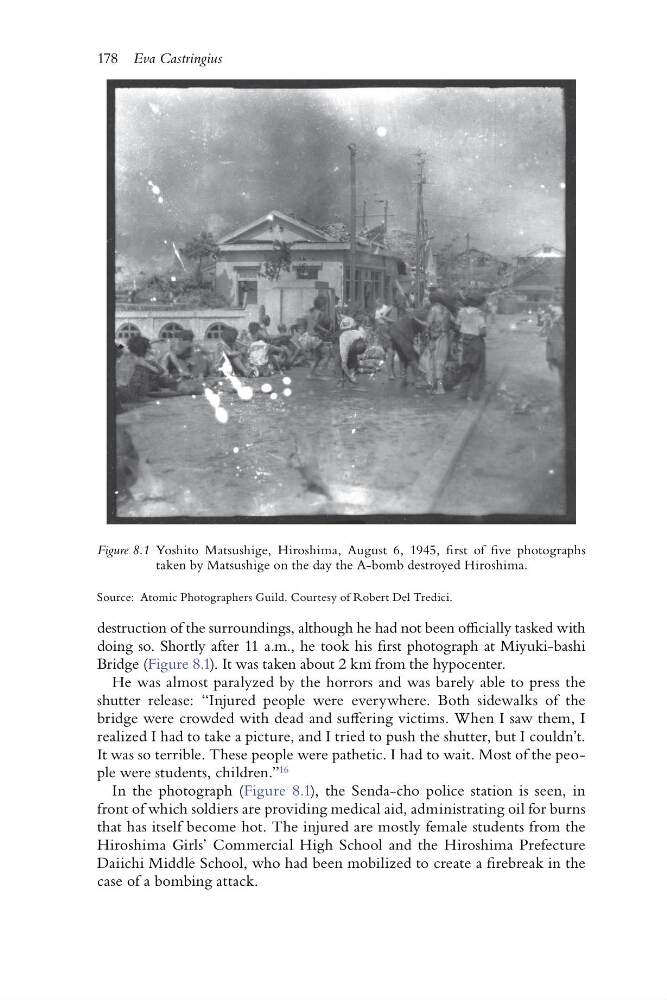
doing so. Shortly after 11 a.m., he took his first photograph at Miyuki-bashi
Bridge (Figure 8.1). It was taken about 2 km from the hypocenter.
He was almost paralyzed by the horrors and was barely able to press the
shutter release: “Injured people were everywhere. Both sidewalks of the
bridge were crowded with dead and suffering victims. When I saw them, I
realized I had to take a picture, and I tried to push the shutter, but I couldn’t.
It was so terrible. These people were pathetic. I had to wait. Most of the people were students, children.” 16
In the photograph (Figure 8.1), the Senda-cho police station is seen, in
front of which soldiers are providing medical aid, administrating oil for burns
that has itself become hot. The injured are mostly female students from the
Hiroshima Girls’ Commercial High School and the Hiroshima Prefecture
Daiichi Middle School, who had been mobilized to create a firebreak in the
case of a bombing attack.
Figure 8.1 Yoshito Matsushige, Hiroshima, August 6, 1945, first of five photographs
taken by Matsushige on the day the A-bomb destroyed Hiroshima.
Source: Atomic Photographers Guild. Courtesy of Robert Del Tredici.
destruction of the surroundings, although he had not been officially tasked with
doing so. Shortly after 11 a.m., he took his first photograph at Miyuki-bashi
Bridge (Figure 8.1). It was taken about 2 km from the hypocenter.
He was almost paralyzed by the horrors and was barely able to press the
shutter release: “Injured people were everywhere. Both sidewalks of the
bridge were crowded with dead and suffering victims. When I saw them, I
realized I had to take a picture, and I tried to push the shutter, but I couldn’t.
It was so terrible. These people were pathetic. I had to wait. Most of the people were students, children.” 16
In the photograph (Figure 8.1), the Senda-cho police station is seen, in
front of which soldiers are providing medical aid, administrating oil for burns
that has itself become hot. The injured are mostly female students from the
Hiroshima Girls’ Commercial High School and the Hiroshima Prefecture
Daiichi Middle School, who had been mobilized to create a firebreak in the
case of a bombing attack.
Figure 8.1 Yoshito Matsushige, Hiroshima, August 6, 1945, first of five photographs
taken by Matsushige on the day the A-bomb destroyed Hiroshima.
Source: Atomic Photographers Guild. Courtesy of Robert Del Tredici.