

fractions [40, 47, 48]. In one early study, it was
observed that mean particle diameter decreases
with increasing speed, and this may be one factor
contributing to the differences in the reported
findings [42].
Airborne brake particles are composed of
metals (iron, copper, lead, etc.), organic material,
and silicon compounds, which are used as binders
in brake pads, but composition varies greatly
[37]. Test track and wind tunnel measurements
have revealed that typically 50% of the brake
wear debris escapes the vehicle and enters the
atmosphere, although the actual proportion
depends on the severity of the braking and the
design of the vehicle [49]. The remaining debris
either falls on the road or is retained on the vehicle.
It appears that most airborne brake wear particles
can be classified as PM10, although a substantial
proportion has a diameter of less than 2.5 mm [49–
52]. The highest proportions of PM 2.5 have been
found under urban driving conditions [52].
Very little information is available on the size
distribution of road surface wear particles. The
data that are available suggest that airborne bitumen particles range in size between 0.35 mm and
2.8 mm [40].
Effect of vehicle type and fuel (all vehicles Euro 3/III)
0
2
4
6
8
10
NOx emission factor (g/km)
Effect of technology (rigid HGV >32 t)
0
2
4
6
8
10
12
14
NOx emission factor (g/km)
Effect of average speed (Euro 4 diesel car)
0.0
0.2
0.4
0.6
0.8
1.0
1.2
Car
Petrol
Car
Diesel
LDV
Petrol
LDV
Diesel
HGV
Diesel
Bus
Diesel
Coach
Diesel
Moped
Petrol
M/C
Petrol
Pre-Euro I
Euro I
Euro II
Euro III
Euro IV
Euro V
Euro VI
0
20
40
60
80
100
120
140
Average speed (km/h)
c
NOx emission factor (g/km)
0.00
0.01
0.02
0.03
0.04
0.05
0.06
HC/PM emission factor
(g/km)
NOx (g/km)
HC (g/km)
PM (g/km)
b
a
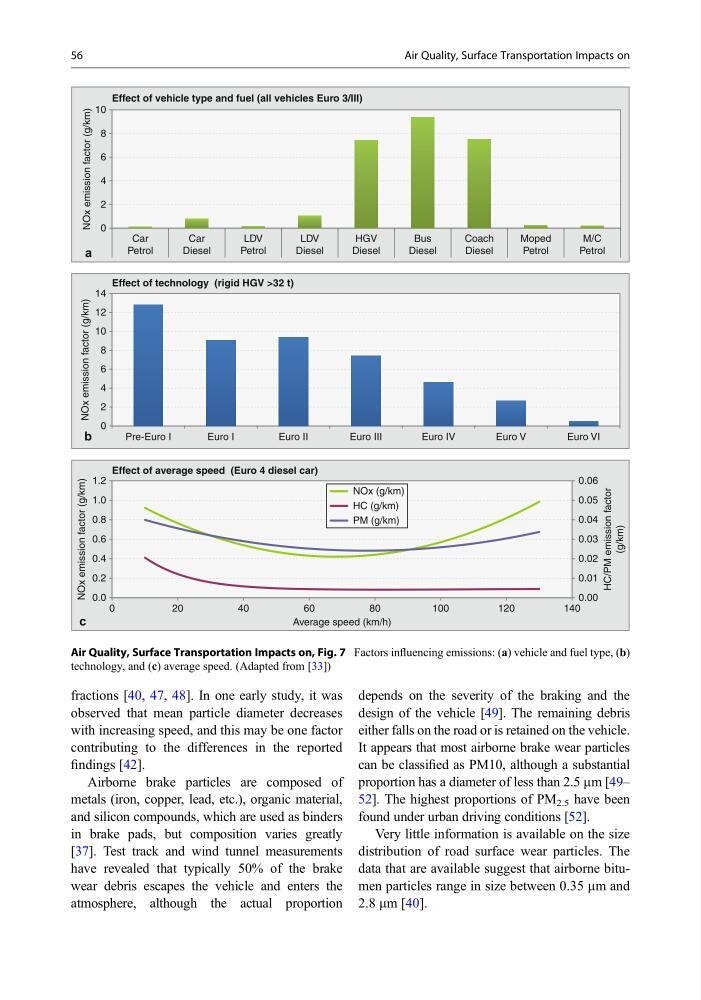
Air Quality, Surface Transportation Impacts on, Fig. 7 Factors influencing emissions: (a) vehicle and fuel type, (b)
technology, and (c) average speed. (Adapted from [33])
56
Air Quality, Surface Transportation Impacts on
observed that mean particle diameter decreases
with increasing speed, and this may be one factor
contributing to the differences in the reported
findings [42].
Airborne brake particles are composed of
metals (iron, copper, lead, etc.), organic material,
and silicon compounds, which are used as binders
in brake pads, but composition varies greatly
[37]. Test track and wind tunnel measurements
have revealed that typically 50% of the brake
wear debris escapes the vehicle and enters the
atmosphere, although the actual proportion
depends on the severity of the braking and the
design of the vehicle [49]. The remaining debris
either falls on the road or is retained on the vehicle.
It appears that most airborne brake wear particles
can be classified as PM10, although a substantial
proportion has a diameter of less than 2.5 mm [49–
52]. The highest proportions of PM 2.5 have been
found under urban driving conditions [52].
Very little information is available on the size
distribution of road surface wear particles. The
data that are available suggest that airborne bitumen particles range in size between 0.35 mm and
2.8 mm [40].
Effect of vehicle type and fuel (all vehicles Euro 3/III)
0
2
4
6
8
10
NOx emission factor (g/km)
Effect of technology (rigid HGV >32 t)
0
2
4
6
8
10
12
14
NOx emission factor (g/km)
Effect of average speed (Euro 4 diesel car)
0.0
0.2
0.4
0.6
0.8
1.0
1.2
Car
Petrol
Car
Diesel
LDV
Petrol
LDV
Diesel
HGV
Diesel
Bus
Diesel
Coach
Diesel
Moped
Petrol
M/C
Petrol
Pre-Euro I
Euro I
Euro II
Euro III
Euro IV
Euro V
Euro VI
0
20
40
60
80
100
120
140
Average speed (km/h)
c
NOx emission factor (g/km)
0.00
0.01
0.02
0.03
0.04
0.05
0.06
HC/PM emission factor
(g/km)
NOx (g/km)
HC (g/km)
PM (g/km)
b
a
Air Quality, Surface Transportation Impacts on, Fig. 7 Factors influencing emissions: (a) vehicle and fuel type, (b)
technology, and (c) average speed. (Adapted from [33])
56
Air Quality, Surface Transportation Impacts on