

for use around the world, have focused on Europe.
For Europe, the WHO Guidelines have provided
valuable input to national and local authorities for
developing legal binding air quality standards.
The Standards developed by European nations
and other nations round the world have not been
reviewed in detail in this entry.
The section on “Air Quality Management
Framework” emphasized that Air Quality Standards and Guidelines were a key element of the
overall scheme; however, the Standards and
Guidelines are just one element of an integrated
air quality management scheme. It is noteworthy
that substantial progress has been made in
improving air quality in the United States and in
western European countries. That progress has no
doubt been facilitated by the Standards and
Guidelines. However, setting up goal posts
(Standards and Guidelines) does not necessarily
mean the goals will be achieved. Specific emission reductions informed by the Standards and
Guidelines are ultimately required to achieve the
goals. In the United States, major regulations have
mandated reductions in emissions of particulate
matter, SO 2 , and NO 2 from stationary sources
such as power plants and from mobile sources
such as passenger cars and on-road trucks and,
more recently, from off-road equipment, rail locomotives, and ships. These regulations have
resulted in substantial reductions in the emissions
of the criteria pollutants or their precursors while
the economy also grew until recently. A stagnant
economy in 2011 is raising questions as to the
wisdom of further reductions in NAAQS and
aggressive regulatory actions to further reduce
emissions.
Since the Clean Air Act Amendments of 1970
were passed in the United States there has been a
steady increase in research on the health effects of
air pollutants. The increase in research has been
most notable since the mid-1990s when major
controversies arose over the health effects of
PM 2.5 . Indeed, what has developed might be characterized as a “clean air enterprise” involving air
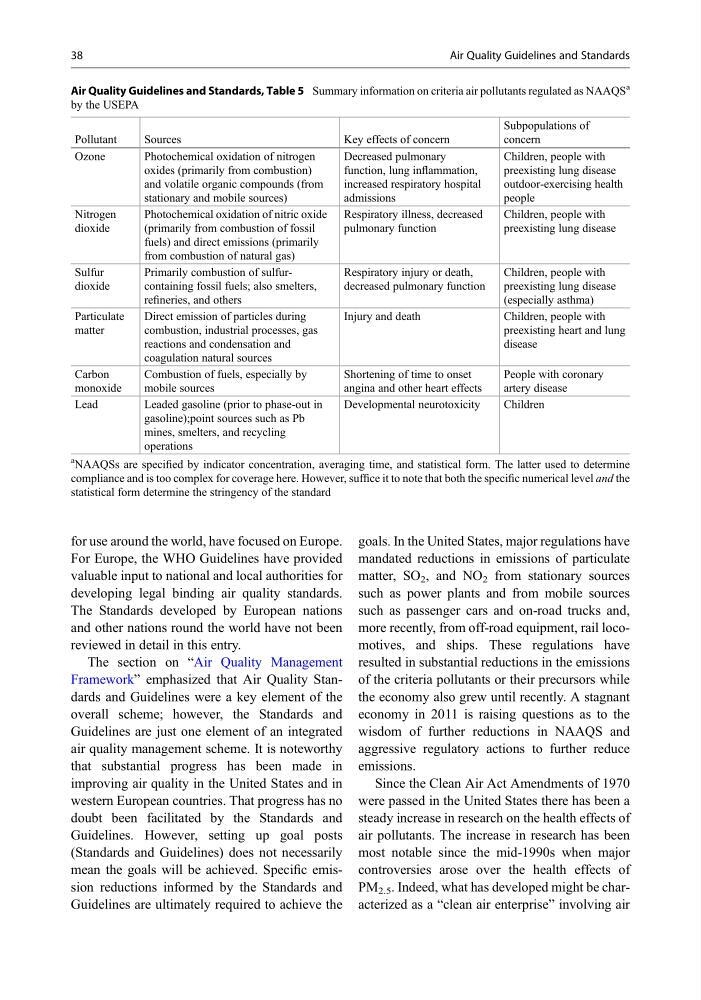
Air Quality Guidelines and Standards, Table 5 Summary information on criteria air pollutants regulated as NAAQS
a
by the USEPA
Pollutant
Sources
Key effects of concern
Subpopulations of
concern
Ozone
Photochemical oxidation of nitrogen
oxides (primarily from combustion)
and volatile organic compounds (from
stationary and mobile sources)
Decreased pulmonary
function, lung inflammation,
increased respiratory hospital
admissions
Children, people with
preexisting lung disease
outdoor-exercising health
people
Nitrogen
dioxide
Photochemical oxidation of nitric oxide
(primarily from combustion of fossil
fuels) and direct emissions (primarily
from combustion of natural gas)
Respiratory illness, decreased
pulmonary function
Children, people with
preexisting lung disease
Sulfur
dioxide
Primarily combustion of sulfurcontaining fossil fuels; also smelters,
refineries, and others
Respiratory injury or death,
decreased pulmonary function
Children, people with
preexisting lung disease
(especially asthma)
Particulate
matter
Direct emission of particles during
combustion, industrial processes, gas
reactions and condensation and
coagulation natural sources
Injury and death
Children, people with
preexisting heart and lung
disease
Carbon
monoxide
Combustion of fuels, especially by
mobile sources
Shortening of time to onset
angina and other heart effects
People with coronary
artery disease
Lead
Leaded gasoline (prior to phase-out in
gasoline);point sources such as Pb
mines, smelters, and recycling
operations
Developmental neurotoxicity
Children
a NAAQSs are specified by indicator concentration, averaging time, and statistical form. The latter used to determine
compliance and is too complex for coverage here. However, suffice it to note that both the specific numerical level and the
statistical form determine the stringency of the standard
38
Air Quality Guidelines and Standards
For Europe, the WHO Guidelines have provided
valuable input to national and local authorities for
developing legal binding air quality standards.
The Standards developed by European nations
and other nations round the world have not been
reviewed in detail in this entry.
The section on “Air Quality Management
Framework” emphasized that Air Quality Standards and Guidelines were a key element of the
overall scheme; however, the Standards and
Guidelines are just one element of an integrated
air quality management scheme. It is noteworthy
that substantial progress has been made in
improving air quality in the United States and in
western European countries. That progress has no
doubt been facilitated by the Standards and
Guidelines. However, setting up goal posts
(Standards and Guidelines) does not necessarily
mean the goals will be achieved. Specific emission reductions informed by the Standards and
Guidelines are ultimately required to achieve the
goals. In the United States, major regulations have
mandated reductions in emissions of particulate
matter, SO 2 , and NO 2 from stationary sources
such as power plants and from mobile sources
such as passenger cars and on-road trucks and,
more recently, from off-road equipment, rail locomotives, and ships. These regulations have
resulted in substantial reductions in the emissions
of the criteria pollutants or their precursors while
the economy also grew until recently. A stagnant
economy in 2011 is raising questions as to the
wisdom of further reductions in NAAQS and
aggressive regulatory actions to further reduce
emissions.
Since the Clean Air Act Amendments of 1970
were passed in the United States there has been a
steady increase in research on the health effects of
air pollutants. The increase in research has been
most notable since the mid-1990s when major
controversies arose over the health effects of
PM 2.5 . Indeed, what has developed might be characterized as a “clean air enterprise” involving air
Air Quality Guidelines and Standards, Table 5 Summary information on criteria air pollutants regulated as NAAQS
a
by the USEPA
Pollutant
Sources
Key effects of concern
Subpopulations of
concern
Ozone
Photochemical oxidation of nitrogen
oxides (primarily from combustion)
and volatile organic compounds (from
stationary and mobile sources)
Decreased pulmonary
function, lung inflammation,
increased respiratory hospital
admissions
Children, people with
preexisting lung disease
outdoor-exercising health
people
Nitrogen
dioxide
Photochemical oxidation of nitric oxide
(primarily from combustion of fossil
fuels) and direct emissions (primarily
from combustion of natural gas)
Respiratory illness, decreased
pulmonary function
Children, people with
preexisting lung disease
Sulfur
dioxide
Primarily combustion of sulfurcontaining fossil fuels; also smelters,
refineries, and others
Respiratory injury or death,
decreased pulmonary function
Children, people with
preexisting lung disease
(especially asthma)
Particulate
matter
Direct emission of particles during
combustion, industrial processes, gas
reactions and condensation and
coagulation natural sources
Injury and death
Children, people with
preexisting heart and lung
disease
Carbon
monoxide
Combustion of fuels, especially by
mobile sources
Shortening of time to onset
angina and other heart effects
People with coronary
artery disease
Lead
Leaded gasoline (prior to phase-out in
gasoline);point sources such as Pb
mines, smelters, and recycling
operations
Developmental neurotoxicity
Children
a NAAQSs are specified by indicator concentration, averaging time, and statistical form. The latter used to determine
compliance and is too complex for coverage here. However, suffice it to note that both the specific numerical level and the
statistical form determine the stringency of the standard
38
Air Quality Guidelines and Standards