

manganese, nickel, and cobalt or acidic oxides
like zeolites or TiO 2 have been also extensively
studied with mixed results [94]. The activity of a
catalyst is highly dependent on the number of
active sites available for the catalytic reaction to
occur. Therefore, materials with high porosity and
extensive surface area, like titania and g-alumina,
are especially interesting as a support material for
catalysts. This approach has also an economic
motivation. Since the reaction takes place on the
surface, a thin layer of finely dispersed expensive
material (catalyst) is a very cost-effective idea. In
some cases catalysts serve as their own support,
mostly in the shape of spherical pellets. Alternatively, the catalyst can be mounted on the
honeycomb-like monolith block. This will result
in a high specific area and provide increased catalytic activity [94].
Scrubbers
General Description of Scrubbers
Industrial processes produce exhaust gas
containing various harmful gases such as SO 2
and CO 2 . The most effective way of reducing air
pollution is to capture these pollutants at the
source. Post-combustion pollution removal
methods such as scrubbers are one way to do
it. Scrubber technologies can be divided into wet
scrubbers and dry scrubbers [95]. One of the first
known scrubbers was used in submarines to
remove carbon dioxide. Nowadays however they
are now widely used in all kinds of industries
[96]. The shipping industry depends on highsulfur fuel for ships, which during combustion
release SO x and PM into the air. Scrubbers can
remove up to 99% of SO x and 98% of PM and are
an important prospective technology for green
shipping [97]. Furthermore the rendering industry
produces large amounts of VOC, and wet scrubbers are used to remove these harmful gases
[98]. Scrubber technology can be used in collaboration with other filtration methods to increase
removal efficiency [99]. A hybrid process of wet
scrubbers and biofilters will increase the removal
of VOCs from, e.g., poultry-rendering
industries [99].
Wet Scrubbers
Wet scrubbers involve scrubbing pollutant gasses
with a scrubbing liquid. The technology is primarily used for water-soluble toxic gases (e.g., HCl
and NH 3 [95, 100]). Different types of wet scrubbers are available. The most common are venturi
scrubbers, spray towers, cyclonic scrubbers, and
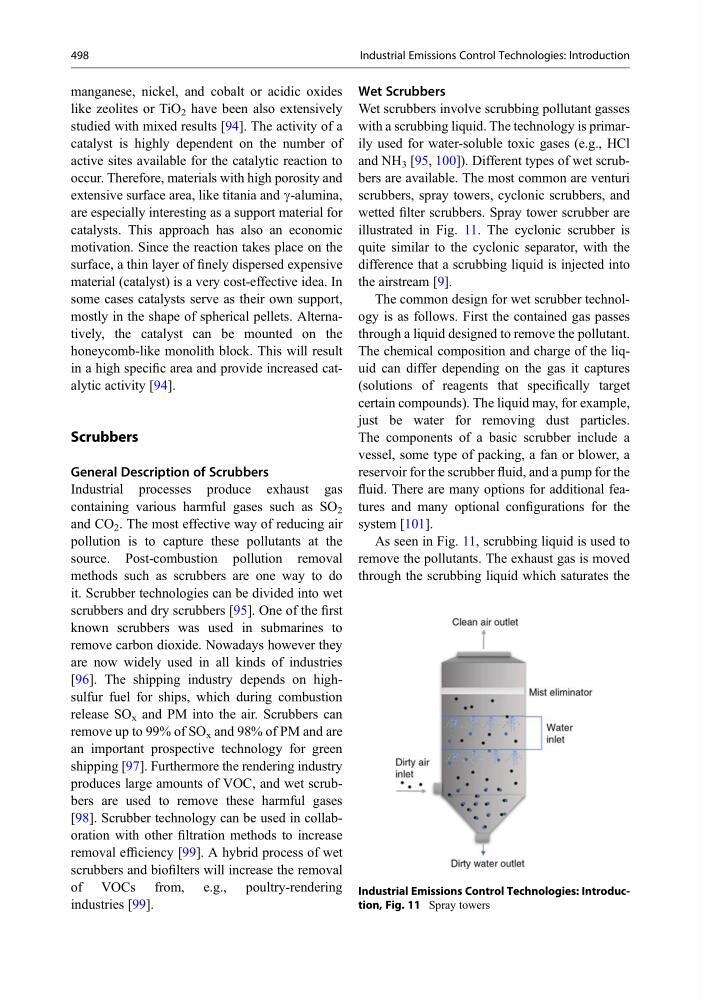
wetted filter scrubbers. Spray tower scrubber are
illustrated in Fig. 11. The cyclonic scrubber is
quite similar to the cyclonic separator, with the
difference that a scrubbing liquid is injected into
the airstream [9].
The common design for wet scrubber technology is as follows. First the contained gas passes
through a liquid designed to remove the pollutant.
The chemical composition and charge of the liquid can differ depending on the gas it captures
(solutions of reagents that specifically target
certain compounds). The liquid may, for example,
just be water for removing dust particles.
The components of a basic scrubber include a
vessel, some type of packing, a fan or blower, a
reservoir for the scrubber fluid, and a pump for the
fluid. There are many options for additional features and many optional configurations for the
system [101].
As seen in Fig. 11, scrubbing liquid is used to
remove the pollutants. The exhaust gas is moved
through the scrubbing liquid which saturates the
Industrial Emissions Control Technologies: Introduction, Fig. 11 Spray towers
498
Industrial Emissions Control Technologies: Introduction
like zeolites or TiO 2 have been also extensively
studied with mixed results [94]. The activity of a
catalyst is highly dependent on the number of
active sites available for the catalytic reaction to
occur. Therefore, materials with high porosity and
extensive surface area, like titania and g-alumina,
are especially interesting as a support material for
catalysts. This approach has also an economic
motivation. Since the reaction takes place on the
surface, a thin layer of finely dispersed expensive
material (catalyst) is a very cost-effective idea. In
some cases catalysts serve as their own support,
mostly in the shape of spherical pellets. Alternatively, the catalyst can be mounted on the
honeycomb-like monolith block. This will result
in a high specific area and provide increased catalytic activity [94].
Scrubbers
General Description of Scrubbers
Industrial processes produce exhaust gas
containing various harmful gases such as SO 2
and CO 2 . The most effective way of reducing air
pollution is to capture these pollutants at the
source. Post-combustion pollution removal
methods such as scrubbers are one way to do
it. Scrubber technologies can be divided into wet
scrubbers and dry scrubbers [95]. One of the first
known scrubbers was used in submarines to
remove carbon dioxide. Nowadays however they
are now widely used in all kinds of industries
[96]. The shipping industry depends on highsulfur fuel for ships, which during combustion
release SO x and PM into the air. Scrubbers can
remove up to 99% of SO x and 98% of PM and are
an important prospective technology for green
shipping [97]. Furthermore the rendering industry
produces large amounts of VOC, and wet scrubbers are used to remove these harmful gases
[98]. Scrubber technology can be used in collaboration with other filtration methods to increase
removal efficiency [99]. A hybrid process of wet
scrubbers and biofilters will increase the removal
of VOCs from, e.g., poultry-rendering
industries [99].
Wet Scrubbers
Wet scrubbers involve scrubbing pollutant gasses
with a scrubbing liquid. The technology is primarily used for water-soluble toxic gases (e.g., HCl
and NH 3 [95, 100]). Different types of wet scrubbers are available. The most common are venturi
scrubbers, spray towers, cyclonic scrubbers, and
wetted filter scrubbers. Spray tower scrubber are
illustrated in Fig. 11. The cyclonic scrubber is
quite similar to the cyclonic separator, with the
difference that a scrubbing liquid is injected into
the airstream [9].
The common design for wet scrubber technology is as follows. First the contained gas passes
through a liquid designed to remove the pollutant.
The chemical composition and charge of the liquid can differ depending on the gas it captures
(solutions of reagents that specifically target
certain compounds). The liquid may, for example,
just be water for removing dust particles.
The components of a basic scrubber include a
vessel, some type of packing, a fan or blower, a
reservoir for the scrubber fluid, and a pump for the
fluid. There are many options for additional features and many optional configurations for the
system [101].
As seen in Fig. 11, scrubbing liquid is used to
remove the pollutants. The exhaust gas is moved
through the scrubbing liquid which saturates the
Industrial Emissions Control Technologies: Introduction, Fig. 11 Spray towers
498
Industrial Emissions Control Technologies: Introduction