

Assessing Hazards and Risks
The risk approach used around the world today
(Fig. 2) developed within the USEPA in parallel
with the process for setting NAAQS [35, 36, 38,
39]. The setting of air quality standards and guidelines may be viewed as a specialized use of the risk
characterization paradigm illustrated in Fig. 2
[35]. In particular, the establishment of air quality
standards and guidelines draws on the schematic
rendering in the box labeled “risk assessment.” An
initial step in that process is to determine the hazard
potential of the agent, in short, to determinewhether
the specific agent has the potential for causing
adverse health effects in humans. In the case of the
criteria or common air pollutants discussed in this
entry, there is sufficient evidence to establish that
with exposure of sufficient duration and concentration the agent is capable of causing disease in people, based on epidemiological evidence. The key
issue then becomes the nature of the relationship
between ambient concentrations and duration of
exposure and increased disease. The specific characteristics of that complex relationship are crucial to
determining for a particular ambient concentration
the estimated health impacts including the ambient
concentration level. Moreover, the same information is required if one is to estimate the health
benefits associated with a postulated improvement
in air quality, that is, reductions in ambient
concentrations.
Sources of Information for Setting
Standards and Guidelines
The multiple sources of information for evaluating the potential health effects of any air pollutant
are illustrated in Fig. 6 [35–39, 41]. In the case of
all the criteria air pollutants, the dominant sources
of information are those based on the study of
humans, the left side arm of the figure. However,
all of the common air pollutants have been viewed
as being sufficiently innocuous, and with effects
that are readily reversible when exposures are
discontinued, that controlled human exposure
studies can be conducted with the pollutant.
Such studies have provided very useful information on short-term exposures, typically a few
hours in duration as will be discussed later for
ozone. A limitation of such studies is the appropriate requirement for the conduct of such studies
only in healthy adults or individuals with modest
preexisting disease. Controlled exposure studies
in individuals with serious preexisting disease
would not be ethical. The paramount advantage
of controlled human exposure studies is that the
exposures can be well characterized unlike the
situation for field studies or epidemiological
studies.
For some of the common air pollutants, valuable data on shorter-term exposures have been
acquired from field studies of individuals exposed
to ambient concentrations of pollutants. In these
Characterization of Hazard and Estimation
of Potency
Clinical Case
Observations in
Species of Interest
Studies in Laboratory Animals
Studies with Cells and Tissues From
Species of Interest and Other Species
Structure-Activity Analyses
Controlled Exposure
Studies in Species
of Interest
Epidemiological of
Epizootological Studies
in Species of Interest
Extrapolation Across
Species Not Required
Extrapolation Required Across
Species
Extrapolation to Intact Organism,
May Require Cross Species Extrapolation
Multiple Extrapolations
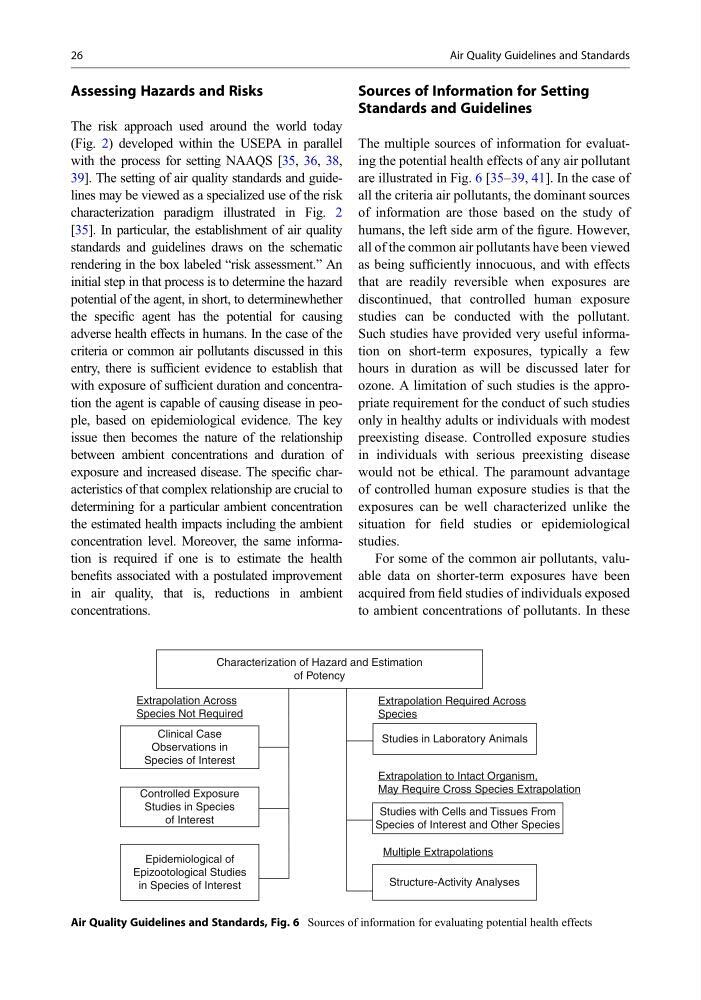
Air Quality Guidelines and Standards, Fig. 6 Sources of information for evaluating potential health effects
26
Air Quality Guidelines and Standards
The risk approach used around the world today
(Fig. 2) developed within the USEPA in parallel
with the process for setting NAAQS [35, 36, 38,
39]. The setting of air quality standards and guidelines may be viewed as a specialized use of the risk
characterization paradigm illustrated in Fig. 2
[35]. In particular, the establishment of air quality
standards and guidelines draws on the schematic
rendering in the box labeled “risk assessment.” An
initial step in that process is to determine the hazard
potential of the agent, in short, to determinewhether
the specific agent has the potential for causing
adverse health effects in humans. In the case of the
criteria or common air pollutants discussed in this
entry, there is sufficient evidence to establish that
with exposure of sufficient duration and concentration the agent is capable of causing disease in people, based on epidemiological evidence. The key
issue then becomes the nature of the relationship
between ambient concentrations and duration of
exposure and increased disease. The specific characteristics of that complex relationship are crucial to
determining for a particular ambient concentration
the estimated health impacts including the ambient
concentration level. Moreover, the same information is required if one is to estimate the health
benefits associated with a postulated improvement
in air quality, that is, reductions in ambient
concentrations.
Sources of Information for Setting
Standards and Guidelines
The multiple sources of information for evaluating the potential health effects of any air pollutant
are illustrated in Fig. 6 [35–39, 41]. In the case of
all the criteria air pollutants, the dominant sources
of information are those based on the study of
humans, the left side arm of the figure. However,
all of the common air pollutants have been viewed
as being sufficiently innocuous, and with effects
that are readily reversible when exposures are
discontinued, that controlled human exposure
studies can be conducted with the pollutant.
Such studies have provided very useful information on short-term exposures, typically a few
hours in duration as will be discussed later for
ozone. A limitation of such studies is the appropriate requirement for the conduct of such studies
only in healthy adults or individuals with modest
preexisting disease. Controlled exposure studies
in individuals with serious preexisting disease
would not be ethical. The paramount advantage
of controlled human exposure studies is that the
exposures can be well characterized unlike the
situation for field studies or epidemiological
studies.
For some of the common air pollutants, valuable data on shorter-term exposures have been
acquired from field studies of individuals exposed
to ambient concentrations of pollutants. In these
Characterization of Hazard and Estimation
of Potency
Clinical Case
Observations in
Species of Interest
Studies in Laboratory Animals
Studies with Cells and Tissues From
Species of Interest and Other Species
Structure-Activity Analyses
Controlled Exposure
Studies in Species
of Interest
Epidemiological of
Epizootological Studies
in Species of Interest
Extrapolation Across
Species Not Required
Extrapolation Required Across
Species
Extrapolation to Intact Organism,
May Require Cross Species Extrapolation
Multiple Extrapolations
Air Quality Guidelines and Standards, Fig. 6 Sources of information for evaluating potential health effects
26
Air Quality Guidelines and Standards