

improvements in emissions abatement and shows
where the need is greatest. It also demonstrates that
standards and monitoring alone cannot lead to
sustainability. Strong enforcement of standards
must make air pollution a consideration in the
development and uptake of technologies.
The Effects of Air Pollution Science on
Policy Air pollution policy, like all environmental
policy, is dependent on research and the state of
science. If science has not developed the discourse
to describe an air pollution issue, there are no
grounds or even terms to support policy-based mitigation. For example, it is believed that different
species of air pollutants may act together to produce
more severe health impacts than either species
would produce if acting alone, but the current understanding of synergistic interactions is inadequate to
support this level of policy development [100].
Air pollution science is also critical in identifying the most significant contributors to pollution
[100] and can use this and other information to
recommend optimally cost-effective solutions to
air pollution problems [101]. The concept of critical load is an example of a scientific tool that aids
air pollution problem solving [101]. It is also an
example, as discussed above, of scientific knowledge being used as a framework but not being
fully respected by the political process. While
science is the basis of policy’s discourse, as well
as the basis for policy evolution, there is room for
improvement in how science and policy cooperate
in achieving sustainability.
Policy and Air Pollution Standards:
Conclusion Policy sets standards by which the
results of air pollution monitoring are judged.
Concentration standards indicate accepted levels
of air pollution in ambient air, and emissions
standards are measures of how much any source
can contribute to air pollution. Political, social,
and economic considerations often influence standards and result in more lax standards than science
or sustainability would recommend. Even in these
cases of standards not consistent with sustainability, standards are often exceeded. Much of air
Current ambient air
quality
Scientific evidence of
health effects
Track and evaluate
progress
Implement programmes
Develop emissions
reductions programmes
Government commitment
Economic impacts
Cultural/social conditions
Stakeholder participation
Policy environment
Establish air quality goals
Determine emissions
reduction
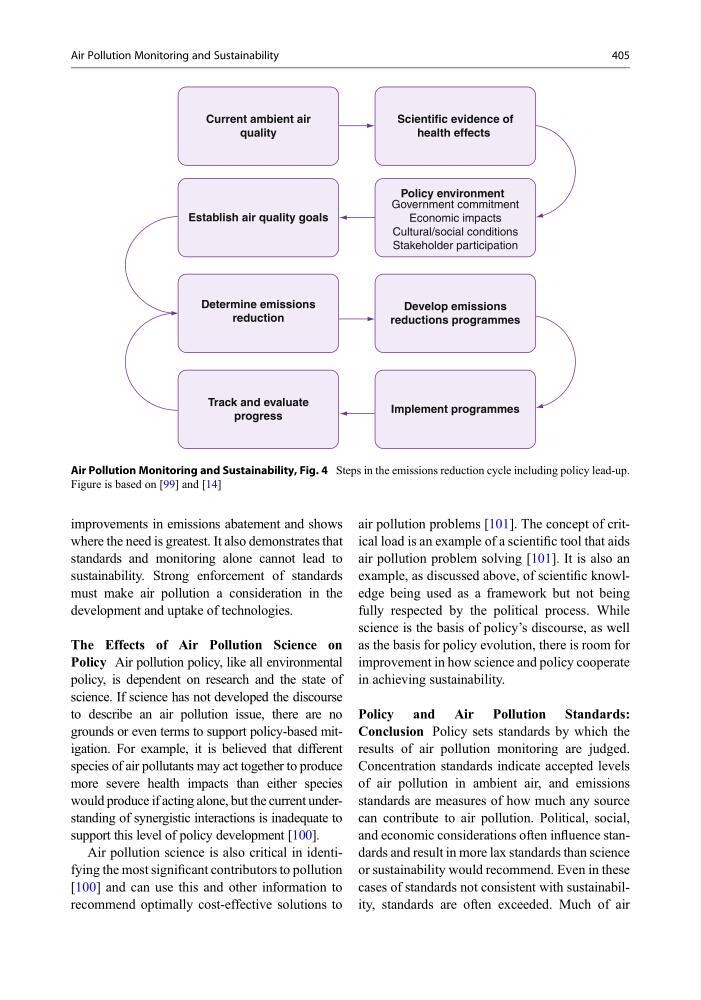
Air Pollution Monitoring and Sustainability, Fig. 4 Steps in the emissions reduction cycle including policy lead-up.
Figure is based on [99] and [14]
Air Pollution Monitoring and Sustainability
405
where the need is greatest. It also demonstrates that
standards and monitoring alone cannot lead to
sustainability. Strong enforcement of standards
must make air pollution a consideration in the
development and uptake of technologies.
The Effects of Air Pollution Science on
Policy Air pollution policy, like all environmental
policy, is dependent on research and the state of
science. If science has not developed the discourse
to describe an air pollution issue, there are no
grounds or even terms to support policy-based mitigation. For example, it is believed that different
species of air pollutants may act together to produce
more severe health impacts than either species
would produce if acting alone, but the current understanding of synergistic interactions is inadequate to
support this level of policy development [100].
Air pollution science is also critical in identifying the most significant contributors to pollution
[100] and can use this and other information to
recommend optimally cost-effective solutions to
air pollution problems [101]. The concept of critical load is an example of a scientific tool that aids
air pollution problem solving [101]. It is also an
example, as discussed above, of scientific knowledge being used as a framework but not being
fully respected by the political process. While
science is the basis of policy’s discourse, as well
as the basis for policy evolution, there is room for
improvement in how science and policy cooperate
in achieving sustainability.
Policy and Air Pollution Standards:
Conclusion Policy sets standards by which the
results of air pollution monitoring are judged.
Concentration standards indicate accepted levels
of air pollution in ambient air, and emissions
standards are measures of how much any source
can contribute to air pollution. Political, social,
and economic considerations often influence standards and result in more lax standards than science
or sustainability would recommend. Even in these
cases of standards not consistent with sustainability, standards are often exceeded. Much of air
Current ambient air
quality
Scientific evidence of
health effects
Track and evaluate
progress
Implement programmes
Develop emissions
reductions programmes
Government commitment
Economic impacts
Cultural/social conditions
Stakeholder participation
Policy environment
Establish air quality goals
Determine emissions
reduction
Air Pollution Monitoring and Sustainability, Fig. 4 Steps in the emissions reduction cycle including policy lead-up.
Figure is based on [99] and [14]
Air Pollution Monitoring and Sustainability
405