

processes, input data (e.g., emissions), and numerical methods [78]. When supported by detailed
measurements, evaluation exercises also identify
specific weaknesses in models and possible ways
to improve future versions.
Policy and Air Pollution Standards
Air pollution policy is a major influence on monitoring and monitoring is a major influence on
policy. Policies determine legally acceptable concentrations of air pollutants. Monitoring shows
which pollutants must be subject to improved
standards and which areas require the most
pollution-abatement planning.
Policies on air pollution centre on concentration standards and emission standards. Standards
are often set based on concentrations deemed
achievable using the Best Available Technology
(BAT) for emissions reduction (an example of a
“command and control” strategy), the effects of
air pollution deemed acceptable (an example of
“risk-based” strategy), or a hybrid of the two
strategies [91].
While monitoring and the related science is
one influence on policy and standards, it is not
NPRI INDUSTRIAL SECTORS
ALUMINUM
CEMENT, LIME AND OTHER NON-METALLIC MINERALS
CHEMICALS
ELECTRICITY
IRON AND STEEL
MANUFACTURING, OTHER
METALS (EXCEPT ALUMINUM AND IRON AND STEEL)
MINING AND QUARRYING
OIL AND GAS PIPELINES AND STORAGE
OILSANDS AND HEAVY OIL
PETROLEUM AND COAL PRODUCTS REFINING AND MFG.
PLASTICS AND RUBBER
PULP AND PAPER
TRANSPORTATION EQUIPMENT MFG.
UPSTREAM OIL AND GAS
WASTE TREATMENT AND DISPOSAL
WATER AND WASTEWATER SYSTEMS
WOOD PRODUCTS
OTHER (EXCEPT MANUFACTURING)
Environment
Canada
Environnement
Canada
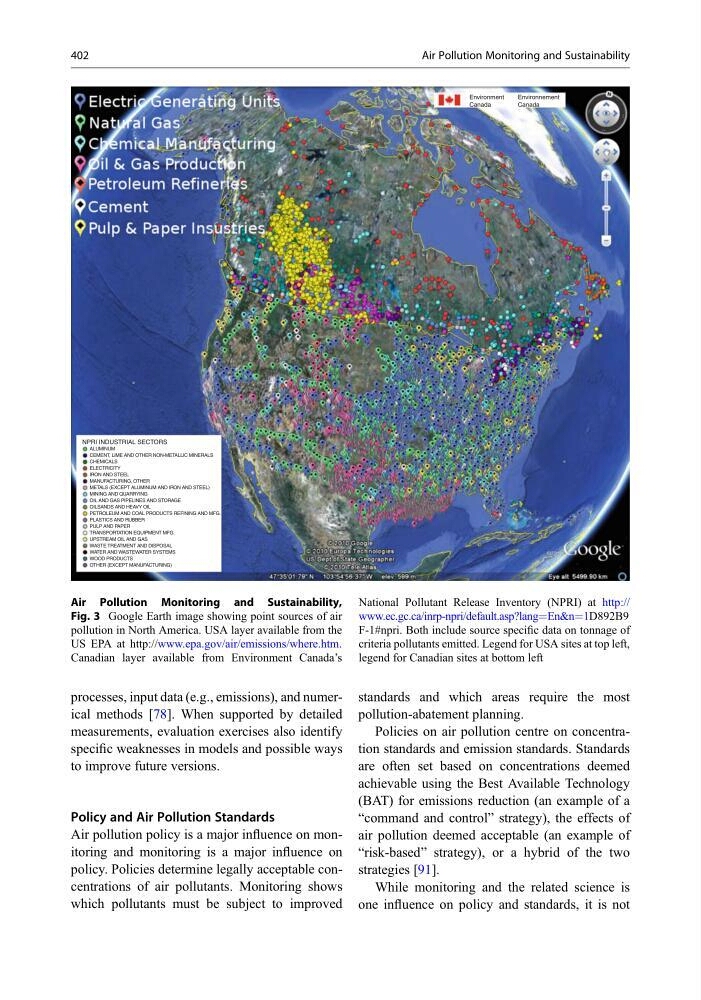
Air Pollution Monitoring and Sustainability,
Fig. 3 Google Earth image showing point sources of air
pollution in North America. USA layer available from the
US EPA at http://www.epa.gov/air/emissions/where.htm.
Canadian layer available from Environment Canada’s
National Pollutant Release Inventory (NPRI) at http://
www.ec.gc.ca/inrp-npri/default.asp?lang¼En&n¼1D892B9
F-1#npri. Both include source specific data on tonnage of
criteria pollutants emitted. Legend for USA sites at top left,
legend for Canadian sites at bottom left
402
Air Pollution Monitoring and Sustainability
measurements, evaluation exercises also identify
specific weaknesses in models and possible ways
to improve future versions.
Policy and Air Pollution Standards
Air pollution policy is a major influence on monitoring and monitoring is a major influence on
policy. Policies determine legally acceptable concentrations of air pollutants. Monitoring shows
which pollutants must be subject to improved
standards and which areas require the most
pollution-abatement planning.
Policies on air pollution centre on concentration standards and emission standards. Standards
are often set based on concentrations deemed
achievable using the Best Available Technology
(BAT) for emissions reduction (an example of a
“command and control” strategy), the effects of
air pollution deemed acceptable (an example of
“risk-based” strategy), or a hybrid of the two
strategies [91].
While monitoring and the related science is
one influence on policy and standards, it is not
NPRI INDUSTRIAL SECTORS
ALUMINUM
CEMENT, LIME AND OTHER NON-METALLIC MINERALS
CHEMICALS
ELECTRICITY
IRON AND STEEL
MANUFACTURING, OTHER
METALS (EXCEPT ALUMINUM AND IRON AND STEEL)
MINING AND QUARRYING
OIL AND GAS PIPELINES AND STORAGE
OILSANDS AND HEAVY OIL
PETROLEUM AND COAL PRODUCTS REFINING AND MFG.
PLASTICS AND RUBBER
PULP AND PAPER
TRANSPORTATION EQUIPMENT MFG.
UPSTREAM OIL AND GAS
WASTE TREATMENT AND DISPOSAL
WATER AND WASTEWATER SYSTEMS
WOOD PRODUCTS
OTHER (EXCEPT MANUFACTURING)
Environment
Canada
Environnement
Canada
Air Pollution Monitoring and Sustainability,
Fig. 3 Google Earth image showing point sources of air
pollution in North America. USA layer available from the
US EPA at http://www.epa.gov/air/emissions/where.htm.
Canadian layer available from Environment Canada’s
National Pollutant Release Inventory (NPRI) at http://
www.ec.gc.ca/inrp-npri/default.asp?lang¼En&n¼1D892B9
F-1#npri. Both include source specific data on tonnage of
criteria pollutants emitted. Legend for USA sites at top left,
legend for Canadian sites at bottom left
402
Air Pollution Monitoring and Sustainability