

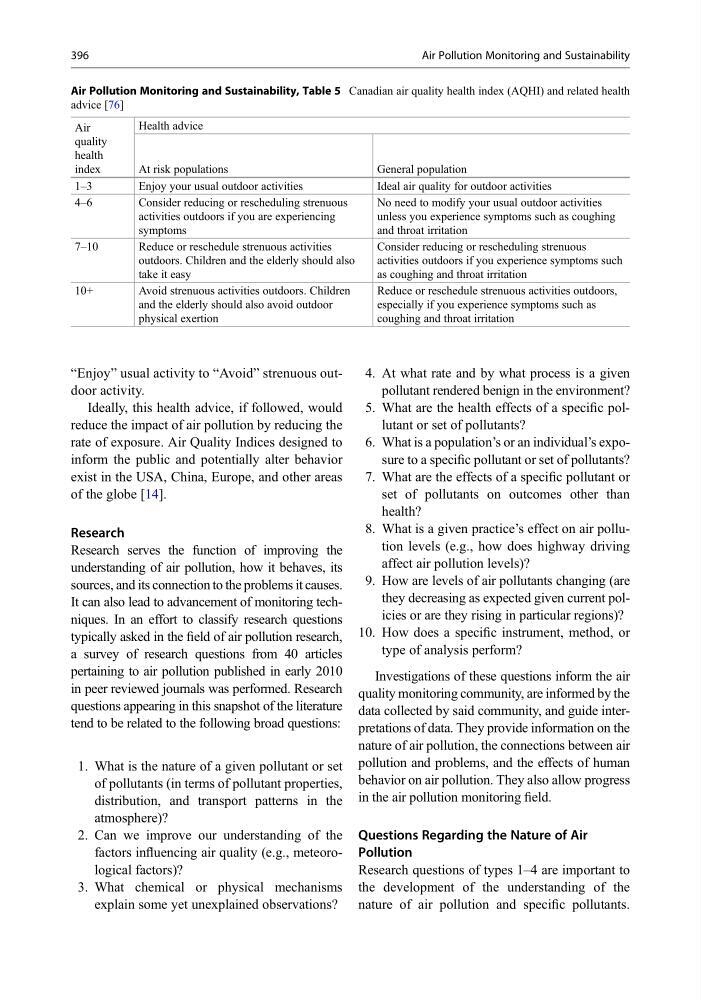
“Enjoy” usual activity to “Avoid” strenuous outdoor activity.
Ideally, this health advice, if followed, would
reduce the impact of air pollution by reducing the
rate of exposure. Air Quality Indices designed to
inform the public and potentially alter behavior
exist in the USA, China, Europe, and other areas
of the globe [14].
Research
Research serves the function of improving the
understanding of air pollution, how it behaves, its
sources, and its connection to the problems it causes.
It can also lead to advancement of monitoring techniques. In an effort to classify research questions
typically asked in the field of air pollution research,
a survey of research questions from 40 articles
pertaining to air pollution published in early 2010
in peer reviewed journals was performed. Research
questions appearing in this snapshot of the literature
tend to be related to the following broad questions:
1. What is the nature of a given pollutant or set
of pollutants (in terms of pollutant properties,
distribution, and transport patterns in the
atmosphere)?
2. Can we improve our understanding of the
factors influencing air quality (e.g., meteorological factors)?
3. What chemical or physical mechanisms
explain some yet unexplained observations?
4. At what rate and by what process is a given
pollutant rendered benign in the environment?
5. What are the health effects of a specific pollutant or set of pollutants?
6. What is a population’s or an individual’s exposure to a specific pollutant or set of pollutants?
7. What are the effects of a specific pollutant or
set of pollutants on outcomes other than
health?
8. What is a given practice’s effect on air pollution levels (e.g., how does highway driving
affect air pollution levels)?
9. How are levels of air pollutants changing (are
they decreasing as expected given current policies or are they rising in particular regions)?
10. How does a specific instrument, method, or
type of analysis perform?
Investigations of these questions inform the air
quality monitoring community, are informed by the
data collected by said community, and guide interpretations of data. They provide information on the
nature of air pollution, the connections between air
pollution and problems, and the effects of human
behavior on air pollution. They also allow progress
in the air pollution monitoring field.
Questions Regarding the Nature of Air
Pollution
Research questions of types 1–4 are important to
the development of the understanding of the
nature of air pollution and specific pollutants.
Air Pollution Monitoring and Sustainability, Table 5 Canadian air quality health index (AQHI) and related health
advice [76]
Air
quality
health
index
Health advice
At risk populations
General population
1–3
Enjoy your usual outdoor activities
Ideal air quality for outdoor activities
4–6
Consider reducing or rescheduling strenuous
activities outdoors if you are experiencing
symptoms
No need to modify your usual outdoor activities
unless you experience symptoms such as coughing
and throat irritation
7–10
Reduce or reschedule strenuous activities
outdoors. Children and the elderly should also
take it easy
Consider reducing or rescheduling strenuous
activities outdoors if you experience symptoms such
as coughing and throat irritation
10+
Avoid strenuous activities outdoors. Children
and the elderly should also avoid outdoor
physical exertion
Reduce or reschedule strenuous activities outdoors,
especially if you experience symptoms such as
coughing and throat irritation
396
Air Pollution Monitoring and Sustainability
Ideally, this health advice, if followed, would
reduce the impact of air pollution by reducing the
rate of exposure. Air Quality Indices designed to
inform the public and potentially alter behavior
exist in the USA, China, Europe, and other areas
of the globe [14].
Research
Research serves the function of improving the
understanding of air pollution, how it behaves, its
sources, and its connection to the problems it causes.
It can also lead to advancement of monitoring techniques. In an effort to classify research questions
typically asked in the field of air pollution research,
a survey of research questions from 40 articles
pertaining to air pollution published in early 2010
in peer reviewed journals was performed. Research
questions appearing in this snapshot of the literature
tend to be related to the following broad questions:
1. What is the nature of a given pollutant or set
of pollutants (in terms of pollutant properties,
distribution, and transport patterns in the
atmosphere)?
2. Can we improve our understanding of the
factors influencing air quality (e.g., meteorological factors)?
3. What chemical or physical mechanisms
explain some yet unexplained observations?
4. At what rate and by what process is a given
pollutant rendered benign in the environment?
5. What are the health effects of a specific pollutant or set of pollutants?
6. What is a population’s or an individual’s exposure to a specific pollutant or set of pollutants?
7. What are the effects of a specific pollutant or
set of pollutants on outcomes other than
health?
8. What is a given practice’s effect on air pollution levels (e.g., how does highway driving
affect air pollution levels)?
9. How are levels of air pollutants changing (are
they decreasing as expected given current policies or are they rising in particular regions)?
10. How does a specific instrument, method, or
type of analysis perform?
Investigations of these questions inform the air
quality monitoring community, are informed by the
data collected by said community, and guide interpretations of data. They provide information on the
nature of air pollution, the connections between air
pollution and problems, and the effects of human
behavior on air pollution. They also allow progress
in the air pollution monitoring field.
Questions Regarding the Nature of Air
Pollution
Research questions of types 1–4 are important to
the development of the understanding of the
nature of air pollution and specific pollutants.
Air Pollution Monitoring and Sustainability, Table 5 Canadian air quality health index (AQHI) and related health
advice [76]
Air
quality
health
index
Health advice
At risk populations
General population
1–3
Enjoy your usual outdoor activities
Ideal air quality for outdoor activities
4–6
Consider reducing or rescheduling strenuous
activities outdoors if you are experiencing
symptoms
No need to modify your usual outdoor activities
unless you experience symptoms such as coughing
and throat irritation
7–10
Reduce or reschedule strenuous activities
outdoors. Children and the elderly should also
take it easy
Consider reducing or rescheduling strenuous
activities outdoors if you experience symptoms such
as coughing and throat irritation
10+
Avoid strenuous activities outdoors. Children
and the elderly should also avoid outdoor
physical exertion
Reduce or reschedule strenuous activities outdoors,
especially if you experience symptoms such as
coughing and throat irritation
396
Air Pollution Monitoring and Sustainability