

people currently living in cities and the urban population expected to grow to 70% of all people by 2050
[26], the health impacts of air pollution will continue
to be a challenge. Long-range transportation of air
pollution and local point sources can make the health
effects of air pollution a significant risk in rural
settings as well.
A cohort study of six US cites started in 1974 and
followed up through the present time, the “Harvard
Six Cities Study,” found that the average life expectancy in the dirtiest city studied (corrected for individual risk factors) was 2 years lower than in the
least dirty city [44]. This 2 year gain in average life
expectancy is equivalent to what would be expected
if all forms of cancer in the USA were eliminated
[44]. Indeed, as air quality has improved across the
USA in recent decades, life expectancy has risen
[45]. Thus it can be seen that the health effects of air
pollution pose a substantial problem while mitigation can offer substantial benefits.
Regional Problems
Regional air pollution problems impact large areas
and substantially alter ecologies. Regional problems that have been recognized by governments
include acid deposition, damage to wildlife and
ecosystems, and reduced visibility. In some areas
of the globe, many of these problems have been
substantially mitigated by changes in practice.
Acid Deposition Acid deposition is the settling
of acidic air pollutants on land or water. The
pollutants contributing most significantly to acid
deposition are oxidized sulfur and nitrogen compounds. When “wet deposited” (deposited on land
by precipitation after being taken up in cloud
droplets) sulfur is usually in the form of SO 4
2À
due to oxidation of SO 2 during atmospheric transport. When “dry deposited” (directly deposited
from air onto Earth’s surface), it is usually in the
forms of SO 2 and particulate SO 4
2À [46]. NO x
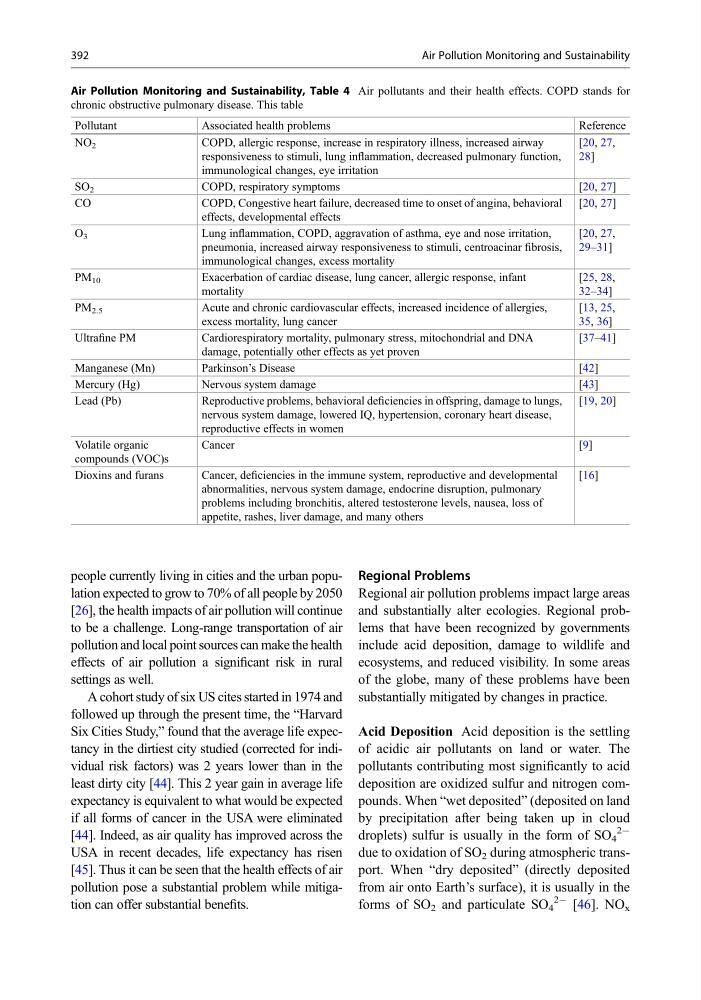
Air Pollution Monitoring and Sustainability, Table 4 Air pollutants and their health effects. COPD stands for
chronic obstructive pulmonary disease. This table
Pollutant
Associated health problems
Reference
NO 2
COPD, allergic response, increase in respiratory illness, increased airway
responsiveness to stimuli, lung inflammation, decreased pulmonary function,
immunological changes, eye irritation
[20, 27,
28]
SO 2
COPD, respiratory symptoms
[20, 27]
CO
COPD, Congestive heart failure, decreased time to onset of angina, behavioral
effects, developmental effects
[20, 27]
O 3
Lung inflammation, COPD, aggravation of asthma, eye and nose irritation,
pneumonia, increased airway responsiveness to stimuli, centroacinar fibrosis,
immunological changes, excess mortality
[20, 27,
29–31]
PM 10
Exacerbation of cardiac disease, lung cancer, allergic response, infant
mortality
[25, 28,
32–34]
PM 2.5
Acute and chronic cardiovascular effects, increased incidence of allergies,
excess mortality, lung cancer
[13, 25,
35, 36]
Ultrafine PM
Cardiorespiratory mortality, pulmonary stress, mitochondrial and DNA
damage, potentially other effects as yet proven
[37–41]
Manganese (Mn)
Parkinson’s Disease
[42]
Mercury (Hg)
Nervous system damage
[43]
Lead (Pb)
Reproductive problems, behavioral deficiencies in offspring, damage to lungs,
nervous system damage, lowered IQ, hypertension, coronary heart disease,
reproductive effects in women
[19, 20]
Volatile organic
compounds (VOC)s
Cancer
[9]
Dioxins and furans
Cancer, deficiencies in the immune system, reproductive and developmental
abnormalities, nervous system damage, endocrine disruption, pulmonary
problems including bronchitis, altered testosterone levels, nausea, loss of
appetite, rashes, liver damage, and many others
[16]
392
Air Pollution Monitoring and Sustainability
[26], the health impacts of air pollution will continue
to be a challenge. Long-range transportation of air
pollution and local point sources can make the health
effects of air pollution a significant risk in rural
settings as well.
A cohort study of six US cites started in 1974 and
followed up through the present time, the “Harvard
Six Cities Study,” found that the average life expectancy in the dirtiest city studied (corrected for individual risk factors) was 2 years lower than in the
least dirty city [44]. This 2 year gain in average life
expectancy is equivalent to what would be expected
if all forms of cancer in the USA were eliminated
[44]. Indeed, as air quality has improved across the
USA in recent decades, life expectancy has risen
[45]. Thus it can be seen that the health effects of air
pollution pose a substantial problem while mitigation can offer substantial benefits.
Regional Problems
Regional air pollution problems impact large areas
and substantially alter ecologies. Regional problems that have been recognized by governments
include acid deposition, damage to wildlife and
ecosystems, and reduced visibility. In some areas
of the globe, many of these problems have been
substantially mitigated by changes in practice.
Acid Deposition Acid deposition is the settling
of acidic air pollutants on land or water. The
pollutants contributing most significantly to acid
deposition are oxidized sulfur and nitrogen compounds. When “wet deposited” (deposited on land
by precipitation after being taken up in cloud
droplets) sulfur is usually in the form of SO 4
2À
due to oxidation of SO 2 during atmospheric transport. When “dry deposited” (directly deposited
from air onto Earth’s surface), it is usually in the
forms of SO 2 and particulate SO 4
2À [46]. NO x
Air Pollution Monitoring and Sustainability, Table 4 Air pollutants and their health effects. COPD stands for
chronic obstructive pulmonary disease. This table
Pollutant
Associated health problems
Reference
NO 2
COPD, allergic response, increase in respiratory illness, increased airway
responsiveness to stimuli, lung inflammation, decreased pulmonary function,
immunological changes, eye irritation
[20, 27,
28]
SO 2
COPD, respiratory symptoms
[20, 27]
CO
COPD, Congestive heart failure, decreased time to onset of angina, behavioral
effects, developmental effects
[20, 27]
O 3
Lung inflammation, COPD, aggravation of asthma, eye and nose irritation,
pneumonia, increased airway responsiveness to stimuli, centroacinar fibrosis,
immunological changes, excess mortality
[20, 27,
29–31]
PM 10
Exacerbation of cardiac disease, lung cancer, allergic response, infant
mortality
[25, 28,
32–34]
PM 2.5
Acute and chronic cardiovascular effects, increased incidence of allergies,
excess mortality, lung cancer
[13, 25,
35, 36]
Ultrafine PM
Cardiorespiratory mortality, pulmonary stress, mitochondrial and DNA
damage, potentially other effects as yet proven
[37–41]
Manganese (Mn)
Parkinson’s Disease
[42]
Mercury (Hg)
Nervous system damage
[43]
Lead (Pb)
Reproductive problems, behavioral deficiencies in offspring, damage to lungs,
nervous system damage, lowered IQ, hypertension, coronary heart disease,
reproductive effects in women
[19, 20]
Volatile organic
compounds (VOC)s
Cancer
[9]
Dioxins and furans
Cancer, deficiencies in the immune system, reproductive and developmental
abnormalities, nervous system damage, endocrine disruption, pulmonary
problems including bronchitis, altered testosterone levels, nausea, loss of
appetite, rashes, liver damage, and many others
[16]
392
Air Pollution Monitoring and Sustainability