

remote areas are possible because of agricultural or
biomass burning and forest fires.
Sulfur dioxide emissions originate primarily
from coal-fired power plants. Once in the atmosphere SO 2 is oxidized to sulfuric acid (H 2 SO 4 )
both homogeneously and heterogeneously in the
liquid and gas phases [11]. The resultant sulfuric
acid can be deposited in the gas phase or can
condense with water vapor onto aerosol particles
or cloud drops to produce aqueous phase sulfuric
acid which can then be deposited through rain or
fog. Acid deposition came to the forefront of
environmental issues in the 1950s and 1960s
when the acidification of Scandinavian lakes was
linked to sulfur emissions in Europe. A Swedish
study in 1972 connected sulfur dioxide emissions
with negative environmental impacts which led to
an international effort to reduce acidification
[2, 3]. It was later also determined that emissions
other than SO 2 were also contributing to the acid
deposition, such as direct emissions of HCl and
nitric acid formed from nitrogen oxides emission
and chemical transformation. Efforts to reduce
acid deposition spawned international agreements
such as the Convention on Long-Range Transboundary Air Pollution (LRTAP), which was the
first such agreement to deal with international air
pollution issues. Measures in the USA to reduce
and monitor sulfur emissions included amendments to the Clean Air Act of 1970, as well as
the creation of the National Atmospheric Deposition Program of 1977 [2]. Significant reductions
Water vapor
Halocarbons
CFCs
Stratosphere
Troposphere
O 3 destruction
O 3 production
Cities
Industry
Agriculture
Desert
dust
Cattle
Biomass
burning
Oceans
Transportation
Transportation
Sulfur
emissions
from oceans
Evaporation
and convection
Free
Troposphere
Boundary
layer
Forests and other
Ecosystems
Deposition
of
pollutants
O 3 production
Natural and
anthropogenic emissions
from the Earth
(CH4, CO, CO2,
VOCs, Sulfate, Black
Carbon, Dust, N2O,
CFCs, NOx, O3)
Chemical
transformation
Chemical
transformation
Chemical
transformation
and
Long-range Transport of Aerosols and Gases
Chemical
transformation
Aircraft emissions
(NO x , Black Carbon, Sulfate)
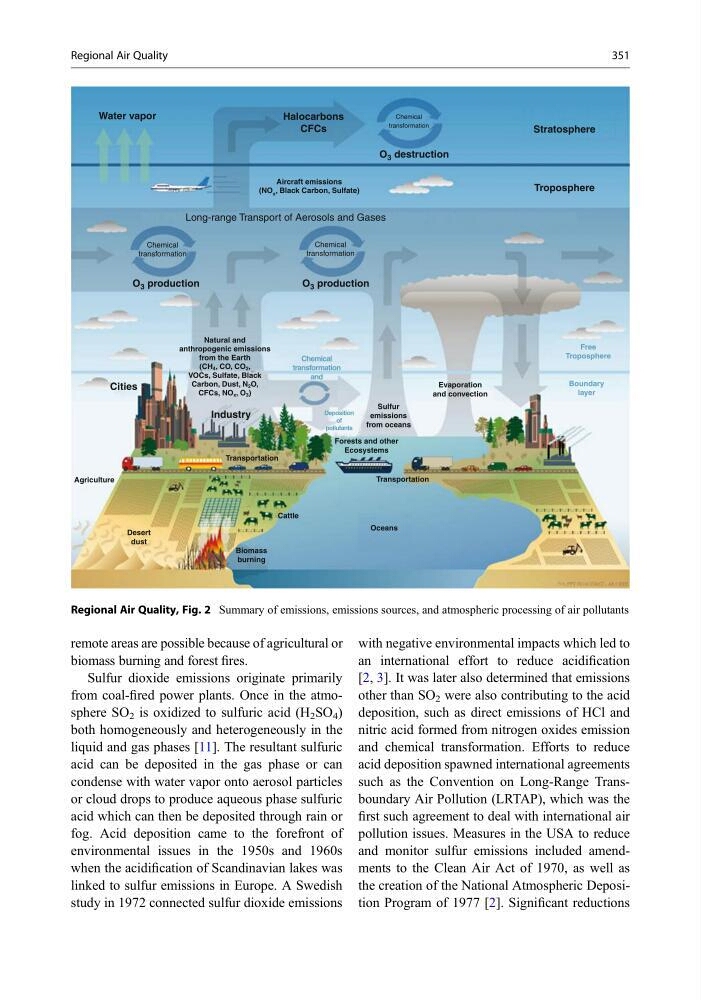
Regional Air Quality, Fig. 2 Summary of emissions, emissions sources, and atmospheric processing of air pollutants
Regional Air Quality
351
biomass burning and forest fires.
Sulfur dioxide emissions originate primarily
from coal-fired power plants. Once in the atmosphere SO 2 is oxidized to sulfuric acid (H 2 SO 4 )
both homogeneously and heterogeneously in the
liquid and gas phases [11]. The resultant sulfuric
acid can be deposited in the gas phase or can
condense with water vapor onto aerosol particles
or cloud drops to produce aqueous phase sulfuric
acid which can then be deposited through rain or
fog. Acid deposition came to the forefront of
environmental issues in the 1950s and 1960s
when the acidification of Scandinavian lakes was
linked to sulfur emissions in Europe. A Swedish
study in 1972 connected sulfur dioxide emissions
with negative environmental impacts which led to
an international effort to reduce acidification
[2, 3]. It was later also determined that emissions
other than SO 2 were also contributing to the acid
deposition, such as direct emissions of HCl and
nitric acid formed from nitrogen oxides emission
and chemical transformation. Efforts to reduce
acid deposition spawned international agreements
such as the Convention on Long-Range Transboundary Air Pollution (LRTAP), which was the
first such agreement to deal with international air
pollution issues. Measures in the USA to reduce
and monitor sulfur emissions included amendments to the Clean Air Act of 1970, as well as
the creation of the National Atmospheric Deposition Program of 1977 [2]. Significant reductions
Water vapor
Halocarbons
CFCs
Stratosphere
Troposphere
O 3 destruction
O 3 production
Cities
Industry
Agriculture
Desert
dust
Cattle
Biomass
burning
Oceans
Transportation
Transportation
Sulfur
emissions
from oceans
Evaporation
and convection
Free
Troposphere
Boundary
layer
Forests and other
Ecosystems
Deposition
of
pollutants
O 3 production
Natural and
anthropogenic emissions
from the Earth
(CH4, CO, CO2,
VOCs, Sulfate, Black
Carbon, Dust, N2O,
CFCs, NOx, O3)
Chemical
transformation
Chemical
transformation
Chemical
transformation
and
Long-range Transport of Aerosols and Gases
Chemical
transformation
Aircraft emissions
(NO x , Black Carbon, Sulfate)
Regional Air Quality, Fig. 2 Summary of emissions, emissions sources, and atmospheric processing of air pollutants
Regional Air Quality
351