

a number of amendments in the 1960s that set
standards for motor vehicle emissions. In 1970,
the Clean Air Act was passed, which established
the National Ambient Air Quality Standards
(NAAQS), set new limits on stationary and
mobile sources emissions, and allowed states to
set their own stricter standards [4]. Catalytic convertors for vehicles in the USA were introduced in
1975, developed in response to the 1970 Clean
Air Act, significantly reducing hydrocarbon
(HC) and carbon monoxide emissions. Further
incarnations of the Clean Air Act and amendments were passed in the years since then, reducing standards for stationary and mobile sources,
and mandating control technology. In the USA,
California has frequently been ahead of the curve
with more stringent air quality standards and
tighter standards for vehicles emissions. In 2002,
California passed legislation that required automakers to reduce greenhouse gas emissions from
vehicles [4].
Just after the first US Air Pollution Control
Act, the UK Clean Air Act was passed in 1956,
setting controls for household and industrial emissions of smoke. In 1968, the UK Clean Air Act
was passed which required tall smoke stacks for
industries using fossil fuels to improve dispersal
of emissions and avoid local deposition [2]. As of
1972, the UK joined the EU and the majority of
air quality policy has been determined by EC
directives applicable across Europe. In 1979, the
International Convention on Long-Range Transboundary Pollution was adopted to limit emissions of acidifying pollutants. The first directive
on ambient air quality was adopted in 1980 and
assigned limits to sulfur dioxide and particles
[3]. Subsequent directives in 1982 and 1985 put
limits on ambient air concentrations of lead and
nitrogen dioxide, and in 1989 a directive required
all new cars in the EU to run on unleaded fuel
[3]. A 1993 directive required the use of catalytic
convertors on all new petrol vehicles. In 1996, an
EC directive was established to provide a new
framework to control levels of sulfur dioxide,
nitrogen dioxide, particulate matter, lead, ozone,
benzene, carbon monoxide, and hydrocarbons.
AQ
Good
FGD
TWC-Petrol
DPF-Diesel
Energy efficiency
Demand management
Nuclear
wind, solar, tidal...
hybrids, L & Z EVs
CCS
Uncontrolled coal and
oil fossil fuels in
stationary and mobile
sources
Increase in
“uncontrolled” diesel
CC Bad
CC
Good
AQ
Bad
Biofuels
Biomass
CHP
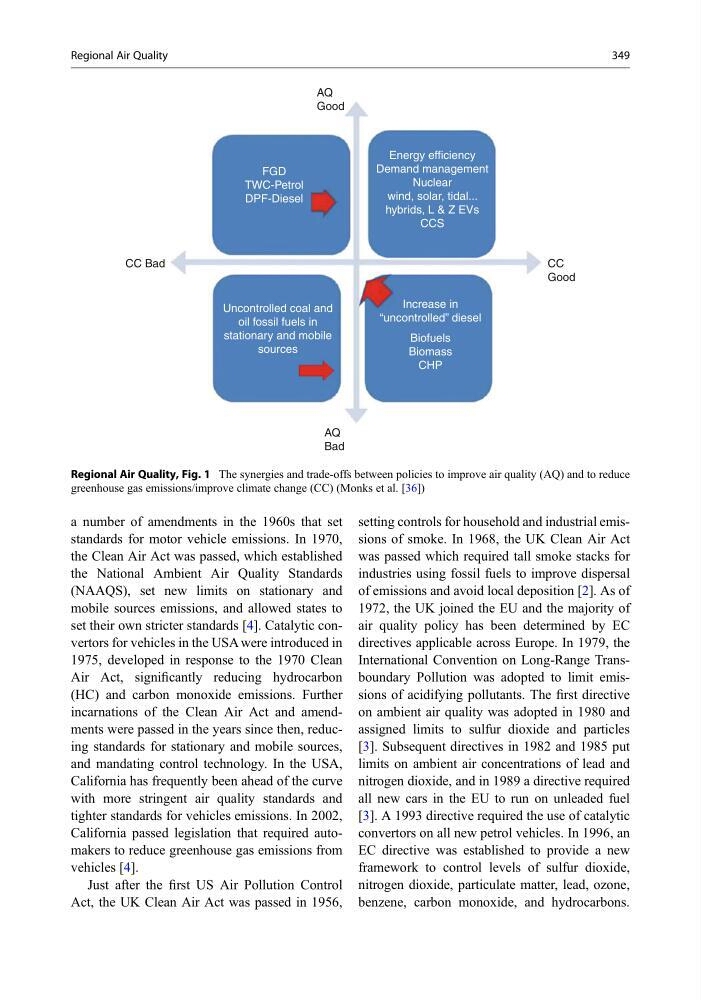
Regional Air Quality, Fig. 1 The synergies and trade-offs between policies to improve air quality (AQ) and to reduce
greenhouse gas emissions/improve climate change (CC) (Monks et al. [36])
Regional Air Quality
349
standards for motor vehicle emissions. In 1970,
the Clean Air Act was passed, which established
the National Ambient Air Quality Standards
(NAAQS), set new limits on stationary and
mobile sources emissions, and allowed states to
set their own stricter standards [4]. Catalytic convertors for vehicles in the USA were introduced in
1975, developed in response to the 1970 Clean
Air Act, significantly reducing hydrocarbon
(HC) and carbon monoxide emissions. Further
incarnations of the Clean Air Act and amendments were passed in the years since then, reducing standards for stationary and mobile sources,
and mandating control technology. In the USA,
California has frequently been ahead of the curve
with more stringent air quality standards and
tighter standards for vehicles emissions. In 2002,
California passed legislation that required automakers to reduce greenhouse gas emissions from
vehicles [4].
Just after the first US Air Pollution Control
Act, the UK Clean Air Act was passed in 1956,
setting controls for household and industrial emissions of smoke. In 1968, the UK Clean Air Act
was passed which required tall smoke stacks for
industries using fossil fuels to improve dispersal
of emissions and avoid local deposition [2]. As of
1972, the UK joined the EU and the majority of
air quality policy has been determined by EC
directives applicable across Europe. In 1979, the
International Convention on Long-Range Transboundary Pollution was adopted to limit emissions of acidifying pollutants. The first directive
on ambient air quality was adopted in 1980 and
assigned limits to sulfur dioxide and particles
[3]. Subsequent directives in 1982 and 1985 put
limits on ambient air concentrations of lead and
nitrogen dioxide, and in 1989 a directive required
all new cars in the EU to run on unleaded fuel
[3]. A 1993 directive required the use of catalytic
convertors on all new petrol vehicles. In 1996, an
EC directive was established to provide a new
framework to control levels of sulfur dioxide,
nitrogen dioxide, particulate matter, lead, ozone,
benzene, carbon monoxide, and hydrocarbons.
AQ
Good
FGD
TWC-Petrol
DPF-Diesel
Energy efficiency
Demand management
Nuclear
wind, solar, tidal...
hybrids, L & Z EVs
CCS
Uncontrolled coal and
oil fossil fuels in
stationary and mobile
sources
Increase in
“uncontrolled” diesel
CC Bad
CC
Good
AQ
Bad
Biofuels
Biomass
CHP
Regional Air Quality, Fig. 1 The synergies and trade-offs between policies to improve air quality (AQ) and to reduce
greenhouse gas emissions/improve climate change (CC) (Monks et al. [36])
Regional Air Quality
349