

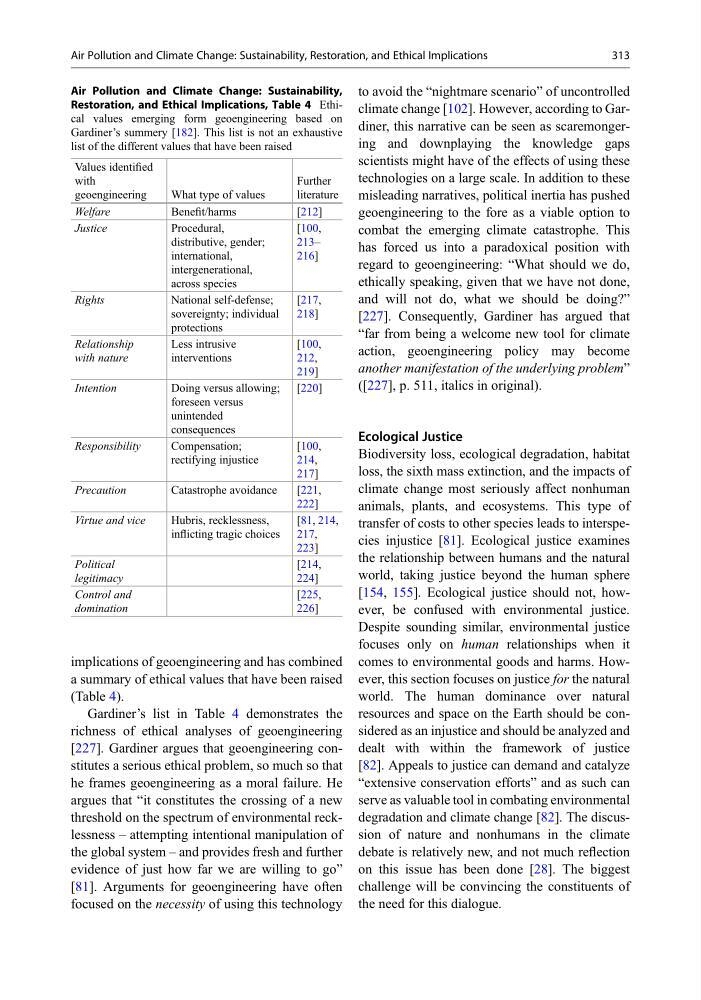
implications of geoengineering and has combined
a summary of ethical values that have been raised
(Table 4).
Gardiner’s list in Table 4 demonstrates the
richness of ethical analyses of geoengineering
[227]. Gardiner argues that geoengineering constitutes a serious ethical problem, so much so that
he frames geoengineering as a moral failure. He
argues that “it constitutes the crossing of a new
threshold on the spectrum of environmental recklessness – attempting intentional manipulation of
the global system – and provides fresh and further
evidence of just how far we are willing to go”
[81]. Arguments for geoengineering have often
focused on the necessity of using this technology
to avoid the “nightmare scenario” of uncontrolled
climate change [102]. However, according to Gardiner, this narrative can be seen as scaremongering and downplaying the knowledge gaps
scientists might have of the effects of using these
technologies on a large scale. In addition to these
misleading narratives, political inertia has pushed
geoengineering to the fore as a viable option to
combat the emerging climate catastrophe. This
has forced us into a paradoxical position with
regard to geoengineering: “What should we do,
ethically speaking, given that we have not done,
and will not do, what we should be doing?”
[227]. Consequently, Gardiner has argued that
“far from being a welcome new tool for climate
action, geoengineering policy may become
another manifestation of the underlying problem”
([227], p. 511, italics in original).
Ecological Justice
Biodiversity loss, ecological degradation, habitat
loss, the sixth mass extinction, and the impacts of
climate change most seriously affect nonhuman
animals, plants, and ecosystems. This type of
transfer of costs to other species leads to interspecies injustice [81]. Ecological justice examines
the relationship between humans and the natural
world, taking justice beyond the human sphere
[154, 155]. Ecological justice should not, however, be confused with environmental justice.
Despite sounding similar, environmental justice
focuses only on human relationships when it
comes to environmental goods and harms. However, this section focuses on justice for the natural
world. The human dominance over natural
resources and space on the Earth should be considered as an injustice and should be analyzed and
dealt with within the framework of justice
[82]. Appeals to justice can demand and catalyze
“extensive conservation efforts” and as such can
serve as valuable tool in combating environmental
degradation and climate change [82]. The discussion of nature and nonhumans in the climate
debate is relatively new, and not much reflection
on this issue has been done [28]. The biggest
challenge will be convincing the constituents of
the need for this dialogue.
Air Pollution and Climate Change: Sustainability,
Restoration, and Ethical Implications, Table 4 Ethical values emerging form geoengineering based on
Gardiner’s summery [182]. This list is not an exhaustive
list of the different values that have been raised
Values identified
with
geoengineering
What type of values
Further
literature
Welfare
Benefit/harms
[212]
Justice
Procedural,
distributive, gender;
international,
intergenerational,
across species
[100,
213–
216]
Rights
National self-defense;
sovereignty; individual
protections
[217,
218]
Relationship
with nature
Less intrusive
interventions
[100,
212,
219]
Intention
Doing versus allowing;
foreseen versus
unintended
consequences
[220]
Responsibility
Compensation;
rectifying injustice
[100,
214,
217]
Precaution
Catastrophe avoidance
[221,
222]
Virtue and vice
Hubris, recklessness,
inflicting tragic choices
[81, 214,
217,
223]
Political
legitimacy
[214,
224]
Control and
domination
[225,
226]
Air Pollution and Climate Change: Sustainability, Restoration, and Ethical Implications
313
a summary of ethical values that have been raised
(Table 4).
Gardiner’s list in Table 4 demonstrates the
richness of ethical analyses of geoengineering
[227]. Gardiner argues that geoengineering constitutes a serious ethical problem, so much so that
he frames geoengineering as a moral failure. He
argues that “it constitutes the crossing of a new
threshold on the spectrum of environmental recklessness – attempting intentional manipulation of
the global system – and provides fresh and further
evidence of just how far we are willing to go”
[81]. Arguments for geoengineering have often
focused on the necessity of using this technology
to avoid the “nightmare scenario” of uncontrolled
climate change [102]. However, according to Gardiner, this narrative can be seen as scaremongering and downplaying the knowledge gaps
scientists might have of the effects of using these
technologies on a large scale. In addition to these
misleading narratives, political inertia has pushed
geoengineering to the fore as a viable option to
combat the emerging climate catastrophe. This
has forced us into a paradoxical position with
regard to geoengineering: “What should we do,
ethically speaking, given that we have not done,
and will not do, what we should be doing?”
[227]. Consequently, Gardiner has argued that
“far from being a welcome new tool for climate
action, geoengineering policy may become
another manifestation of the underlying problem”
([227], p. 511, italics in original).
Ecological Justice
Biodiversity loss, ecological degradation, habitat
loss, the sixth mass extinction, and the impacts of
climate change most seriously affect nonhuman
animals, plants, and ecosystems. This type of
transfer of costs to other species leads to interspecies injustice [81]. Ecological justice examines
the relationship between humans and the natural
world, taking justice beyond the human sphere
[154, 155]. Ecological justice should not, however, be confused with environmental justice.
Despite sounding similar, environmental justice
focuses only on human relationships when it
comes to environmental goods and harms. However, this section focuses on justice for the natural
world. The human dominance over natural
resources and space on the Earth should be considered as an injustice and should be analyzed and
dealt with within the framework of justice
[82]. Appeals to justice can demand and catalyze
“extensive conservation efforts” and as such can
serve as valuable tool in combating environmental
degradation and climate change [82]. The discussion of nature and nonhumans in the climate
debate is relatively new, and not much reflection
on this issue has been done [28]. The biggest
challenge will be convincing the constituents of
the need for this dialogue.
Air Pollution and Climate Change: Sustainability,
Restoration, and Ethical Implications, Table 4 Ethical values emerging form geoengineering based on
Gardiner’s summery [182]. This list is not an exhaustive
list of the different values that have been raised
Values identified
with
geoengineering
What type of values
Further
literature
Welfare
Benefit/harms
[212]
Justice
Procedural,
distributive, gender;
international,
intergenerational,
across species
[100,
213–
216]
Rights
National self-defense;
sovereignty; individual
protections
[217,
218]
Relationship
with nature
Less intrusive
interventions
[100,
212,
219]
Intention
Doing versus allowing;
foreseen versus
unintended
consequences
[220]
Responsibility
Compensation;
rectifying injustice
[100,
214,
217]
Precaution
Catastrophe avoidance
[221,
222]
Virtue and vice
Hubris, recklessness,
inflicting tragic choices
[81, 214,
217,
223]
Political
legitimacy
[214,
224]
Control and
domination
[225,
226]
Air Pollution and Climate Change: Sustainability, Restoration, and Ethical Implications
313