

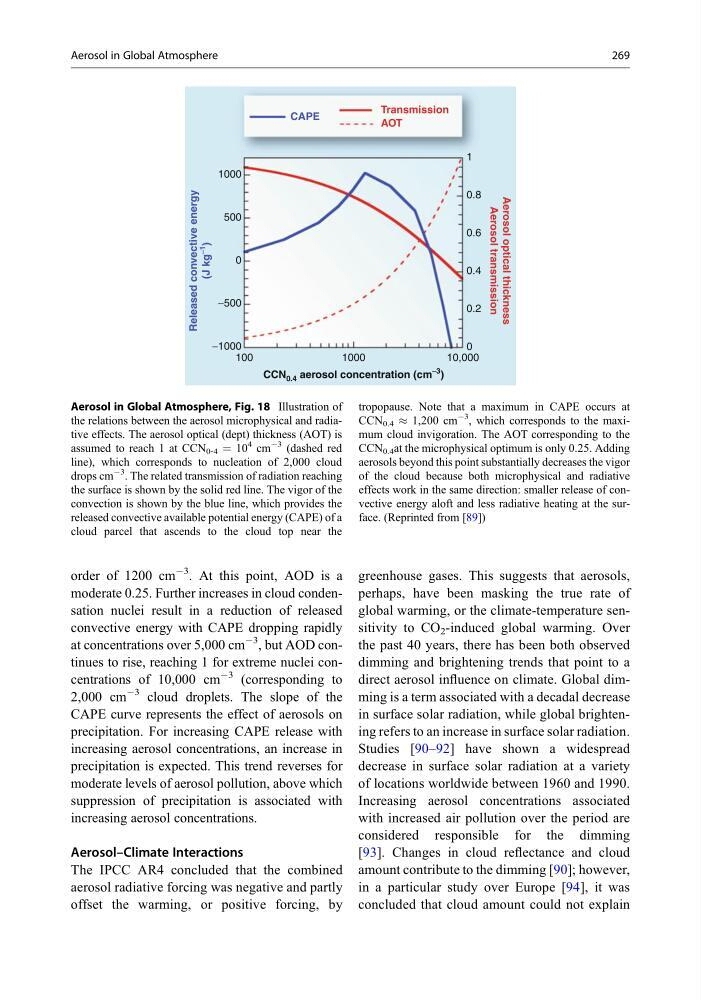
order of 1200 cm
À3 . At this point, AOD is a
moderate 0.25. Further increases in cloud condensation nuclei result in a reduction of released
convective energy with CAPE dropping rapidly
at concentrations over 5,000 cm
À3 , but AOD continues to rise, reaching 1 for extreme nuclei concentrations of 10,000 cm
À3 (corresponding to
2,000 cm
À3 cloud droplets. The slope of the
CAPE curve represents the effect of aerosols on
precipitation. For increasing CAPE release with
increasing aerosol concentrations, an increase in
precipitation is expected. This trend reverses for
moderate levels of aerosol pollution, above which
suppression of precipitation is associated with
increasing aerosol concentrations.
Aerosol–Climate Interactions
The IPCC AR4 concluded that the combined
aerosol radiative forcing was negative and partly
offset the warming, or positive forcing, by
greenhouse gases. This suggests that aerosols,
perhaps, have been masking the true rate of
global warming, or the climate-temperature sensitivity to CO 2 -induced global warming. Over
the past 40 years, there has been both observed
dimming and brightening trends that point to a
direct aerosol influence on climate. Global dimming is a term associated with a decadal decrease
in surface solar radiation, while global brightening refers to an increase in surface solar radiation.
Studies [90–92] have shown a widespread
decrease in surface solar radiation at a variety
of locations worldwide between 1960 and 1990.
Increasing aerosol concentrations associated
with increased air pollution over the period are
considered responsible for the dimming
[93]. Changes in cloud reflectance and cloud
amount contribute to the dimming [90]; however,
in a particular study over Europe [94], it was
concluded that cloud amount could not explain
1000
1
0.8
0.6
0.4
0.2
0
500
Released convective energy
(J kg
-1
)
CAPE
Transmission
Aerosol optical thickness
Aerosol transmission
−500
−1000
100
1000
CCN 0.4 aerosol concentration (cm
-3 )
10,000
0
AOT
Aerosol in Global Atmosphere, Fig. 18 Illustration of
the relations between the aerosol microphysical and radiative effects. The aerosol optical (dept) thickness (AOT) is
assumed to reach 1 at CCN 0 . 4 ¼ 10
4 cm
À3 (dashed red
line), which corresponds to nucleation of 2,000 cloud
drops cm
À3
. The related transmission of radiation reaching
the surface is shown by the solid red line. The vigor of the
convection is shown by the blue line, which provides the
released convective available potential energy (CAPE) of a
cloud parcel that ascends to the cloud top near the
tropopause. Note that a maximum in CAPE occurs at
CCN 0.4 % 1,200 cm
À3
, which corresponds to the maximum cloud invigoration. The AOT corresponding to the
CCN 0.4 at the microphysical optimum is only 0.25. Adding
aerosols beyond this point substantially decreases the vigor
of the cloud because both microphysical and radiative
effects work in the same direction: smaller release of convective energy aloft and less radiative heating at the surface. (Reprinted from [89])
Aerosol in Global Atmosphere
269
À3 . At this point, AOD is a
moderate 0.25. Further increases in cloud condensation nuclei result in a reduction of released
convective energy with CAPE dropping rapidly
at concentrations over 5,000 cm
À3 , but AOD continues to rise, reaching 1 for extreme nuclei concentrations of 10,000 cm
À3 (corresponding to
2,000 cm
À3 cloud droplets. The slope of the
CAPE curve represents the effect of aerosols on
precipitation. For increasing CAPE release with
increasing aerosol concentrations, an increase in
precipitation is expected. This trend reverses for
moderate levels of aerosol pollution, above which
suppression of precipitation is associated with
increasing aerosol concentrations.
Aerosol–Climate Interactions
The IPCC AR4 concluded that the combined
aerosol radiative forcing was negative and partly
offset the warming, or positive forcing, by
greenhouse gases. This suggests that aerosols,
perhaps, have been masking the true rate of
global warming, or the climate-temperature sensitivity to CO 2 -induced global warming. Over
the past 40 years, there has been both observed
dimming and brightening trends that point to a
direct aerosol influence on climate. Global dimming is a term associated with a decadal decrease
in surface solar radiation, while global brightening refers to an increase in surface solar radiation.
Studies [90–92] have shown a widespread
decrease in surface solar radiation at a variety
of locations worldwide between 1960 and 1990.
Increasing aerosol concentrations associated
with increased air pollution over the period are
considered responsible for the dimming
[93]. Changes in cloud reflectance and cloud
amount contribute to the dimming [90]; however,
in a particular study over Europe [94], it was
concluded that cloud amount could not explain
1000
1
0.8
0.6
0.4
0.2
0
500
Released convective energy
(J kg
-1
)
CAPE
Transmission
Aerosol optical thickness
Aerosol transmission
−500
−1000
100
1000
CCN 0.4 aerosol concentration (cm
-3 )
10,000
0
AOT
Aerosol in Global Atmosphere, Fig. 18 Illustration of
the relations between the aerosol microphysical and radiative effects. The aerosol optical (dept) thickness (AOT) is
assumed to reach 1 at CCN 0 . 4 ¼ 10
4 cm
À3 (dashed red
line), which corresponds to nucleation of 2,000 cloud
drops cm
À3
. The related transmission of radiation reaching
the surface is shown by the solid red line. The vigor of the
convection is shown by the blue line, which provides the
released convective available potential energy (CAPE) of a
cloud parcel that ascends to the cloud top near the
tropopause. Note that a maximum in CAPE occurs at
CCN 0.4 % 1,200 cm
À3
, which corresponds to the maximum cloud invigoration. The AOT corresponding to the
CCN 0.4 at the microphysical optimum is only 0.25. Adding
aerosols beyond this point substantially decreases the vigor
of the cloud because both microphysical and radiative
effects work in the same direction: smaller release of convective energy aloft and less radiative heating at the surface. (Reprinted from [89])
Aerosol in Global Atmosphere
269