

is generally formed by rising air parcels which
eventually become supersaturated. Cloud droplets
are activated at cloud base and continue to grow as
the air parcel containing the droplets rise to the top
of cloud. Even for a fixed number of droplets,
their size and liquid water content increases with
increasing height into the cloud. A parameter used
to describe an effective radius in such a changing
field is the cloud drop effective radius defined as
the weighted mean of the size distribution of the
cloud droplets. This amounts to the ratio of the
volumetric distribution to the surface area distribution – or the ratio of the third moment of the
distribution to the second moment. Take the two
cases of clouds forming under the same environmental conditions (and hence the same available
liquid water content), but under different aerosol
fields, one clean containing a low number of cloud
nuclei, and the other polluted, containing a high
number of cloud nuclei. The same amount of
liquid water has to be shared out to different nuclei
concentrations entering into cloud base. The result
is that the clean cloud with a low nuclei and
droplet concentration (N ~ 50 cm
À3 ) leads to a
relatively large effective radius (of the order of
15 mm), while the polluted cloud with high nuclei
and droplet concentration (N ~ 300 cm
À3 ) leads to
a relatively low effect radius (of the order of
5 mm). The net effect is a higher cloud albedo
seen at cloud top. An excellent example of this
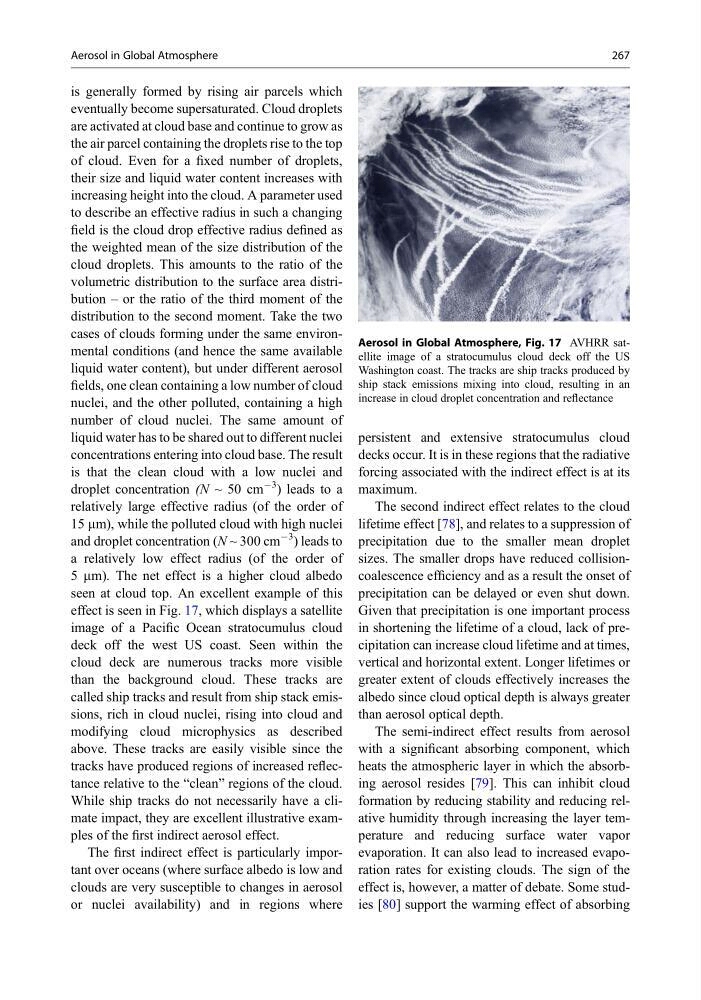
effect is seen in Fig. 17, which displays a satellite
image of a Pacific Ocean stratocumulus cloud
deck off the west US coast. Seen within the
cloud deck are numerous tracks more visible
than the background cloud. These tracks are
called ship tracks and result from ship stack emissions, rich in cloud nuclei, rising into cloud and
modifying cloud microphysics as described
above. These tracks are easily visible since the
tracks have produced regions of increased reflectance relative to the “clean” regions of the cloud.
While ship tracks do not necessarily have a climate impact, they are excellent illustrative examples of the first indirect aerosol effect.
The first indirect effect is particularly important over oceans (where surface albedo is low and
clouds are very susceptible to changes in aerosol
or nuclei availability) and in regions where
persistent and extensive stratocumulus cloud
decks occur. It is in these regions that the radiative
forcing associated with the indirect effect is at its
maximum.
The second indirect effect relates to the cloud
lifetime effect [78], and relates to a suppression of
precipitation due to the smaller mean droplet
sizes. The smaller drops have reduced collisioncoalescence efficiency and as a result the onset of
precipitation can be delayed or even shut down.
Given that precipitation is one important process
in shortening the lifetime of a cloud, lack of precipitation can increase cloud lifetime and at times,
vertical and horizontal extent. Longer lifetimes or
greater extent of clouds effectively increases the
albedo since cloud optical depth is always greater
than aerosol optical depth.
The semi-indirect effect results from aerosol
with a significant absorbing component, which
heats the atmospheric layer in which the absorbing aerosol resides [79]. This can inhibit cloud
formation by reducing stability and reducing relative humidity through increasing the layer temperature and reducing surface water vapor
evaporation. It can also lead to increased evaporation rates for existing clouds. The sign of the
effect is, however, a matter of debate. Some studies [80] support the warming effect of absorbing
Aerosol in Global Atmosphere, Fig. 17 AVHRR satellite image of a stratocumulus cloud deck off the US
Washington coast. The tracks are ship tracks produced by
ship stack emissions mixing into cloud, resulting in an
increase in cloud droplet concentration and reflectance
Aerosol in Global Atmosphere
267
eventually become supersaturated. Cloud droplets
are activated at cloud base and continue to grow as
the air parcel containing the droplets rise to the top
of cloud. Even for a fixed number of droplets,
their size and liquid water content increases with
increasing height into the cloud. A parameter used
to describe an effective radius in such a changing
field is the cloud drop effective radius defined as
the weighted mean of the size distribution of the
cloud droplets. This amounts to the ratio of the
volumetric distribution to the surface area distribution – or the ratio of the third moment of the
distribution to the second moment. Take the two
cases of clouds forming under the same environmental conditions (and hence the same available
liquid water content), but under different aerosol
fields, one clean containing a low number of cloud
nuclei, and the other polluted, containing a high
number of cloud nuclei. The same amount of
liquid water has to be shared out to different nuclei
concentrations entering into cloud base. The result
is that the clean cloud with a low nuclei and
droplet concentration (N ~ 50 cm
À3 ) leads to a
relatively large effective radius (of the order of
15 mm), while the polluted cloud with high nuclei
and droplet concentration (N ~ 300 cm
À3 ) leads to
a relatively low effect radius (of the order of
5 mm). The net effect is a higher cloud albedo
seen at cloud top. An excellent example of this
effect is seen in Fig. 17, which displays a satellite
image of a Pacific Ocean stratocumulus cloud
deck off the west US coast. Seen within the
cloud deck are numerous tracks more visible
than the background cloud. These tracks are
called ship tracks and result from ship stack emissions, rich in cloud nuclei, rising into cloud and
modifying cloud microphysics as described
above. These tracks are easily visible since the
tracks have produced regions of increased reflectance relative to the “clean” regions of the cloud.
While ship tracks do not necessarily have a climate impact, they are excellent illustrative examples of the first indirect aerosol effect.
The first indirect effect is particularly important over oceans (where surface albedo is low and
clouds are very susceptible to changes in aerosol
or nuclei availability) and in regions where
persistent and extensive stratocumulus cloud
decks occur. It is in these regions that the radiative
forcing associated with the indirect effect is at its
maximum.
The second indirect effect relates to the cloud
lifetime effect [78], and relates to a suppression of
precipitation due to the smaller mean droplet
sizes. The smaller drops have reduced collisioncoalescence efficiency and as a result the onset of
precipitation can be delayed or even shut down.
Given that precipitation is one important process
in shortening the lifetime of a cloud, lack of precipitation can increase cloud lifetime and at times,
vertical and horizontal extent. Longer lifetimes or
greater extent of clouds effectively increases the
albedo since cloud optical depth is always greater
than aerosol optical depth.
The semi-indirect effect results from aerosol
with a significant absorbing component, which
heats the atmospheric layer in which the absorbing aerosol resides [79]. This can inhibit cloud
formation by reducing stability and reducing relative humidity through increasing the layer temperature and reducing surface water vapor
evaporation. It can also lead to increased evaporation rates for existing clouds. The sign of the
effect is, however, a matter of debate. Some studies [80] support the warming effect of absorbing
Aerosol in Global Atmosphere, Fig. 17 AVHRR satellite image of a stratocumulus cloud deck off the US
Washington coast. The tracks are ship tracks produced by
ship stack emissions mixing into cloud, resulting in an
increase in cloud droplet concentration and reflectance
Aerosol in Global Atmosphere
267