

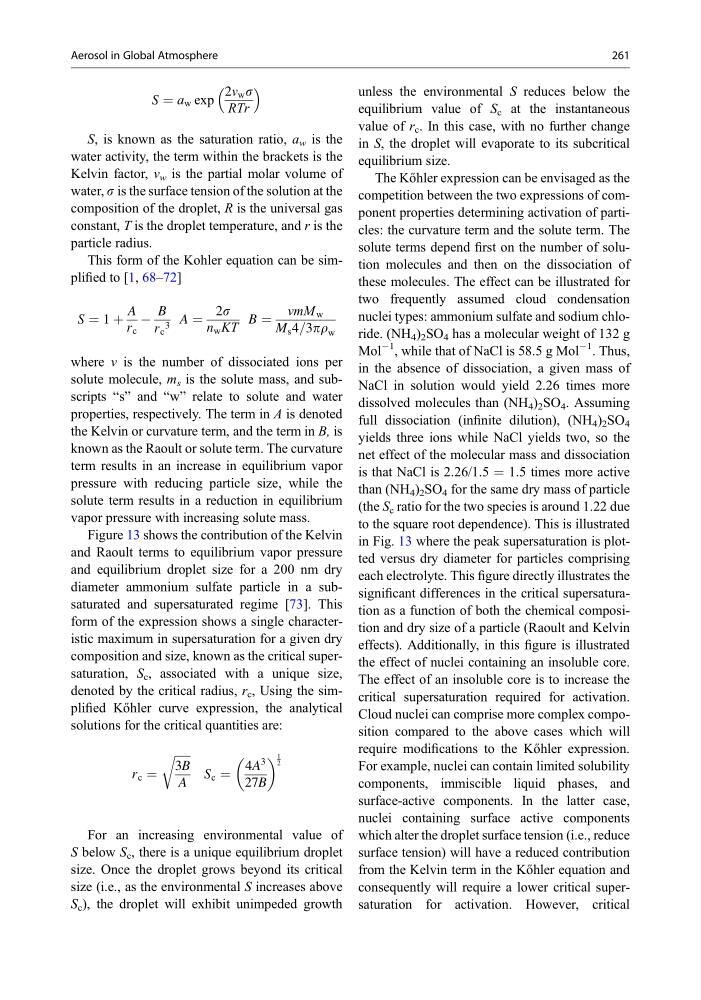
S ¼ a w exp
2v w s
RTr
S, is known as the saturation ratio, a w is the
water activity, the term within the brackets is the
Kelvin factor, v w is the partial molar volume of
water, s is the surface tension of the solution at the
composition of the droplet, R is the universal gas
constant, T is the droplet temperature, and r is the
particle radius.
This form of the Kohler equation can be simplified to [1, 68–72]
S ¼ 1 þ
A
r c
À
B
r c
3
A ¼
2s
n w KT
B ¼
vmM w
M s 4=3pr w
where v is the number of dissociated ions per
solute molecule, m s is the solute mass, and subscripts “s” and “w” relate to solute and water
properties, respectively. The term in A is denoted
the Kelvin or curvature term, and the term in B, is
known as the Raoult or solute term. The curvature
term results in an increase in equilibrium vapor
pressure with reducing particle size, while the
solute term results in a reduction in equilibrium
vapor pressure with increasing solute mass.
Figure 13 shows the contribution of the Kelvin
and Raoult terms to equilibrium vapor pressure
and equilibrium droplet size for a 200 nm dry
diameter ammonium sulfate particle in a subsaturated and supersaturated regime [73]. This
form of the expression shows a single characteristic maximum in supersaturation for a given dry
composition and size, known as the critical supersaturation, S c , associated with a unique size,
denoted by the critical radius, r c , Using the simplified Kőhler curve expression, the analytical
solutions for the critical quantities are:
r c ¼
ffiffiffiffiffi ffi
3B
A
r
S c ¼
4A
3
27B
1 2
For an increasing environmental value of
S below S c , there is a unique equilibrium droplet
size. Once the droplet grows beyond its critical
size (i.e., as the environmental S increases above
S c ), the droplet will exhibit unimpeded growth
unless the environmental S reduces below the
equilibrium value of S c at the instantaneous
value of r c . In this case, with no further change
in S, the droplet will evaporate to its subcritical
equilibrium size.
The Kőhler expression can be envisaged as the
competition between the two expressions of component properties determining activation of particles: the curvature term and the solute term. The
solute terms depend first on the number of solution molecules and then on the dissociation of
these molecules. The effect can be illustrated for
two frequently assumed cloud condensation
nuclei types: ammonium sulfate and sodium chloride. (NH 4 ) 2 SO 4 has a molecular weight of 132 g
Mol
À1 , while that of NaCl is 58.5 g Mol
À1 . Thus,
in the absence of dissociation, a given mass of
NaCl in solution would yield 2.26 times more
dissolved molecules than (NH 4 ) 2 SO 4 . Assuming
full dissociation (infinite dilution), (NH 4 ) 2 SO 4
yields three ions while NaCl yields two, so the
net effect of the molecular mass and dissociation
is that NaCl is 2.26/1.5 ¼ 1.5 times more active
than (NH 4 ) 2 SO 4 for the same dry mass of particle
(the S c ratio for the two species is around 1.22 due
to the square root dependence). This is illustrated
in Fig. 13 where the peak supersaturation is plotted versus dry diameter for particles comprising
each electrolyte. This figure directly illustrates the
significant differences in the critical supersaturation as a function of both the chemical composition and dry size of a particle (Raoult and Kelvin
effects). Additionally, in this figure is illustrated
the effect of nuclei containing an insoluble core.
The effect of an insoluble core is to increase the
critical supersaturation required for activation.
Cloud nuclei can comprise more complex composition compared to the above cases which will
require modifications to the Kőhler expression.
For example, nuclei can contain limited solubility
components, immiscible liquid phases, and
surface-active components. In the latter case,
nuclei containing surface active components
which alter the droplet surface tension (i.e., reduce
surface tension) will have a reduced contribution
from the Kelvin term in the Kőhler equation and
consequently will require a lower critical supersaturation for activation. However, critical
Aerosol in Global Atmosphere
261
2v w s
RTr
S, is known as the saturation ratio, a w is the
water activity, the term within the brackets is the
Kelvin factor, v w is the partial molar volume of
water, s is the surface tension of the solution at the
composition of the droplet, R is the universal gas
constant, T is the droplet temperature, and r is the
particle radius.
This form of the Kohler equation can be simplified to [1, 68–72]
S ¼ 1 þ
A
r c
À
B
r c
3
A ¼
2s
n w KT
B ¼
vmM w
M s 4=3pr w
where v is the number of dissociated ions per
solute molecule, m s is the solute mass, and subscripts “s” and “w” relate to solute and water
properties, respectively. The term in A is denoted
the Kelvin or curvature term, and the term in B, is
known as the Raoult or solute term. The curvature
term results in an increase in equilibrium vapor
pressure with reducing particle size, while the
solute term results in a reduction in equilibrium
vapor pressure with increasing solute mass.
Figure 13 shows the contribution of the Kelvin
and Raoult terms to equilibrium vapor pressure
and equilibrium droplet size for a 200 nm dry
diameter ammonium sulfate particle in a subsaturated and supersaturated regime [73]. This
form of the expression shows a single characteristic maximum in supersaturation for a given dry
composition and size, known as the critical supersaturation, S c , associated with a unique size,
denoted by the critical radius, r c , Using the simplified Kőhler curve expression, the analytical
solutions for the critical quantities are:
r c ¼
ffiffiffiffiffi ffi
3B
A
r
S c ¼
4A
3
27B
1 2
For an increasing environmental value of
S below S c , there is a unique equilibrium droplet
size. Once the droplet grows beyond its critical
size (i.e., as the environmental S increases above
S c ), the droplet will exhibit unimpeded growth
unless the environmental S reduces below the
equilibrium value of S c at the instantaneous
value of r c . In this case, with no further change
in S, the droplet will evaporate to its subcritical
equilibrium size.
The Kőhler expression can be envisaged as the
competition between the two expressions of component properties determining activation of particles: the curvature term and the solute term. The
solute terms depend first on the number of solution molecules and then on the dissociation of
these molecules. The effect can be illustrated for
two frequently assumed cloud condensation
nuclei types: ammonium sulfate and sodium chloride. (NH 4 ) 2 SO 4 has a molecular weight of 132 g
Mol
À1 , while that of NaCl is 58.5 g Mol
À1 . Thus,
in the absence of dissociation, a given mass of
NaCl in solution would yield 2.26 times more
dissolved molecules than (NH 4 ) 2 SO 4 . Assuming
full dissociation (infinite dilution), (NH 4 ) 2 SO 4
yields three ions while NaCl yields two, so the
net effect of the molecular mass and dissociation
is that NaCl is 2.26/1.5 ¼ 1.5 times more active
than (NH 4 ) 2 SO 4 for the same dry mass of particle
(the S c ratio for the two species is around 1.22 due
to the square root dependence). This is illustrated
in Fig. 13 where the peak supersaturation is plotted versus dry diameter for particles comprising
each electrolyte. This figure directly illustrates the
significant differences in the critical supersaturation as a function of both the chemical composition and dry size of a particle (Raoult and Kelvin
effects). Additionally, in this figure is illustrated
the effect of nuclei containing an insoluble core.
The effect of an insoluble core is to increase the
critical supersaturation required for activation.
Cloud nuclei can comprise more complex composition compared to the above cases which will
require modifications to the Kőhler expression.
For example, nuclei can contain limited solubility
components, immiscible liquid phases, and
surface-active components. In the latter case,
nuclei containing surface active components
which alter the droplet surface tension (i.e., reduce
surface tension) will have a reduced contribution
from the Kelvin term in the Kőhler equation and
consequently will require a lower critical supersaturation for activation. However, critical
Aerosol in Global Atmosphere
261