

atmospheric plumes. The laboratory results demonstrate that in the early stages of SOA production, the OA mass spectrum resembles that
associated with the respective source, but as oxidation and aging proceeds, the SOA spectra
evolve into initially semivolatile OOA spectra
and ultimately into low-volatility OOA spectra.
The combined atmospheric and laboratory studies suggest that with atmospheric oxidation, most
types of OA converge to a final state of lowvolatility OOA, irrespective of the original
source. It should, however, be noted that primary
and secondary marine aerosol aging was not
evaluated and that these, potentially, could
behave differently to the terrestrial biogenic and
anthropogenic OA types.
The previous study developed, on the basis of
the mentioned experimental studies, a simple 2D
basis (2D-VBS) model encapsulating the evolution of OA volatility (determined as saturation
concentration C* at 298 K) and oxidation state
(O:C ratio) to describe the evolution of OA in the
atmosphere [41]. These two properties can be
measured in real time and are thus used to constrain the model with experimental field data. The
model incorporates photochemical aging using a
branching ratio between functionalization and
fragmentation kernels and homogeneous and heterogeneous oxidation by OH, and where the first
generation of oxidation is explicitly modeled
while the second generation is phenomenologically modeled. The conceptual framework was
Houston, TX
12.8
26.8
2.8
9.5
8.5
2.9
10.7
7.9
11.0
13.2
Mexico
City
Duke Forest
NC
Thompson
Farm, NH
Off Coast
New England, US
Chebogue
Canada
Cheju Island
Korea
Fukue
Japan
Okinawa
Japan
Organics:
Inorganics:
HOA
Pinnacle Park, NY
New York City, NY
Manchester, UK
Edinburgh, UK Chelmsford, UK
Hyytiala
Finland
Taunus
Germany
Mainz
Germany
(Summer)
(Winter)
Tokyo, Japan
Beijing
China
Jungfraujoch
Switzerland
Zurich, Switzerland
(Summer)
(Winter)
Riverside, CA
Boulder, CO Storm Peak, CO Vancouver
Canada
Pittsburgh. PA
Other OA
SV-OOA
Total OOA
LV-OOA
Sulfate
Nitrate
Ammonium
Chloride
Urban
Urban Downwind
Remote
11.6
(Winter)
(Summer)
(Summer)
(Winter)
5.2
14.3
3.0
5.3
2.0
16.3
4.2
25.5
9.6
2.3
80.0
16.2
HOA
0.0
0:C
0.2
0.4
0.6
0.8
1.0
Other OA
SV-OOA
Total OOA
LV-OOA
19.1
4.4
2.1
7.0
14.7
12.3
12.2
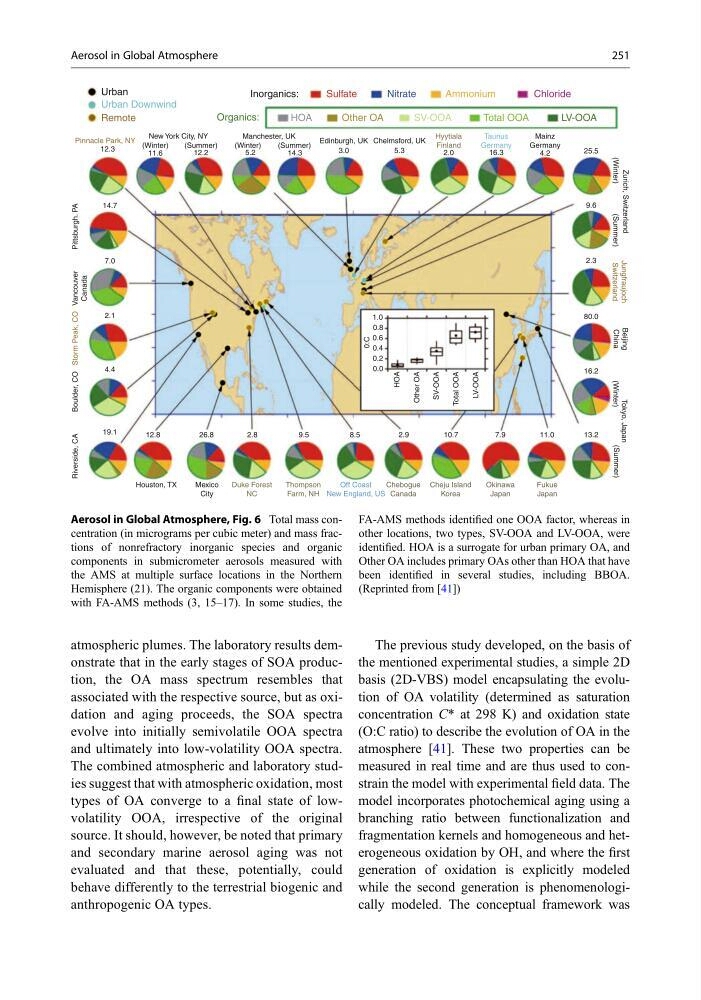
Aerosol in Global Atmosphere, Fig. 6 Total mass concentration (in micrograms per cubic meter) and mass fractions of nonrefractory inorganic species and organic
components in submicrometer aerosols measured with
the AMS at multiple surface locations in the Northern
Hemisphere (21). The organic components were obtained
with FA-AMS methods (3, 15–17). In some studies, the
FA-AMS methods identified one OOA factor, whereas in
other locations, two types, SV-OOA and LV-OOA, were
identified. HOA is a surrogate for urban primary OA, and
Other OA includes primary OAs other than HOA that have
been identified in several studies, including BBOA.
(Reprinted from [41])
Aerosol in Global Atmosphere
251
associated with the respective source, but as oxidation and aging proceeds, the SOA spectra
evolve into initially semivolatile OOA spectra
and ultimately into low-volatility OOA spectra.
The combined atmospheric and laboratory studies suggest that with atmospheric oxidation, most
types of OA converge to a final state of lowvolatility OOA, irrespective of the original
source. It should, however, be noted that primary
and secondary marine aerosol aging was not
evaluated and that these, potentially, could
behave differently to the terrestrial biogenic and
anthropogenic OA types.
The previous study developed, on the basis of
the mentioned experimental studies, a simple 2D
basis (2D-VBS) model encapsulating the evolution of OA volatility (determined as saturation
concentration C* at 298 K) and oxidation state
(O:C ratio) to describe the evolution of OA in the
atmosphere [41]. These two properties can be
measured in real time and are thus used to constrain the model with experimental field data. The
model incorporates photochemical aging using a
branching ratio between functionalization and
fragmentation kernels and homogeneous and heterogeneous oxidation by OH, and where the first
generation of oxidation is explicitly modeled
while the second generation is phenomenologically modeled. The conceptual framework was
Houston, TX
12.8
26.8
2.8
9.5
8.5
2.9
10.7
7.9
11.0
13.2
Mexico
City
Duke Forest
NC
Thompson
Farm, NH
Off Coast
New England, US
Chebogue
Canada
Cheju Island
Korea
Fukue
Japan
Okinawa
Japan
Organics:
Inorganics:
HOA
Pinnacle Park, NY
New York City, NY
Manchester, UK
Edinburgh, UK Chelmsford, UK
Hyytiala
Finland
Taunus
Germany
Mainz
Germany
(Summer)
(Winter)
Tokyo, Japan
Beijing
China
Jungfraujoch
Switzerland
Zurich, Switzerland
(Summer)
(Winter)
Riverside, CA
Boulder, CO Storm Peak, CO Vancouver
Canada
Pittsburgh. PA
Other OA
SV-OOA
Total OOA
LV-OOA
Sulfate
Nitrate
Ammonium
Chloride
Urban
Urban Downwind
Remote
11.6
(Winter)
(Summer)
(Summer)
(Winter)
5.2
14.3
3.0
5.3
2.0
16.3
4.2
25.5
9.6
2.3
80.0
16.2
HOA
0.0
0:C
0.2
0.4
0.6
0.8
1.0
Other OA
SV-OOA
Total OOA
LV-OOA
19.1
4.4
2.1
7.0
14.7
12.3
12.2
Aerosol in Global Atmosphere, Fig. 6 Total mass concentration (in micrograms per cubic meter) and mass fractions of nonrefractory inorganic species and organic
components in submicrometer aerosols measured with
the AMS at multiple surface locations in the Northern
Hemisphere (21). The organic components were obtained
with FA-AMS methods (3, 15–17). In some studies, the
FA-AMS methods identified one OOA factor, whereas in
other locations, two types, SV-OOA and LV-OOA, were
identified. HOA is a surrogate for urban primary OA, and
Other OA includes primary OAs other than HOA that have
been identified in several studies, including BBOA.
(Reprinted from [41])
Aerosol in Global Atmosphere
251