

processes [6]. Primary bioaerosols also include
entire organisms such as bacteria, fungi, and
viruses as well as debris [7, 8].
Over oceanic water surfaces, wind stress at the
air–sea interface leads to breaking waves and the
entrainment of air into the water column, producing whitecaps [9, 10]. Whitecaps are ensembles of
bubbles of entrained air rising to the surface where
they burst due to the pressure differential inside
and outside of the bubble. When the bubble film
bursts, it breaks up into hundreds of individual
seawater drops that rapidly equilibrate to ambient
humidity leaving behind sea-salt “film” droplets,
0.01–1 mm in size and comprising a concentrated
solution of the ionic compounds found in sea-salt
and water. After the film bursts, the cavity
remaining collapses through instabilities leading
to the formation of an upward movement of a
water jet which fragments into a few jet droplets,
typically 1–10 mm in size, of similar composition
to film drops [11]. Film and jet drops are produced
at wind speeds greater than 3–4 m s
À1 which is
observed to be the threshold for the onset of
whitecaps. At wind speeds of 8–10 m s
À1 , the
wind stress is sufficient to tear off the crests of
waves and produce spume droplets, typically
10–100 mm in size. The flux of sea spray follows
a power-law dependency on wind speed [12]. In
biologically active waters, organic matter tends to
become concentrated at the ocean surface and at
the bubble–water interface. This organic matter
displaces seawater in the bubble film, ultimately
displacing the ionic sea-salt in the film and jet
drops produced, leading to the enrichment of
organic matter in sea-spray aerosol [13]. The
enrichment is observed to increase with
Sea Salt
Dust
Pollen
Biomass Smoke
Crystal Bio-Organic
Nucleation
Aitken
Accumulation
Coarse
Soot
Number
Particle Diameter, nm
Volume
1000
1000
1 μm
1 μm
100
10
1
Sulfuric Acid
Marine Organic
Ammonium Sulfate
100 nm
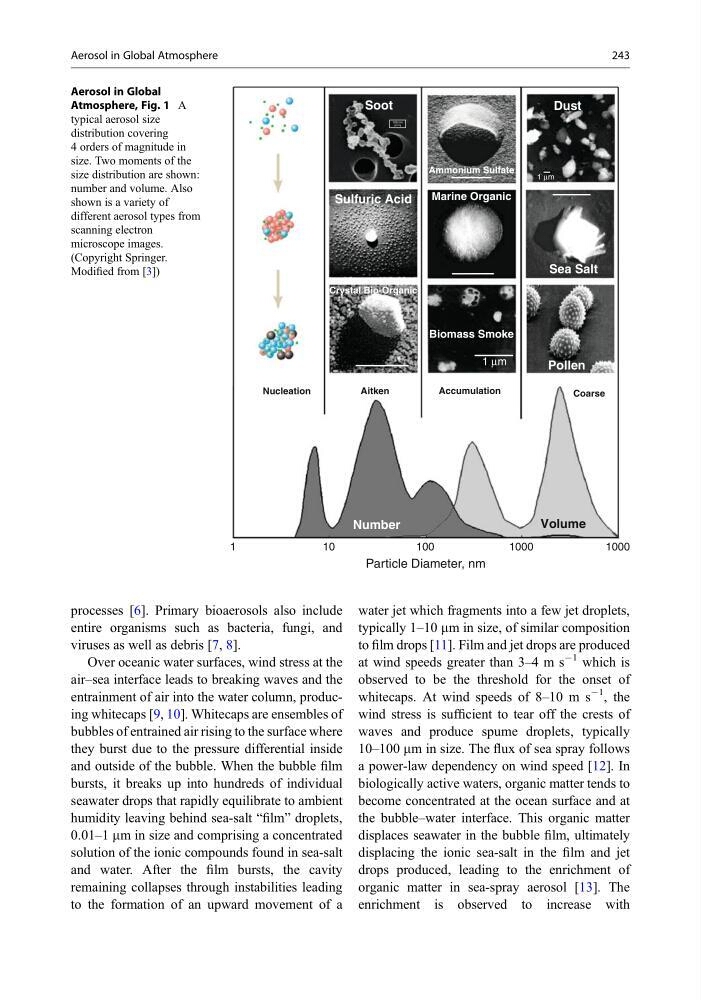
Aerosol in Global
Atmosphere, Fig. 1 A
typical aerosol size
distribution covering
4 orders of magnitude in
size. Two moments of the
size distribution are shown:
number and volume. Also
shown is a variety of
different aerosol types from
scanning electron
microscope images.
(Copyright Springer.
Modified from [3])
Aerosol in Global Atmosphere
243
entire organisms such as bacteria, fungi, and
viruses as well as debris [7, 8].
Over oceanic water surfaces, wind stress at the
air–sea interface leads to breaking waves and the
entrainment of air into the water column, producing whitecaps [9, 10]. Whitecaps are ensembles of
bubbles of entrained air rising to the surface where
they burst due to the pressure differential inside
and outside of the bubble. When the bubble film
bursts, it breaks up into hundreds of individual
seawater drops that rapidly equilibrate to ambient
humidity leaving behind sea-salt “film” droplets,
0.01–1 mm in size and comprising a concentrated
solution of the ionic compounds found in sea-salt
and water. After the film bursts, the cavity
remaining collapses through instabilities leading
to the formation of an upward movement of a
water jet which fragments into a few jet droplets,
typically 1–10 mm in size, of similar composition
to film drops [11]. Film and jet drops are produced
at wind speeds greater than 3–4 m s
À1 which is
observed to be the threshold for the onset of
whitecaps. At wind speeds of 8–10 m s
À1 , the
wind stress is sufficient to tear off the crests of
waves and produce spume droplets, typically
10–100 mm in size. The flux of sea spray follows
a power-law dependency on wind speed [12]. In
biologically active waters, organic matter tends to
become concentrated at the ocean surface and at
the bubble–water interface. This organic matter
displaces seawater in the bubble film, ultimately
displacing the ionic sea-salt in the film and jet
drops produced, leading to the enrichment of
organic matter in sea-spray aerosol [13]. The
enrichment is observed to increase with
Sea Salt
Dust
Pollen
Biomass Smoke
Crystal Bio-Organic
Nucleation
Aitken
Accumulation
Coarse
Soot
Number
Particle Diameter, nm
Volume
1000
1000
1 μm
1 μm
100
10
1
Sulfuric Acid
Marine Organic
Ammonium Sulfate
100 nm
Aerosol in Global
Atmosphere, Fig. 1 A
typical aerosol size
distribution covering
4 orders of magnitude in
size. Two moments of the
size distribution are shown:
number and volume. Also
shown is a variety of
different aerosol types from
scanning electron
microscope images.
(Copyright Springer.
Modified from [3])
Aerosol in Global Atmosphere
243