

measurements are now performed routinely at a
small number of sites in various countries. Within
the sphere of such semi-routine monitoring, the
(mass) contributions from sulfate, nitrate, ammonium, chloride and other elemental components
may be determined, alongside the elemental and
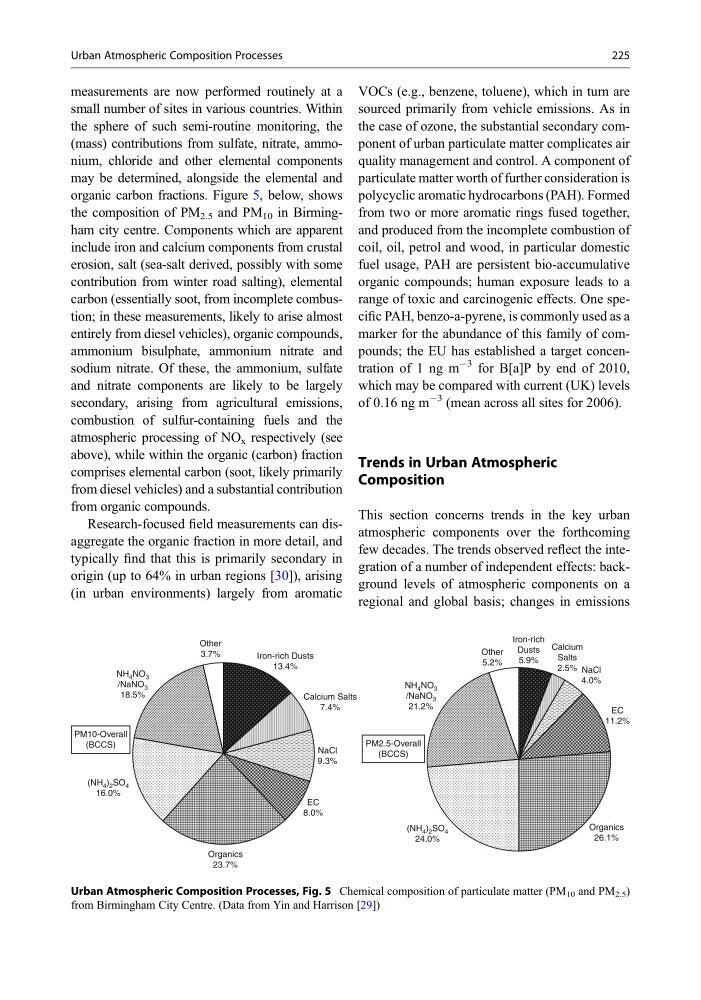
organic carbon fractions. Figure 5, below, shows
the composition of PM 2.5 and PM 10 in Birmingham city centre. Components which are apparent
include iron and calcium components from crustal
erosion, salt (sea-salt derived, possibly with some
contribution from winter road salting), elemental
carbon (essentially soot, from incomplete combustion; in these measurements, likely to arise almost
entirely from diesel vehicles), organic compounds,
ammonium bisulphate, ammonium nitrate and
sodium nitrate. Of these, the ammonium, sulfate
and nitrate components are likely to be largely
secondary, arising from agricultural emissions,
combustion of sulfur-containing fuels and the
atmospheric processing of NO x respectively (see
above), while within the organic (carbon) fraction
comprises elemental carbon (soot, likely primarily
from diesel vehicles) and a substantial contribution
from organic compounds.
Research-focused field measurements can disaggregate the organic fraction in more detail, and
typically find that this is primarily secondary in
origin (up to 64% in urban regions [30]), arising
(in urban environments) largely from aromatic
VOCs (e.g., benzene, toluene), which in turn are
sourced primarily from vehicle emissions. As in
the case of ozone, the substantial secondary component of urban particulate matter complicates air
quality management and control. A component of
particulate matter worth of further consideration is
polycyclic aromatic hydrocarbons (PAH). Formed
from two or more aromatic rings fused together,
and produced from the incomplete combustion of
coil, oil, petrol and wood, in particular domestic
fuel usage, PAH are persistent bio-accumulative
organic compounds; human exposure leads to a
range of toxic and carcinogenic effects. One specific PAH, benzo-a-pyrene, is commonly used as a
marker for the abundance of this family of compounds; the EU has established a target concentration of 1 ng m
À3 for B[a]P by end of 2010,
which may be compared with current (UK) levels
of 0.16 ng m
À3 (mean across all sites for 2006).
Trends in Urban Atmospheric
Composition
This section concerns trends in the key urban
atmospheric components over the forthcoming
few decades. The trends observed reflect the integration of a number of independent effects: background levels of atmospheric components on a
regional and global basis; changes in emissions
Other
3.7%
Other
5.2%
Iron-rich Dusts
13.4%
Iron-rich
Dusts
5.9%
Calcium Salts
7.4%
Calcium
Salts
2.5%
NaCl
9.3%
NaCl
4.0%
EC
8.0%
EC
11.2%
Organics
23.7%
Organics
26.1%
(NH 4 ) 2 SO 4
16.0%
(NH 4 ) 2 SO 4
24.0%
NH 4 NO 3
/NaNO 3
18.5%
NH 4 NO 3
/NaNO 3
21.2%
PM10-Overall
(BCCS)
PM2.5-Overall
(BCCS)
Urban Atmospheric Composition Processes, Fig. 5 Chemical composition of particulate matter (PM 10 and PM 2.5 )
from Birmingham City Centre. (Data from Yin and Harrison [29])
Urban Atmospheric Composition Processes
225
small number of sites in various countries. Within
the sphere of such semi-routine monitoring, the
(mass) contributions from sulfate, nitrate, ammonium, chloride and other elemental components
may be determined, alongside the elemental and
organic carbon fractions. Figure 5, below, shows
the composition of PM 2.5 and PM 10 in Birmingham city centre. Components which are apparent
include iron and calcium components from crustal
erosion, salt (sea-salt derived, possibly with some
contribution from winter road salting), elemental
carbon (essentially soot, from incomplete combustion; in these measurements, likely to arise almost
entirely from diesel vehicles), organic compounds,
ammonium bisulphate, ammonium nitrate and
sodium nitrate. Of these, the ammonium, sulfate
and nitrate components are likely to be largely
secondary, arising from agricultural emissions,
combustion of sulfur-containing fuels and the
atmospheric processing of NO x respectively (see
above), while within the organic (carbon) fraction
comprises elemental carbon (soot, likely primarily
from diesel vehicles) and a substantial contribution
from organic compounds.
Research-focused field measurements can disaggregate the organic fraction in more detail, and
typically find that this is primarily secondary in
origin (up to 64% in urban regions [30]), arising
(in urban environments) largely from aromatic
VOCs (e.g., benzene, toluene), which in turn are
sourced primarily from vehicle emissions. As in
the case of ozone, the substantial secondary component of urban particulate matter complicates air
quality management and control. A component of
particulate matter worth of further consideration is
polycyclic aromatic hydrocarbons (PAH). Formed
from two or more aromatic rings fused together,
and produced from the incomplete combustion of
coil, oil, petrol and wood, in particular domestic
fuel usage, PAH are persistent bio-accumulative
organic compounds; human exposure leads to a
range of toxic and carcinogenic effects. One specific PAH, benzo-a-pyrene, is commonly used as a
marker for the abundance of this family of compounds; the EU has established a target concentration of 1 ng m
À3 for B[a]P by end of 2010,
which may be compared with current (UK) levels
of 0.16 ng m
À3 (mean across all sites for 2006).
Trends in Urban Atmospheric
Composition
This section concerns trends in the key urban
atmospheric components over the forthcoming
few decades. The trends observed reflect the integration of a number of independent effects: background levels of atmospheric components on a
regional and global basis; changes in emissions
Other
3.7%
Other
5.2%
Iron-rich Dusts
13.4%
Iron-rich
Dusts
5.9%
Calcium Salts
7.4%
Calcium
Salts
2.5%
NaCl
9.3%
NaCl
4.0%
EC
8.0%
EC
11.2%
Organics
23.7%
Organics
26.1%
(NH 4 ) 2 SO 4
16.0%
(NH 4 ) 2 SO 4
24.0%
NH 4 NO 3
/NaNO 3
18.5%
NH 4 NO 3
/NaNO 3
21.2%
PM10-Overall
(BCCS)
PM2.5-Overall
(BCCS)
Urban Atmospheric Composition Processes, Fig. 5 Chemical composition of particulate matter (PM 10 and PM 2.5 )
from Birmingham City Centre. (Data from Yin and Harrison [29])
Urban Atmospheric Composition Processes
225