

limiting factor for the highest local air pollution
concentrations and therefore local air quality. The
urban heat island effect may thus be the limiting
factor for the highest pollution concentrations and
thereby air quality parameters in the urban
environment.
Pollutant Dispersion in Urban Streets
Pollution “hot spots” are areas where large concentrations of pollution are emitted or concentrate. In urban areas, trafficked streets are air
pollution hot spots (Fig. 1). The concentration
inside the urban street is generally the result of
two contributions, one from emissions from the
local traffic in the street itself and one from background pollution entering the street canyon from
above roof level [26]:
C ¼ c b þ c s
where c is the concentration in the street, c b the
urban background contribution, and cs the contribution from traffic inside the street itself. The
background contribution arises from two contributions: (1) the contribution from nearby sources
in the urban area (typically this will be the traffic
in surrounding streets) and (2) the regional
(sources within a distance of a few hundred km)
and long-range transport (sources placed up to
thousands of km away) of air pollution.
The pollutant levels in the urban streets are
strongly affected by the emissions from traffic
taking place on the street itself. The concentration
level and the distribution of air pollution inside the
street canyon (the street “boxed in” by buildings
on each side) are largely governed by the surrounding physical conditions. These physical
conditions heavily affect the wind speed and the
wind direction inside the street, with residence
time for an air packet in the vicinity of an urban
street usually on the order of seconds to a few
minutes depending on the street topography. This
means that only very fast chemical conversions of
pollutants have time to take place [26].
The airflow generated inside the streets and
around building obstacles may result in very different
concentration levels at different places in the street.
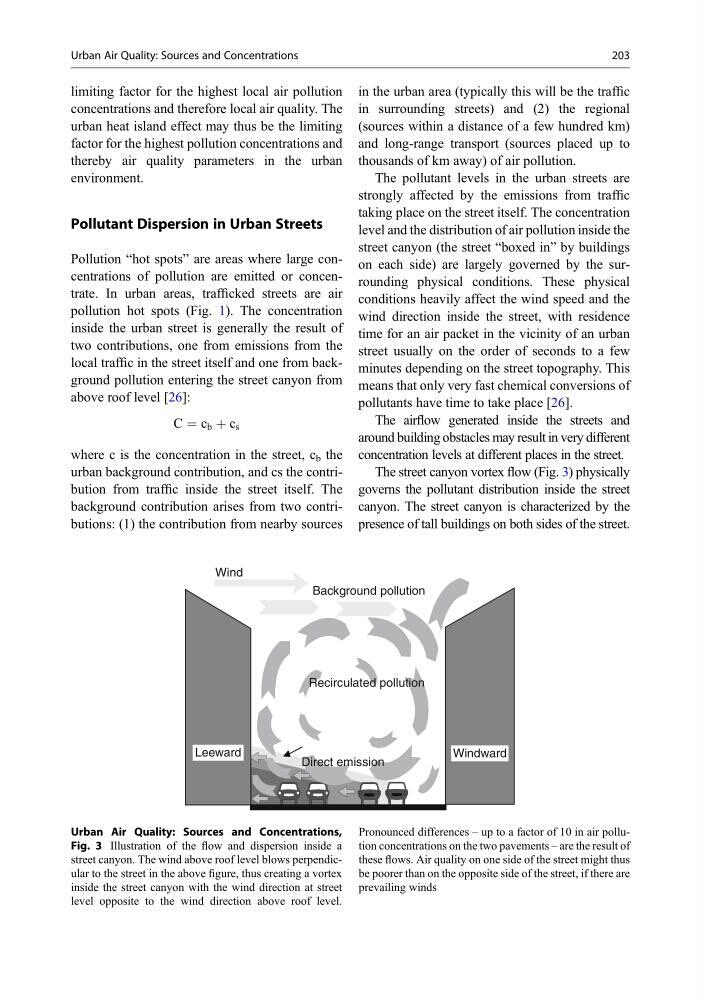
The street canyon vortex flow (Fig. 3) physically
governs the pollutant distribution inside the street
canyon. The street canyon is characterized by the
presence of tall buildings on both sides of the street.
Wind
Leeward
Windward
Recirculated pollution
Direct emission
Background pollution
Urban Air Quality: Sources and Concentrations,
Fig. 3 Illustration of the flow and dispersion inside a
street canyon. The wind above roof level blows perpendicular to the street in the above figure, thus creating a vortex
inside the street canyon with the wind direction at street
level opposite to the wind direction above roof level.
Pronounced differences – up to a factor of 10 in air pollution concentrations on the two pavements – are the result of
these flows. Air quality on one side of the street might thus
be poorer than on the opposite side of the street, if there are
prevailing winds
Urban Air Quality: Sources and Concentrations
203
concentrations and therefore local air quality. The
urban heat island effect may thus be the limiting
factor for the highest pollution concentrations and
thereby air quality parameters in the urban
environment.
Pollutant Dispersion in Urban Streets
Pollution “hot spots” are areas where large concentrations of pollution are emitted or concentrate. In urban areas, trafficked streets are air
pollution hot spots (Fig. 1). The concentration
inside the urban street is generally the result of
two contributions, one from emissions from the
local traffic in the street itself and one from background pollution entering the street canyon from
above roof level [26]:
C ¼ c b þ c s
where c is the concentration in the street, c b the
urban background contribution, and cs the contribution from traffic inside the street itself. The
background contribution arises from two contributions: (1) the contribution from nearby sources
in the urban area (typically this will be the traffic
in surrounding streets) and (2) the regional
(sources within a distance of a few hundred km)
and long-range transport (sources placed up to
thousands of km away) of air pollution.
The pollutant levels in the urban streets are
strongly affected by the emissions from traffic
taking place on the street itself. The concentration
level and the distribution of air pollution inside the
street canyon (the street “boxed in” by buildings
on each side) are largely governed by the surrounding physical conditions. These physical
conditions heavily affect the wind speed and the
wind direction inside the street, with residence
time for an air packet in the vicinity of an urban
street usually on the order of seconds to a few
minutes depending on the street topography. This
means that only very fast chemical conversions of
pollutants have time to take place [26].
The airflow generated inside the streets and
around building obstacles may result in very different
concentration levels at different places in the street.
The street canyon vortex flow (Fig. 3) physically
governs the pollutant distribution inside the street
canyon. The street canyon is characterized by the
presence of tall buildings on both sides of the street.
Wind
Leeward
Windward
Recirculated pollution
Direct emission
Background pollution
Urban Air Quality: Sources and Concentrations,
Fig. 3 Illustration of the flow and dispersion inside a
street canyon. The wind above roof level blows perpendicular to the street in the above figure, thus creating a vortex
inside the street canyon with the wind direction at street
level opposite to the wind direction above roof level.
Pronounced differences – up to a factor of 10 in air pollution concentrations on the two pavements – are the result of
these flows. Air quality on one side of the street might thus
be poorer than on the opposite side of the street, if there are
prevailing winds
Urban Air Quality: Sources and Concentrations
203