

because they may not stay on the surface long
enough to react. Once a molecule is on the surface, it is degraded by a heterogeneous chemical
reaction. In addition, because of atmospheric
humidity, mineral surfaces like TiO 2 will be covered with water. The thickness of the water layer
depends on relative humidity; at low humidities, a
hydrogen-bound layer and a layer, several monolayers thick, of quasi-crystalline water will be
present. At higher humidities, a layer of water
with properties resembling bulk water will be
present. First TiO 2 is photoexcited, yielding an
electron (e
À ), and a corresponding hole in the
valence band (h
+ )
TiO 2 þ hv ! e
À
þ h
þ
The electron may react with dissolved O 2 ,
forming superoxide O 2
À
. In aqueous solution,
O 2
À is in equilibrium with HO 2 and OH-; superoxide has a pKa value of 4.8, so, e.g., at neutral
pH, most is in the superoxide form. Under suitable
conditions, HO 2 will react with itself to form
hydrogen peroxide (H 2 O 2 ). The electron hole h
+
will oxidize water, producing hydroxyl radicals:
h
þ
þ H 2 O ads
ð Þ ! OH þ H
þ
The hydroxyl radicals reacts with many pollutants to form products which are then desorbed and
re-emitted into the ambient air [90]:
OH þ VOC ! Intermediates ! Final products
Photocatalytic paints containing TiO 2 have
been shown to remove VOCs, including xylene,
and NO 2 , both of which are known to have negative health impacts. However, photocatalytic paints
Indoor Air Quality:
Status and Standards,
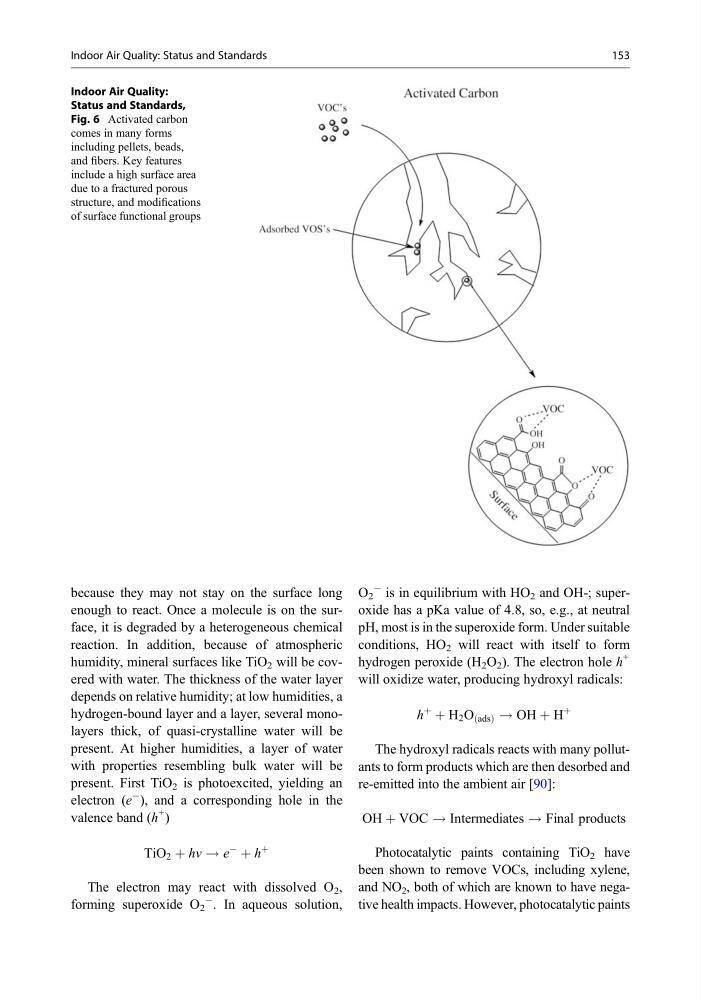
Fig. 6 Activated carbon
comes in many forms
including pellets, beads,
and fibers. Key features
include a high surface area
due to a fractured porous
structure, and modifications
of surface functional groups
Indoor Air Quality: Status and Standards
153
enough to react. Once a molecule is on the surface, it is degraded by a heterogeneous chemical
reaction. In addition, because of atmospheric
humidity, mineral surfaces like TiO 2 will be covered with water. The thickness of the water layer
depends on relative humidity; at low humidities, a
hydrogen-bound layer and a layer, several monolayers thick, of quasi-crystalline water will be
present. At higher humidities, a layer of water
with properties resembling bulk water will be
present. First TiO 2 is photoexcited, yielding an
electron (e
À ), and a corresponding hole in the
valence band (h
+ )
TiO 2 þ hv ! e
À
þ h
þ
The electron may react with dissolved O 2 ,
forming superoxide O 2
À
. In aqueous solution,
O 2
À is in equilibrium with HO 2 and OH-; superoxide has a pKa value of 4.8, so, e.g., at neutral
pH, most is in the superoxide form. Under suitable
conditions, HO 2 will react with itself to form
hydrogen peroxide (H 2 O 2 ). The electron hole h
+
will oxidize water, producing hydroxyl radicals:
h
þ
þ H 2 O ads
ð Þ ! OH þ H
þ
The hydroxyl radicals reacts with many pollutants to form products which are then desorbed and
re-emitted into the ambient air [90]:
OH þ VOC ! Intermediates ! Final products
Photocatalytic paints containing TiO 2 have
been shown to remove VOCs, including xylene,
and NO 2 , both of which are known to have negative health impacts. However, photocatalytic paints
Indoor Air Quality:
Status and Standards,
Fig. 6 Activated carbon
comes in many forms
including pellets, beads,
and fibers. Key features
include a high surface area
due to a fractured porous
structure, and modifications
of surface functional groups
Indoor Air Quality: Status and Standards
153