

example, for particle sizes larger than the fiber
diameter, the single-fiber efficiency derived
using interception is not correct. The relationship
between particle size and filtration efficiency can
be quantified using the MPPS. Many studies
found that a particle size of around 100–300 nm
is usually the MPPS [38, 55] (Fig. 4g). It has been
also found that the MPPS changes when the face
velocity changes. Sambaer et al. have shown that
with an increase of the face velocity, the MPPS
decreases (Fig. 4h) [31].
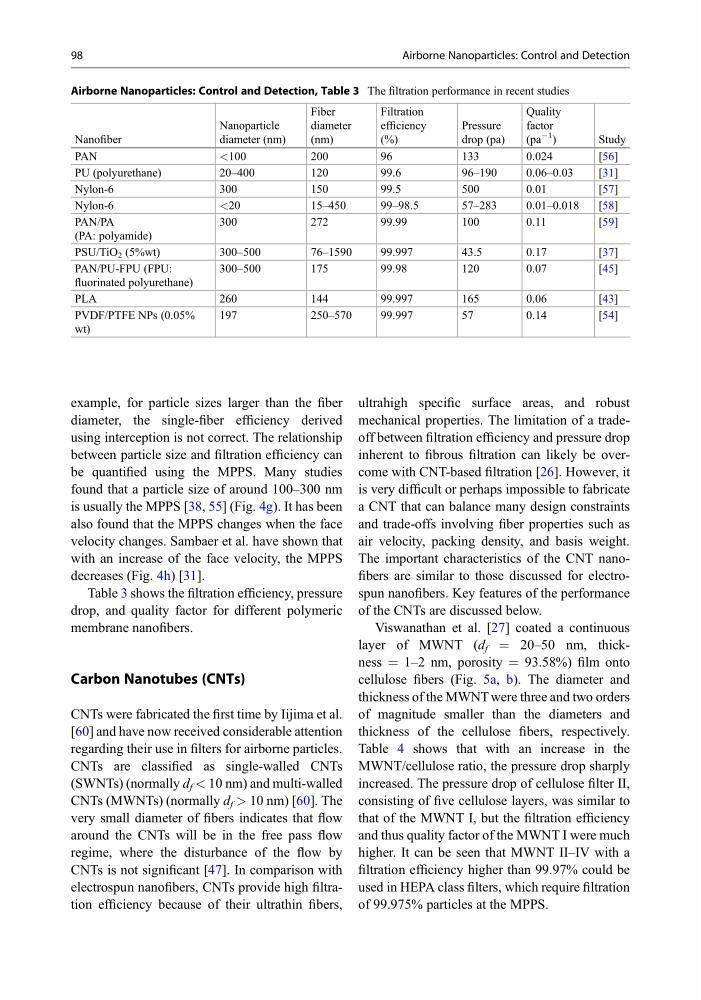
Table 3 shows the filtration efficiency, pressure
drop, and quality factor for different polymeric
membrane nanofibers.
Carbon Nanotubes (CNTs)
CNTs were fabricated the first time by Iijima et al.
[60] and have now received considerable attention
regarding their use in filters for airborne particles.
CNTs are classified as single-walled CNTs
(SWNTs) (normally d f < 10 nm) and multi-walled
CNTs (MWNTs) (normally d f > 10 nm) [60]. The
very small diameter of fibers indicates that flow
around the CNTs will be in the free pass flow
regime, where the disturbance of the flow by
CNTs is not significant [47]. In comparison with
electrospun nanofibers, CNTs provide high filtration efficiency because of their ultrathin fibers,
ultrahigh specific surface areas, and robust
mechanical properties. The limitation of a tradeoff between filtration efficiency and pressure drop
inherent to fibrous filtration can likely be overcome with CNT-based filtration [26]. However, it
is very difficult or perhaps impossible to fabricate
a CNT that can balance many design constraints
and trade-offs involving fiber properties such as
air velocity, packing density, and basis weight.
The important characteristics of the CNT nanofibers are similar to those discussed for electrospun nanofibers. Key features of the performance
of the CNTs are discussed below.
Viswanathan et al. [27] coated a continuous
layer of MWNT (d f ¼ 20–50 nm, thickness ¼ 1–2 nm, porosity ¼ 93.58%) film onto
cellulose fibers (Fig. 5a, b). The diameter and
thickness of the MWNT were three and two orders
of magnitude smaller than the diameters and
thickness of the cellulose fibers, respectively.
Table 4 shows that with an increase in the
MWNT/cellulose ratio, the pressure drop sharply
increased. The pressure drop of cellulose filter II,
consisting of five cellulose layers, was similar to
that of the MWNT I, but the filtration efficiency
and thus quality factor of the MWNT I were much
higher. It can be seen that MWNT II–IV with a
filtration efficiency higher than 99.97% could be
used in HEPA class filters, which require filtration
of 99.975% particles at the MPPS.
Airborne Nanoparticles: Control and Detection, Table 3 The filtration performance in recent studies
Nanofiber
Nanoparticle
diameter (nm)
Fiber
diameter
(nm)
Filtration
efficiency
(%)
Pressure
drop (pa)
Quality
factor
(pa
À1
)
Study
PAN
<100
200
96
133
0.024
[56]
PU (polyurethane)
20–400
120
99.6
96–190
0.06–0.03
[31]
Nylon-6
300
150
99.5
500
0.01
[57]
Nylon-6
<20
15–450
99–98.5
57–283
0.01–0.018
[58]
PAN/PA
(PA: polyamide)
300
272
99.99
100
0.11
[59]
PSU/TiO 2 (5%wt)
300–500
76–1590
99.997
43.5
0.17
[37]
PAN/PU-FPU (FPU:
fluorinated polyurethane)
300–500
175
99.98
120
0.07
[45]
PLA
260
144
99.997
165
0.06
[43]
PVDF/PTFE NPs (0.05%
wt)
197
250–570
99.997
57
0.14
[54]
98
Airborne Nanoparticles: Control and Detection
diameter, the single-fiber efficiency derived
using interception is not correct. The relationship
between particle size and filtration efficiency can
be quantified using the MPPS. Many studies
found that a particle size of around 100–300 nm
is usually the MPPS [38, 55] (Fig. 4g). It has been
also found that the MPPS changes when the face
velocity changes. Sambaer et al. have shown that
with an increase of the face velocity, the MPPS
decreases (Fig. 4h) [31].
Table 3 shows the filtration efficiency, pressure
drop, and quality factor for different polymeric
membrane nanofibers.
Carbon Nanotubes (CNTs)
CNTs were fabricated the first time by Iijima et al.
[60] and have now received considerable attention
regarding their use in filters for airborne particles.
CNTs are classified as single-walled CNTs
(SWNTs) (normally d f < 10 nm) and multi-walled
CNTs (MWNTs) (normally d f > 10 nm) [60]. The
very small diameter of fibers indicates that flow
around the CNTs will be in the free pass flow
regime, where the disturbance of the flow by
CNTs is not significant [47]. In comparison with
electrospun nanofibers, CNTs provide high filtration efficiency because of their ultrathin fibers,
ultrahigh specific surface areas, and robust
mechanical properties. The limitation of a tradeoff between filtration efficiency and pressure drop
inherent to fibrous filtration can likely be overcome with CNT-based filtration [26]. However, it
is very difficult or perhaps impossible to fabricate
a CNT that can balance many design constraints
and trade-offs involving fiber properties such as
air velocity, packing density, and basis weight.
The important characteristics of the CNT nanofibers are similar to those discussed for electrospun nanofibers. Key features of the performance
of the CNTs are discussed below.
Viswanathan et al. [27] coated a continuous
layer of MWNT (d f ¼ 20–50 nm, thickness ¼ 1–2 nm, porosity ¼ 93.58%) film onto
cellulose fibers (Fig. 5a, b). The diameter and
thickness of the MWNT were three and two orders
of magnitude smaller than the diameters and
thickness of the cellulose fibers, respectively.
Table 4 shows that with an increase in the
MWNT/cellulose ratio, the pressure drop sharply
increased. The pressure drop of cellulose filter II,
consisting of five cellulose layers, was similar to
that of the MWNT I, but the filtration efficiency
and thus quality factor of the MWNT I were much
higher. It can be seen that MWNT II–IV with a
filtration efficiency higher than 99.97% could be
used in HEPA class filters, which require filtration
of 99.975% particles at the MPPS.
Airborne Nanoparticles: Control and Detection, Table 3 The filtration performance in recent studies
Nanofiber
Nanoparticle
diameter (nm)
Fiber
diameter
(nm)
Filtration
efficiency
(%)
Pressure
drop (pa)
Quality
factor
(pa
À1
)
Study
PAN
<100
200
96
133
0.024
[56]
PU (polyurethane)
20–400
120
99.6
96–190
0.06–0.03
[31]
Nylon-6
300
150
99.5
500
0.01
[57]
Nylon-6
<20
15–450
99–98.5
57–283
0.01–0.018
[58]
PAN/PA
(PA: polyamide)
300
272
99.99
100
0.11
[59]
PSU/TiO 2 (5%wt)
300–500
76–1590
99.997
43.5
0.17
[37]
PAN/PU-FPU (FPU:
fluorinated polyurethane)
300–500
175
99.98
120
0.07
[45]
PLA
260
144
99.997
165
0.06
[43]
PVDF/PTFE NPs (0.05%
wt)
197
250–570
99.997
57
0.14
[54]
98
Airborne Nanoparticles: Control and Detection