

6
%
[
1
1 [
6
\
) \
6
)
[
1
1 [
6
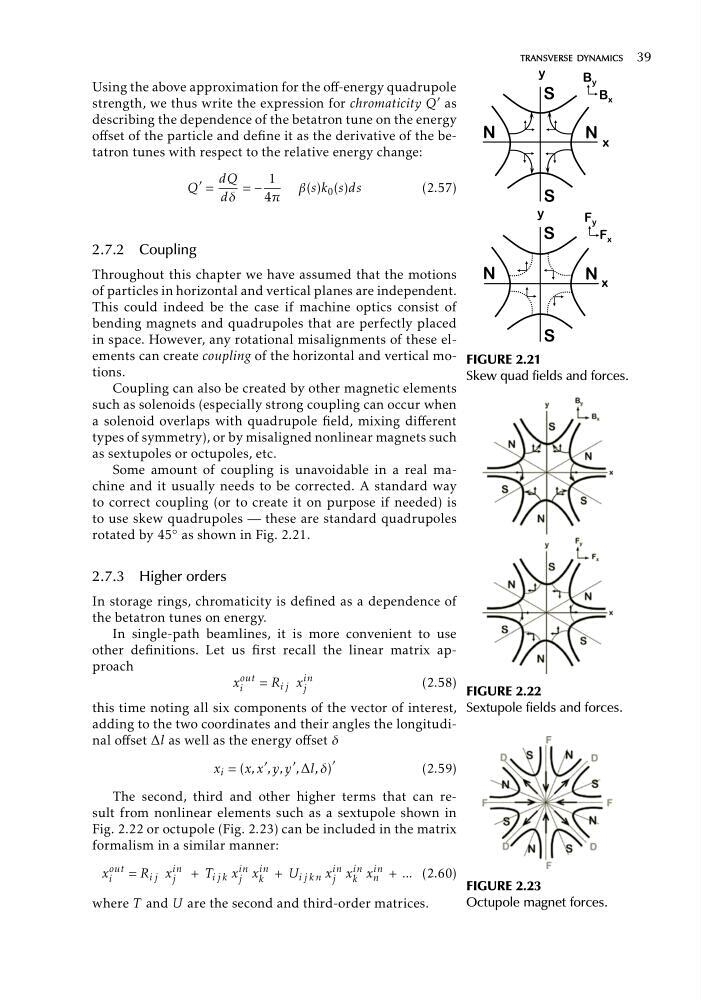
FIGURE 2.21
Skew quad fields and forces.
\
% \
Using the above approximation for the off-energy quadrupole
strength, we thus write the expression for chromaticity Q ' as
describing the dependence of the betatron tune on the energy
offset of the particle and define it as the derivative of the betatron tunes with respect to the relative energy change:
'
dQ
1
Q =
= −
β(s)k
4
0 (s)ds
(2.57)
dδ
π
2.7.2 Coupling
Throughout this chapter we have assumed that the motions
of particles in horizontal and vertical planes are independent.
This could indeed be the case if machine optics consist of
bending magnets and quadrupoles that are perfectly placed
in space. However, any rotational misalignments of these elements can create coupling of the horizontal and vertical motions.
Coupling can also be created by other magnetic elements
such as solenoids (especially strong coupling can occur when
a solenoid overlaps with quadrupole field, mixing different
types of symmetry), or by misaligned nonlinear magnets such
as sextupoles or octupoles, etc.
Some amount of coupling is unavoidable in a real machine and it usually needs to be corrected. A standard way
to correct coupling (or to create it on purpose if needed) is
to use skew quadrupoles — these are standard quadrupoles
rotated by 45 ◦ as shown in Fig. 2.21.
2.7.3 Higher orders
In storage rings, chromaticity is defined as a dependence of
the betatron tunes on energy.
In single-path beamlines, it is more convenient to use
other definitions. Let us first recall the linear matrix approach
x
out
i
=
x
in
R i j j
(2.58) FIGURE 2.22
this time noting all six components of the vector of interest, Sextupole fields and forces.
adding to the two coordinates and their angles the longitudinal offset Δl as well as the energy offset δ
'
x i = (x, x
' ,y,y , Δl, δ)
'
(2.59)
The second, third and other higher terms that can result from nonlinear elements such as a sextupole shown in
Fig. 2.22 or octupole (Fig. 2.23) can be included in the matrix
formalism in a similar manner:
out
in
x i = R
in in
in in in
i j x j + T i j k x x + U i j k n
j
k
x j x k x n + ... (2.60)
FIGURE 2.23
where T and U are the second and third-order matrices.
Octupole magnet forces.
transverse dynamics 39
%
[
1
1 [
6
\
) \
6
)
[
1
1 [
6
FIGURE 2.21
Skew quad fields and forces.
\
% \
Using the above approximation for the off-energy quadrupole
strength, we thus write the expression for chromaticity Q ' as
describing the dependence of the betatron tune on the energy
offset of the particle and define it as the derivative of the betatron tunes with respect to the relative energy change:
'
dQ
1
Q =
= −
β(s)k
4
0 (s)ds
(2.57)
dδ
π
2.7.2 Coupling
Throughout this chapter we have assumed that the motions
of particles in horizontal and vertical planes are independent.
This could indeed be the case if machine optics consist of
bending magnets and quadrupoles that are perfectly placed
in space. However, any rotational misalignments of these elements can create coupling of the horizontal and vertical motions.
Coupling can also be created by other magnetic elements
such as solenoids (especially strong coupling can occur when
a solenoid overlaps with quadrupole field, mixing different
types of symmetry), or by misaligned nonlinear magnets such
as sextupoles or octupoles, etc.
Some amount of coupling is unavoidable in a real machine and it usually needs to be corrected. A standard way
to correct coupling (or to create it on purpose if needed) is
to use skew quadrupoles — these are standard quadrupoles
rotated by 45 ◦ as shown in Fig. 2.21.
2.7.3 Higher orders
In storage rings, chromaticity is defined as a dependence of
the betatron tunes on energy.
In single-path beamlines, it is more convenient to use
other definitions. Let us first recall the linear matrix approach
x
out
i
=
x
in
R i j j
(2.58) FIGURE 2.22
this time noting all six components of the vector of interest, Sextupole fields and forces.
adding to the two coordinates and their angles the longitudinal offset Δl as well as the energy offset δ
'
x i = (x, x
' ,y,y , Δl, δ)
'
(2.59)
The second, third and other higher terms that can result from nonlinear elements such as a sextupole shown in
Fig. 2.22 or octupole (Fig. 2.23) can be included in the matrix
formalism in a similar manner:
out
in
x i = R
in in
in in in
i j x j + T i j k x x + U i j k n
j
k
x j x k x n + ... (2.60)
FIGURE 2.23
where T and U are the second and third-order matrices.
Octupole magnet forces.
transverse dynamics 39