

36 unifying physics of accelerators, lasers and plasma
2
2
tan
/
/
/
/
Area
FIGURE 2.17
Evolution of phase-space ellipse. Locations: (a) in D and
(c) in F quadrupoles, and (b)
in between.
FIGURE 2.18
Bending magnet creates dispersion.
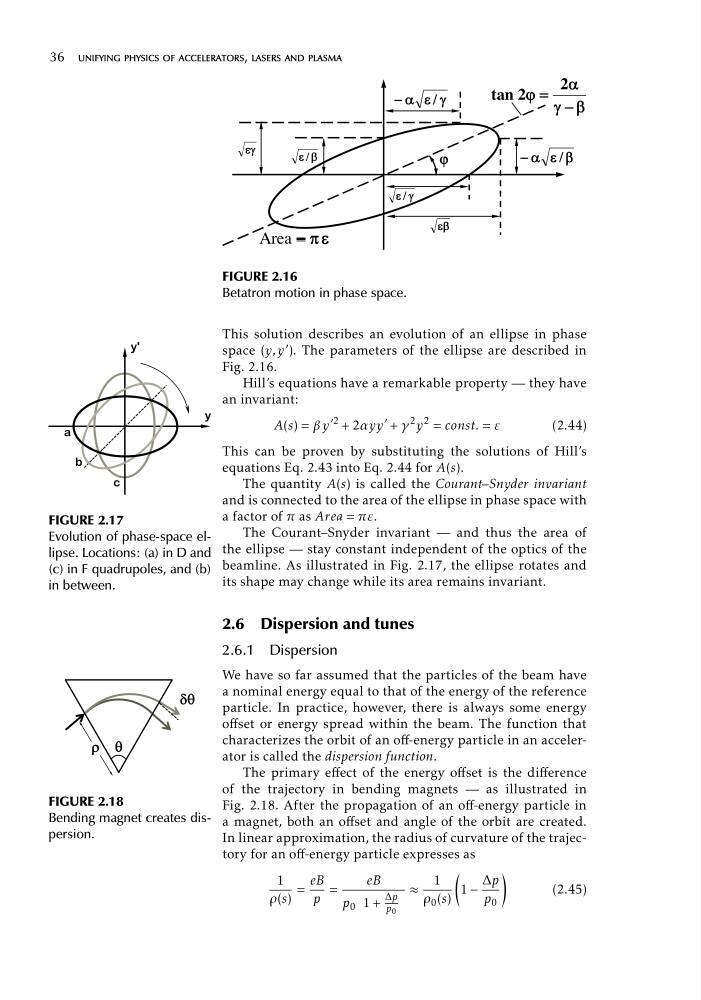
FIGURE 2.16
Betatron motion in phase space.
This solution describes an evolution of an ellipse in phase
space (y, y ' ). The parameters of the ellipse are described in
Fig. 2.16.
Hill’s equations have a remarkable property — they have
an invariant:
2
A(s) = β y
'2 + 2αyy
' + γ
2 y = const. = ε
(2.44)
This can be proven by substituting the solutions of Hill’s
equations Eq. 2.43 into Eq. 2.44 for A(s).
The quantity A(s) is called the Courant–Snyder invariant
and is connected to the area of the ellipse in phase space with
a factor of π as Area = πε.
The Courant–Snyder invariant — and thus the area of
the ellipse — stay constant independent of the optics of the
beamline. As illustrated in Fig. 2.17, the ellipse rotates and
its shape may change while its area remains invariant.
2.6 Dispersion and tunes
2.6.1 Dispersion
We have so far assumed that the particles of the beam have
a nominal energy equal to that of the energy of the reference
particle. In practice, however, there is always some energy
offset or energy spread within the beam. The function that
characterizes the orbit of an off-energy particle in an accelerator is called the dispersion function.
The primary effect of the energy offset is the difference
of the trajectory in bending magnets — as illustrated in
Fig. 2.18. After the propagation of an off-energy particle in
a magnet, both an offset and angle of the orbit are created.
In linear approximation, the radius of curvature of the trajectory for an off-energy particle expresses as
(
)
1
eB
eB
1
Δp
=
=
≈
1 −
(2.45)
ρ(s)
p
p 0 1 +
Δp
ρ 0 (s)
p 0
p 0
2
2
tan
/
/
/
/
Area
FIGURE 2.17
Evolution of phase-space ellipse. Locations: (a) in D and
(c) in F quadrupoles, and (b)
in between.
FIGURE 2.18
Bending magnet creates dispersion.
FIGURE 2.16
Betatron motion in phase space.
This solution describes an evolution of an ellipse in phase
space (y, y ' ). The parameters of the ellipse are described in
Fig. 2.16.
Hill’s equations have a remarkable property — they have
an invariant:
2
A(s) = β y
'2 + 2αyy
' + γ
2 y = const. = ε
(2.44)
This can be proven by substituting the solutions of Hill’s
equations Eq. 2.43 into Eq. 2.44 for A(s).
The quantity A(s) is called the Courant–Snyder invariant
and is connected to the area of the ellipse in phase space with
a factor of π as Area = πε.
The Courant–Snyder invariant — and thus the area of
the ellipse — stay constant independent of the optics of the
beamline. As illustrated in Fig. 2.17, the ellipse rotates and
its shape may change while its area remains invariant.
2.6 Dispersion and tunes
2.6.1 Dispersion
We have so far assumed that the particles of the beam have
a nominal energy equal to that of the energy of the reference
particle. In practice, however, there is always some energy
offset or energy spread within the beam. The function that
characterizes the orbit of an off-energy particle in an accelerator is called the dispersion function.
The primary effect of the energy offset is the difference
of the trajectory in bending magnets — as illustrated in
Fig. 2.18. After the propagation of an off-energy particle in
a magnet, both an offset and angle of the orbit are created.
In linear approximation, the radius of curvature of the trajectory for an off-energy particle expresses as
(
)
1
eB
eB
1
Δp
=
=
≈
1 −
(2.45)
ρ(s)
p
p 0 1 +
Δp
ρ 0 (s)
p 0
p 0