

;
S (s 0 ) = 1 S
' (s 0 ) = 1; sine−like solution
The general solution can then be written as a linear combination of the principal trajectories
y( s) = y 0 C(s) + y
'
0 S(s)
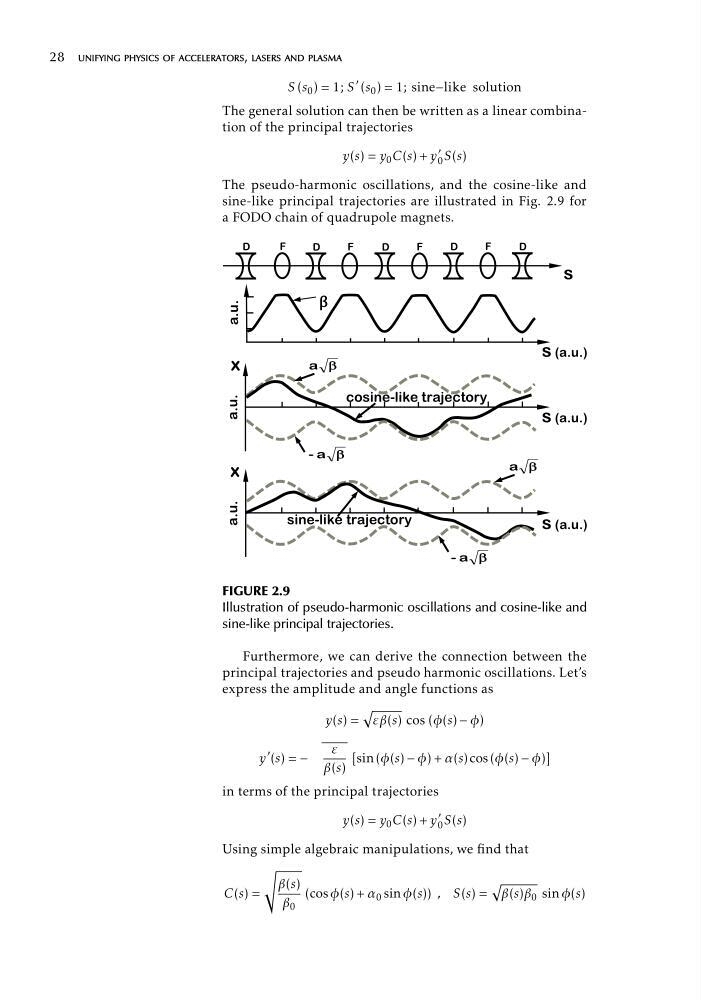
The pseudo-harmonic oscillations, and the cosine-like and
sine-like principal trajectories are illustrated in Fig. 2.9 for
a FODO chain of quadrupole magnets.
'
)
'
)
'
)
'
)
'
V
X
D
VDX
[
D
X
FRVLQHOLNHWUDMHFWRU\
D
VDX
D
[
D
X
D
VLQHOLNHWUDMHFWRU\
VDX
D
FIGURE 2.9
Illustration of pseudo-harmonic oscillations and cosine-like and
sine-like principal trajectories.
Furthermore,
principal trajectories and pseudo harmonic oscillations. Let’s
express the amplitude and angle functions as
y(s) =
.
εβ(s) cos (φ(s) − φ)
ε
y
' (s) = −
[sin (φ(s) − φ) + α(s) cos (φ(s) − φ)]
β(s)
in terms of the principal trajectories
y(s) = y 0 C( ) +
s y
'
0 S(s)
Using simple algebraic manipulations, we find that
(
β(s)
C s) =
(cos φ(s) + α 0 sin φ(s)) , S(s) =
.
β(s)β 0 sin φ(s)
β 0
we can derive the connection between the
28 unifying physics of accelerators, lasers and plasma
S (s 0 ) = 1 S
' (s 0 ) = 1; sine−like solution
The general solution can then be written as a linear combination of the principal trajectories
y( s) = y 0 C(s) + y
'
0 S(s)
The pseudo-harmonic oscillations, and the cosine-like and
sine-like principal trajectories are illustrated in Fig. 2.9 for
a FODO chain of quadrupole magnets.
'
)
'
)
'
)
'
)
'
V
X
D
VDX
[
D
X
FRVLQHOLNHWUDMHFWRU\
D
VDX
D
[
D
X
D
VLQHOLNHWUDMHFWRU\
VDX
D
FIGURE 2.9
Illustration of pseudo-harmonic oscillations and cosine-like and
sine-like principal trajectories.
Furthermore,
principal trajectories and pseudo harmonic oscillations. Let’s
express the amplitude and angle functions as
y(s) =
.
εβ(s) cos (φ(s) − φ)
ε
y
' (s) = −
[sin (φ(s) − φ) + α(s) cos (φ(s) − φ)]
β(s)
in terms of the principal trajectories
y(s) = y 0 C( ) +
s y
'
0 S(s)
Using simple algebraic manipulations, we find that
(
β(s)
C s) =
(cos φ(s) + α 0 sin φ(s)) , S(s) =
.
β(s)β 0 sin φ(s)
β 0
we can derive the connection between the
28 unifying physics of accelerators, lasers and plasma