

basics of accelerators and of the art of inventiveness 11
The beauty of the TRIZ method is also illustrated by the
fact that the entire field of engineering can be described by
the TRIZ contradiction matrix using only 39 parameters, and
that the number of TRIZ inventive principles is also remarkably small — only 40.
The second step of the TRIZ algorithm involves checking 4
the TRIZ matrix for this pair of contradicting parameters and
then identifying the relevant, in this case, inventive principles.
Having identified the necessary inventive principles, we
are ready for the third and final step of the TRIZ algorithm
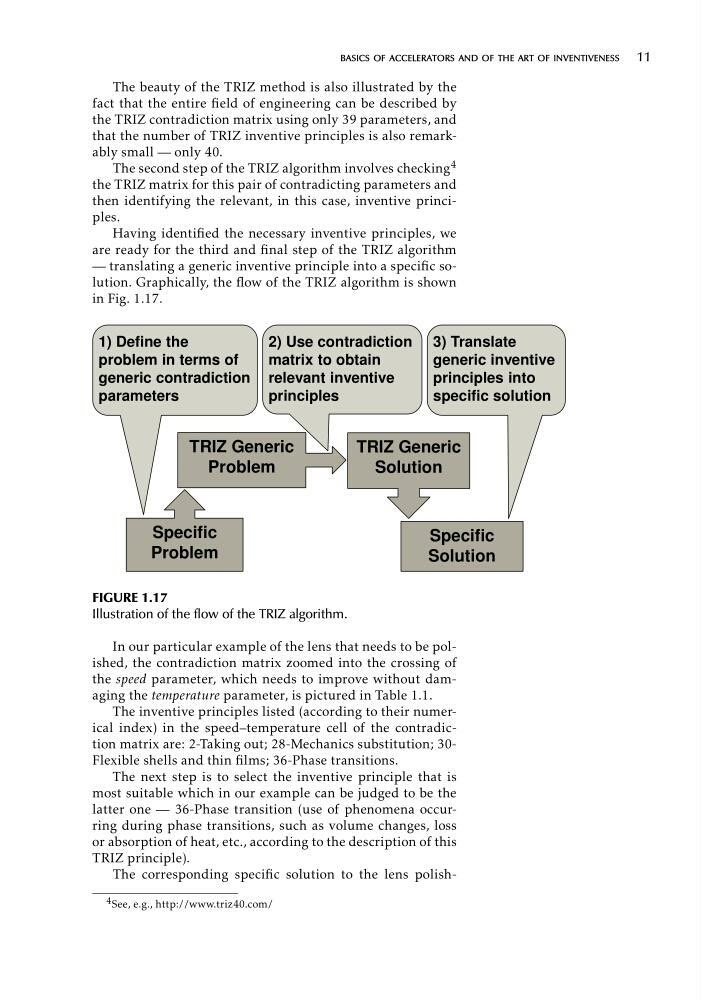
— translating a generic inventive principle into a specific solution. Graphically, the flow of the TRIZ algorithm is shown
in Fig. 1.17.
Specific
Problem
TRIZ Generic
Problem
TRIZ Generic
Solution
Specific
Solution
1) Define the
problem in terms of
generic contradiction
parameters
3) Translate
generic inventive
principles into
specific solution
2) Use contradiction
matrix to obtain
relevant inventive
principles
FIGURE 1.17
Illustration of the flow of the TRIZ algorithm.
In our particular example of the lens that needs to be polished, the contradiction matrix zoomed into the crossing of
the speed parameter, which needs to improve without damaging the temperature parameter, is pictured in Table 1.1.
The inventive principles listed (according to their numerical index) in the speed–temperature cell of the contradiction matrix are: 2-Taking out; 28-Mechanics substitution; 30Flexible shells and thin films; 36-Phase transitions.
The next step is to select the inventive principle that is
most suitable which in our example can be judged to be the
latter one — 36-Phase transition (use of phenomena occurring during phase transitions, such as volume changes, loss
or absorption of heat, etc., according to the description of this
TRIZ principle).
The corresponding specific solution to the lens polish4 See, e.g., http://www.triz40.com/
The beauty of the TRIZ method is also illustrated by the
fact that the entire field of engineering can be described by
the TRIZ contradiction matrix using only 39 parameters, and
that the number of TRIZ inventive principles is also remarkably small — only 40.
The second step of the TRIZ algorithm involves checking 4
the TRIZ matrix for this pair of contradicting parameters and
then identifying the relevant, in this case, inventive principles.
Having identified the necessary inventive principles, we
are ready for the third and final step of the TRIZ algorithm
— translating a generic inventive principle into a specific solution. Graphically, the flow of the TRIZ algorithm is shown
in Fig. 1.17.
Specific
Problem
TRIZ Generic
Problem
TRIZ Generic
Solution
Specific
Solution
1) Define the
problem in terms of
generic contradiction
parameters
3) Translate
generic inventive
principles into
specific solution
2) Use contradiction
matrix to obtain
relevant inventive
principles
FIGURE 1.17
Illustration of the flow of the TRIZ algorithm.
In our particular example of the lens that needs to be polished, the contradiction matrix zoomed into the crossing of
the speed parameter, which needs to improve without damaging the temperature parameter, is pictured in Table 1.1.
The inventive principles listed (according to their numerical index) in the speed–temperature cell of the contradiction matrix are: 2-Taking out; 28-Mechanics substitution; 30Flexible shells and thin films; 36-Phase transitions.
The next step is to select the inventive principle that is
most suitable which in our example can be judged to be the
latter one — 36-Phase transition (use of phenomena occurring during phase transitions, such as volume changes, loss
or absorption of heat, etc., according to the description of this
TRIZ principle).
The corresponding specific solution to the lens polish4 See, e.g., http://www.triz40.com/