

basics of accelerators and of the art of inventiveness 9
synectics, was introduced by George Prince and William Gordon in an attempt to improve brainstorming. One of the main
feature of synectics is that it is assumed to be practiced by a
permanent group of experts, whose members, with time, become less sensitive to critics from among their peers and thus
become more efficient in inventing. This method emphasized
the importance of seeing familiarity in an unknown and vice
versa, which helps to solve new and unfamiliar problems using known methods. The authors of synectics stressed the importance of approaching a problem with a fresh gaze, and
also stressed the use of analogies to generate this attitude.
The analogies employed by synectics can be direct (any
analogy, e.g., from nature), emphatic (attempting to look at
the problem by identifying yourself with the object), symbolic (finding a short symbolic description of the problem
and the object), or even metaphorical (describing the problem in terms of fairy-tales and legends).
Synectics is still a variation of the exhaustive search
method and is in fact the limit of what can be achieved, maintaining the brute force method of an exhaustive search.
There must, then, be a better inventive approach free from
the irrationality of synectics. Indeed, why would one employ
analogies and metaphors and other irrational factors in order
to come to a formula — the action has to happen itself — a natural and universal inventive formula of an ideal invention?
Such a formula (which means that the action needed to solve
the problem should happen by itself, i.e., without introducing any additional systems) should indeed be programmed
into the process of any inventive solution, aimed at an appropriately selected part of the object, and with precise identification of the physical contradiction and intended physical action. These features are the characteristics of TRIZ, the
powerful inventive method described in the next section.
1.5 TRIZ method
The abbreviation TRIZ (pronounced [treez]) can be translated
as the Theory of Inventive Problem Solving. TRIZ was developed by Genrikh Altshuller in the Soviet Union in the mid20th century. The author, while working in the patent office
since 1946, analyzed many thousands of patents, trying to
discover patterns to identify what makes a patent successful.
Between 1956 and 1985, following his work in the patent
office, Altshuller formulated TRIZ and, together with his
team of supporters, developed it further.
Altshuller and his team devised four key constructs of the
TRIZ methodology:
• The same problems and solutions appear again and again
but in different industries.
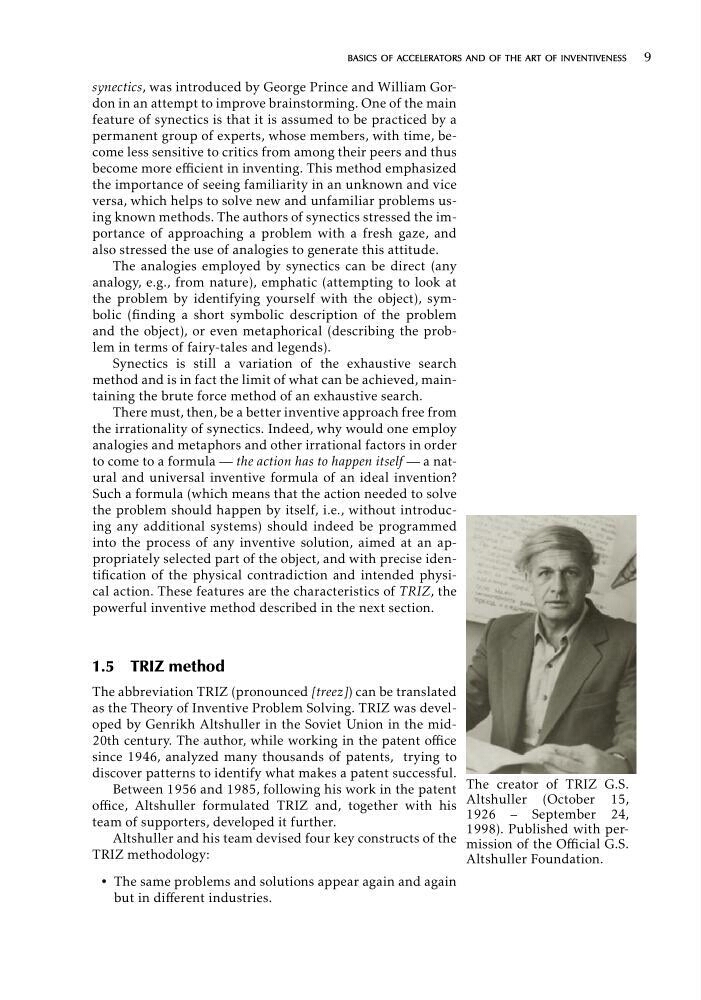
The creator of TRIZ G.S.
Altshuller (October 15,
1926 – September 24,
1998). Published with permission of the Official G.S.
Altshuller Foundation.
synectics, was introduced by George Prince and William Gordon in an attempt to improve brainstorming. One of the main
feature of synectics is that it is assumed to be practiced by a
permanent group of experts, whose members, with time, become less sensitive to critics from among their peers and thus
become more efficient in inventing. This method emphasized
the importance of seeing familiarity in an unknown and vice
versa, which helps to solve new and unfamiliar problems using known methods. The authors of synectics stressed the importance of approaching a problem with a fresh gaze, and
also stressed the use of analogies to generate this attitude.
The analogies employed by synectics can be direct (any
analogy, e.g., from nature), emphatic (attempting to look at
the problem by identifying yourself with the object), symbolic (finding a short symbolic description of the problem
and the object), or even metaphorical (describing the problem in terms of fairy-tales and legends).
Synectics is still a variation of the exhaustive search
method and is in fact the limit of what can be achieved, maintaining the brute force method of an exhaustive search.
There must, then, be a better inventive approach free from
the irrationality of synectics. Indeed, why would one employ
analogies and metaphors and other irrational factors in order
to come to a formula — the action has to happen itself — a natural and universal inventive formula of an ideal invention?
Such a formula (which means that the action needed to solve
the problem should happen by itself, i.e., without introducing any additional systems) should indeed be programmed
into the process of any inventive solution, aimed at an appropriately selected part of the object, and with precise identification of the physical contradiction and intended physical action. These features are the characteristics of TRIZ, the
powerful inventive method described in the next section.
1.5 TRIZ method
The abbreviation TRIZ (pronounced [treez]) can be translated
as the Theory of Inventive Problem Solving. TRIZ was developed by Genrikh Altshuller in the Soviet Union in the mid20th century. The author, while working in the patent office
since 1946, analyzed many thousands of patents, trying to
discover patterns to identify what makes a patent successful.
Between 1956 and 1985, following his work in the patent
office, Altshuller formulated TRIZ and, together with his
team of supporters, developed it further.
Altshuller and his team devised four key constructs of the
TRIZ methodology:
• The same problems and solutions appear again and again
but in different industries.
The creator of TRIZ G.S.
Altshuller (October 15,
1926 – September 24,
1998). Published with permission of the Official G.S.
Altshuller Foundation.