

226 unifying physics of accelerators, lasers and plasma
ourselves in the proactive process of developing an extension
of TRIZ — Accelerating Science TRIZ.
And finally, we will aspire to apply these developed principles to new, challenging projects and their unsolved problems.
11.1 Accelerating Science TRIZ
First of all, we hope that the reader has already guessed the
play of words in the term “Accelerating Science TRIZ.” The
word “accelerating” does not refer here to accelerators — the
devices that help particles reach higher energies. Instead, the
word “accelerating” in AS-TRIZ implies that science itself can
be accelerated via the application of these inventive principles.
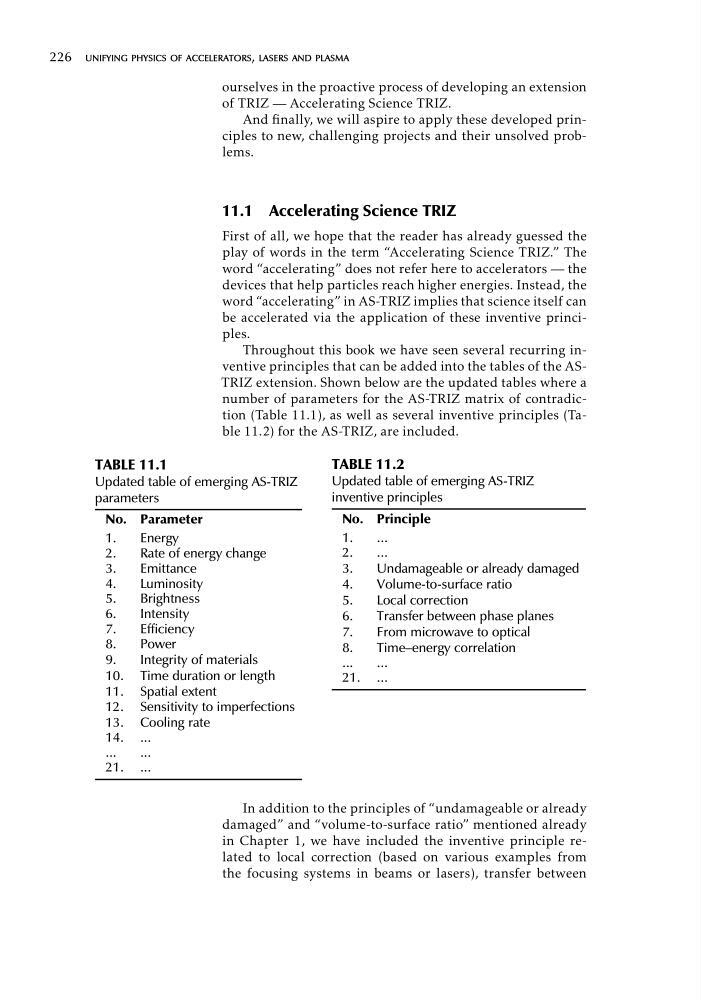
Throughout this book we have seen several recurring inventive principles that can be added into the tables of the ASTRIZ extension. Shown below are the updated tables where a
number of parameters for the AS-TRIZ matrix of contradiction (Table 11.1), as well as several inventive principles (Table 11.2) for the AS-TRIZ, are included.
TABLE
Updated table of emerging AS-TRIZ
parameters
No. Parameter
1.
Energy
2.
Rate of energy change
3.
Emittance
4.
Luminosity
5.
Brightness
6.
Intensity
7.
Efficiency
8.
Power
9.
Integrity of materials
10. Time duration or length
11. Spatial extent
12. Sensitivity to imperfections
13. Cooling rate
14. ...
...
...
21. ...
11.1
TABLE 11.2
Updated table of emerging AS-TRIZ
inventive principles
No. Principle
1.
...
2.
...
3.
Undamageable or already damaged
4.
Volume-to-surface ratio
5.
Local correction
6.
Transfer between phase planes
7.
From microwave to optical
8.
Time–energy correlation
...
...
21. ...
In addition to the principles of “undamageable or already
damaged” and “volume-to-surface ratio” mentioned already
in Chapter 1, we have included the inventive principle related to local correction (based on various examples from
the focusing systems in beams or lasers), transfer between
ourselves in the proactive process of developing an extension
of TRIZ — Accelerating Science TRIZ.
And finally, we will aspire to apply these developed principles to new, challenging projects and their unsolved problems.
11.1 Accelerating Science TRIZ
First of all, we hope that the reader has already guessed the
play of words in the term “Accelerating Science TRIZ.” The
word “accelerating” does not refer here to accelerators — the
devices that help particles reach higher energies. Instead, the
word “accelerating” in AS-TRIZ implies that science itself can
be accelerated via the application of these inventive principles.
Throughout this book we have seen several recurring inventive principles that can be added into the tables of the ASTRIZ extension. Shown below are the updated tables where a
number of parameters for the AS-TRIZ matrix of contradiction (Table 11.1), as well as several inventive principles (Table 11.2) for the AS-TRIZ, are included.
TABLE
Updated table of emerging AS-TRIZ
parameters
No. Parameter
1.
Energy
2.
Rate of energy change
3.
Emittance
4.
Luminosity
5.
Brightness
6.
Intensity
7.
Efficiency
8.
Power
9.
Integrity of materials
10. Time duration or length
11. Spatial extent
12. Sensitivity to imperfections
13. Cooling rate
14. ...
...
...
21. ...
11.1
TABLE 11.2
Updated table of emerging AS-TRIZ
inventive principles
No. Principle
1.
...
2.
...
3.
Undamageable or already damaged
4.
Volume-to-surface ratio
5.
Local correction
6.
Transfer between phase planes
7.
From microwave to optical
8.
Time–energy correlation
...
...
21. ...
In addition to the principles of “undamageable or already
damaged” and “volume-to-surface ratio” mentioned already
in Chapter 1, we have included the inventive principle related to local correction (based on various examples from
the focusing systems in beams or lasers), transfer between