

HFRROLQJ
HOHQV
*DERUOHQV
3
3
3
H
H
H
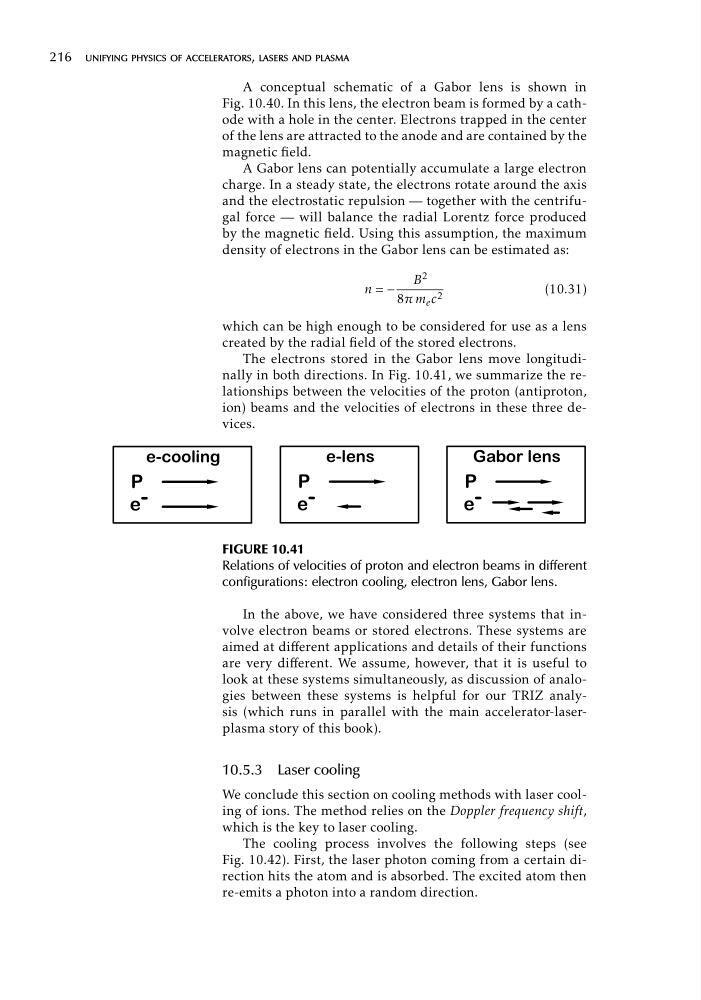
FIGURE 10.41
Relations of velocities of proton and electron beams in different
configurations: electron cooling, electron lens, Gabor lens.
216 unifying physics of accelerators, lasers and plasma
A conceptual schematic of a Gabor lens is shown in
Fig. 10.40. In this lens, the electron beam is formed by a cathode with a hole in the center. Electrons trapped in the center
of the lens are attracted to the anode and are contained by the
magnetic field.
A Gabor lens can potentially accumulate a large electron
charge. In a steady state, the electrons rotate around the axis
and the electrostatic repulsion — together with the centrifugal force — will balance the radial Lorentz force produced
by the magnetic field. Using this assumption, the maximum
density of electrons in the Gabor lens can be estimated as:
B 2
n = −
2
(10.31)
8π m e c
which can be high enough to be considered for use as a lens
created by the radial field of the stored electrons.
The electrons stored in the Gabor lens move longitudinally in both directions. In Fig. 10.41, we summarize the relationships between the velocities of the proton (antiproton,
ion) beams and the velocities of electrons in these three devices.
In the above, we have considered three systems that involve electron beams or stored electrons. These systems are
aimed at different applications and details of their functions
are very different. We assume, however, that it is useful to
look at these systems simultaneously, as discussion of analogies between these systems is helpful for our TRIZ analysis (which runs in parallel with the main accelerator-laserplasma story of this book).
10.5.3 Laser cooling
We conclude this section on cooling methods with laser cooling of ions. The method relies on the Doppler frequency shift,
which is the key to laser cooling.
The cooling process involves the following steps (see
Fig. 10.42). First, the laser photon coming from a certain direction hits the atom and is absorbed. The excited atom then
re-emits a photon into a random direction.
HOHQV
*DERUOHQV
3
3
3
H
H
H
FIGURE 10.41
Relations of velocities of proton and electron beams in different
configurations: electron cooling, electron lens, Gabor lens.
216 unifying physics of accelerators, lasers and plasma
A conceptual schematic of a Gabor lens is shown in
Fig. 10.40. In this lens, the electron beam is formed by a cathode with a hole in the center. Electrons trapped in the center
of the lens are attracted to the anode and are contained by the
magnetic field.
A Gabor lens can potentially accumulate a large electron
charge. In a steady state, the electrons rotate around the axis
and the electrostatic repulsion — together with the centrifugal force — will balance the radial Lorentz force produced
by the magnetic field. Using this assumption, the maximum
density of electrons in the Gabor lens can be estimated as:
B 2
n = −
2
(10.31)
8π m e c
which can be high enough to be considered for use as a lens
created by the radial field of the stored electrons.
The electrons stored in the Gabor lens move longitudinally in both directions. In Fig. 10.41, we summarize the relationships between the velocities of the proton (antiproton,
ion) beams and the velocities of electrons in these three devices.
In the above, we have considered three systems that involve electron beams or stored electrons. These systems are
aimed at different applications and details of their functions
are very different. We assume, however, that it is useful to
look at these systems simultaneously, as discussion of analogies between these systems is helpful for our TRIZ analysis (which runs in parallel with the main accelerator-laserplasma story of this book).
10.5.3 Laser cooling
We conclude this section on cooling methods with laser cooling of ions. The method relies on the Doppler frequency shift,
which is the key to laser cooling.
The cooling process involves the following steps (see
Fig. 10.42). First, the laser photon coming from a certain direction hits the atom and is absorbed. The excited atom then
re-emits a photon into a random direction.