

214 unifying physics of accelerators, lasers and plasma
10.5 Cooling and phase transfer
We will now examine several topics related to beam cooling
and phase space manipulation.
10.5.1 Beam cooling methods
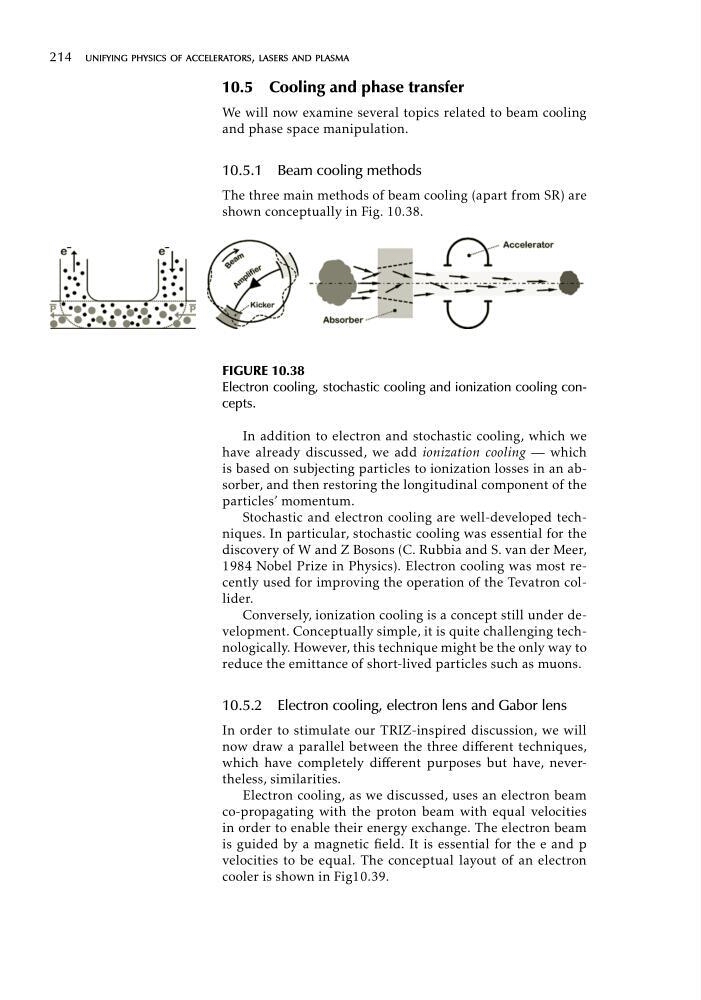
The three main methods of beam cooling (apart from SR) are
shown conceptually in Fig. 10.38.
FIGURE 10.38
Electron cooling, stochastic cooling and ionization cooling concepts.
In addition to electron and stochastic cooling, which we
have already discussed, we add ionization cooling — which
is based on subjecting particles to ionization losses in an absorber, and then restoring the longitudinal component of the
particles’ momentum.
Stochastic and electron cooling are well-developed techniques. In particular, stochastic cooling was essential for the
discovery of W and Z Bosons (C. Rubbia and S. van der Meer,
1984 Nobel Prize in Physics). Electron cooling was most recently used for improving the operation of the Tevatron collider.
Conversely, ionization cooling is a concept still under development. Conceptually simple, it is quite challenging technologically. However, this technique might be the only way to
reduce the emittance of short-lived particles such as muons.
10.5.2 Electron cooling, electron lens and Gabor lens
In order to stimulate our TRIZ-inspired discussion, we will
now draw a parallel between the three different techniques,
which have completely different purposes but have, nevertheless, similarities.
Electron cooling, as we discussed, uses an electron beam
co-propagating with the proton beam with equal velocities
in order to enable their energy exchange. The electron beam
is guided by a magnetic field. It is essential for the e and p
velocities to be equal. The conceptual layout of an electron
cooler is shown in Fig10.39.
10.5 Cooling and phase transfer
We will now examine several topics related to beam cooling
and phase space manipulation.
10.5.1 Beam cooling methods
The three main methods of beam cooling (apart from SR) are
shown conceptually in Fig. 10.38.
FIGURE 10.38
Electron cooling, stochastic cooling and ionization cooling concepts.
In addition to electron and stochastic cooling, which we
have already discussed, we add ionization cooling — which
is based on subjecting particles to ionization losses in an absorber, and then restoring the longitudinal component of the
particles’ momentum.
Stochastic and electron cooling are well-developed techniques. In particular, stochastic cooling was essential for the
discovery of W and Z Bosons (C. Rubbia and S. van der Meer,
1984 Nobel Prize in Physics). Electron cooling was most recently used for improving the operation of the Tevatron collider.
Conversely, ionization cooling is a concept still under development. Conceptually simple, it is quite challenging technologically. However, this technique might be the only way to
reduce the emittance of short-lived particles such as muons.
10.5.2 Electron cooling, electron lens and Gabor lens
In order to stimulate our TRIZ-inspired discussion, we will
now draw a parallel between the three different techniques,
which have completely different purposes but have, nevertheless, similarities.
Electron cooling, as we discussed, uses an electron beam
co-propagating with the proton beam with equal velocities
in order to enable their energy exchange. The electron beam
is guided by a magnetic field. It is essential for the e and p
velocities to be equal. The conceptual layout of an electron
cooler is shown in Fig10.39.