

210 unifying physics of accelerators, lasers and plasma
where charged particles are used — and lasers, where we deal
with light.
In this section, we will briefly discuss the methods of laser
pulse addition in the optical cavities in comparison with injection methods used in accelerators, return to lasers to touch
on a promising technique to coherently combine fiber laser
signals, and finish with resonant plasma excitation by a train
of laser pulses.
10.4.1 Optical cavities
Optical cavities consisting of two or more mirrors are a
widespread element used in practically any laser or optics
system.
Optical cavities, in the event when one of the mirrors is
semi-transparent, are efficient tools for adding laser pulses
together for their accumulation to higher intensities.
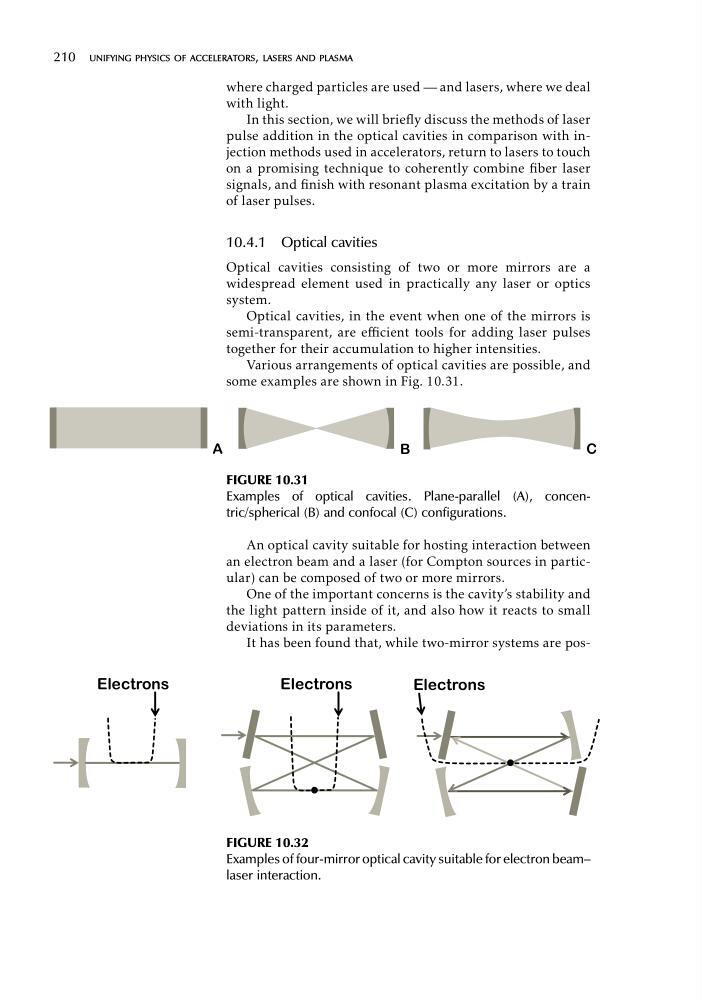
Various arrangements of optical cavities are possible, and
some examples are shown in Fig. 10.31.
$
%
&
FIGURE 10.31
Examples of optical cavities. Plane-parallel (A), concentric/spherical (B) and confocal (C) configurations.
An optical cavity suitable for hosting interaction between
an electron beam and a laser (for Compton sources in particular) can be composed of two or more mirrors.
One of the important concerns is the cavity’s stability and
the light pattern inside of it, and also how it reacts to small
deviations in its parameters.
It has been found that, while two-mirror systems are pos(OHFWURQV
(OHFWURQV
(OHFWURQV
FIGURE 10.32
Examples of four-mirror optical cavity suitable for electron beam–
laser interaction.
where charged particles are used — and lasers, where we deal
with light.
In this section, we will briefly discuss the methods of laser
pulse addition in the optical cavities in comparison with injection methods used in accelerators, return to lasers to touch
on a promising technique to coherently combine fiber laser
signals, and finish with resonant plasma excitation by a train
of laser pulses.
10.4.1 Optical cavities
Optical cavities consisting of two or more mirrors are a
widespread element used in practically any laser or optics
system.
Optical cavities, in the event when one of the mirrors is
semi-transparent, are efficient tools for adding laser pulses
together for their accumulation to higher intensities.
Various arrangements of optical cavities are possible, and
some examples are shown in Fig. 10.31.
$
%
&
FIGURE 10.31
Examples of optical cavities. Plane-parallel (A), concentric/spherical (B) and confocal (C) configurations.
An optical cavity suitable for hosting interaction between
an electron beam and a laser (for Compton sources in particular) can be composed of two or more mirrors.
One of the important concerns is the cavity’s stability and
the light pattern inside of it, and also how it reacts to small
deviations in its parameters.
It has been found that, while two-mirror systems are pos(OHFWURQV
(OHFWURQV
(OHFWURQV
FIGURE 10.32
Examples of four-mirror optical cavity suitable for electron beam–
laser interaction.