

proton and ion laser plasma acceleration 169
9.2 DNA response to radiation
The underlying mechanism of X-ray and proton cancer therapy is the ability to prevent the replication of malignant
cancer cells. This control is achieved by damaging the DNA
of cancerous cells. Let’s now consider the basic facts about
DNA’s response to radiation.
The effect of ionizing radiation on DNA can produce many outcomes, from neutral to negative (stimulating
growth of cancer cells), or positive (eliminating cancer cells)
depending on the initial state of the irradiated object, the radiation dose and the use of concomitant agents — pharmaceutical substances used prior or together with irradiation.
In some cases, radiation simply does not cause DNA damage, but passes through the cell without any side effects. With
an increased dose, the radiation starts to physically affect the
DNA. The effects are distinguished as direct and indirect.
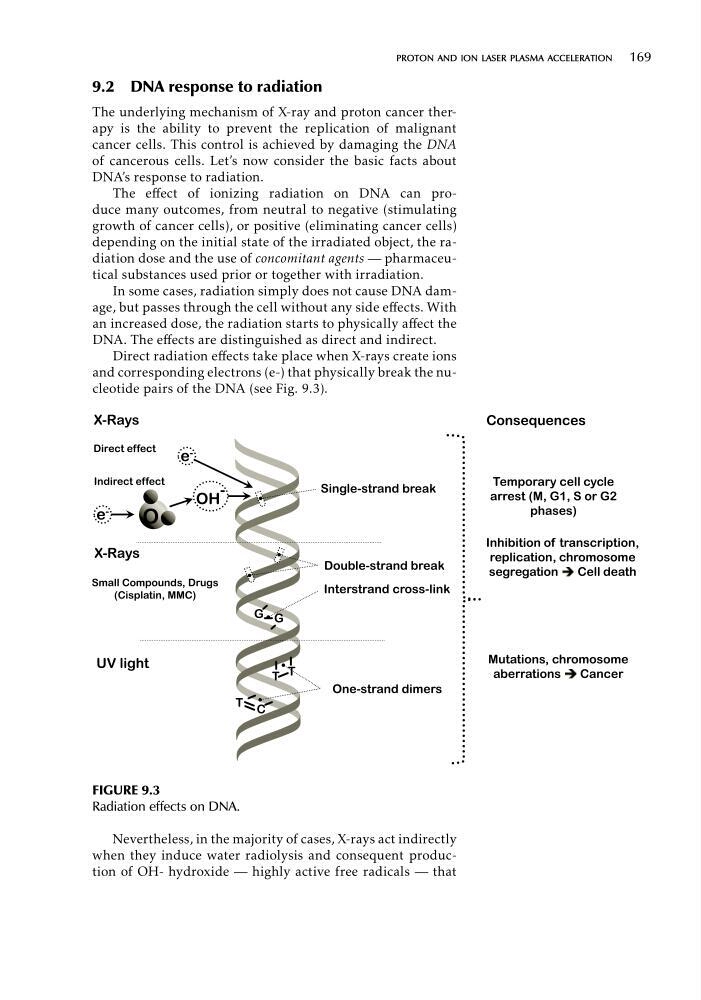
Direct radiation effects take place when X-rays create ions
and corresponding electrons (e-) that physically break the nucleotide pairs of the DNA (see Fig. 9.3).
FIGURE 9.3
Radiation effects on DNA.
Nevertheless, in the majority of cases, X-rays act indirectly
when they induce water radiolysis and consequent production of OH- hydroxide — highly active free radicals — that
9.2 DNA response to radiation
The underlying mechanism of X-ray and proton cancer therapy is the ability to prevent the replication of malignant
cancer cells. This control is achieved by damaging the DNA
of cancerous cells. Let’s now consider the basic facts about
DNA’s response to radiation.
The effect of ionizing radiation on DNA can produce many outcomes, from neutral to negative (stimulating
growth of cancer cells), or positive (eliminating cancer cells)
depending on the initial state of the irradiated object, the radiation dose and the use of concomitant agents — pharmaceutical substances used prior or together with irradiation.
In some cases, radiation simply does not cause DNA damage, but passes through the cell without any side effects. With
an increased dose, the radiation starts to physically affect the
DNA. The effects are distinguished as direct and indirect.
Direct radiation effects take place when X-rays create ions
and corresponding electrons (e-) that physically break the nucleotide pairs of the DNA (see Fig. 9.3).
FIGURE 9.3
Radiation effects on DNA.
Nevertheless, in the majority of cases, X-rays act indirectly
when they induce water radiolysis and consequent production of OH- hydroxide — highly active free radicals — that