

proton and ion laser plasma acceleration 167
The photons that are used in radiation therapy are usually
produced from electron beams of several MeV, converted on
a solid target to photons via the process of bremsstrahlung. As
interaction between the photon beam and medium results in
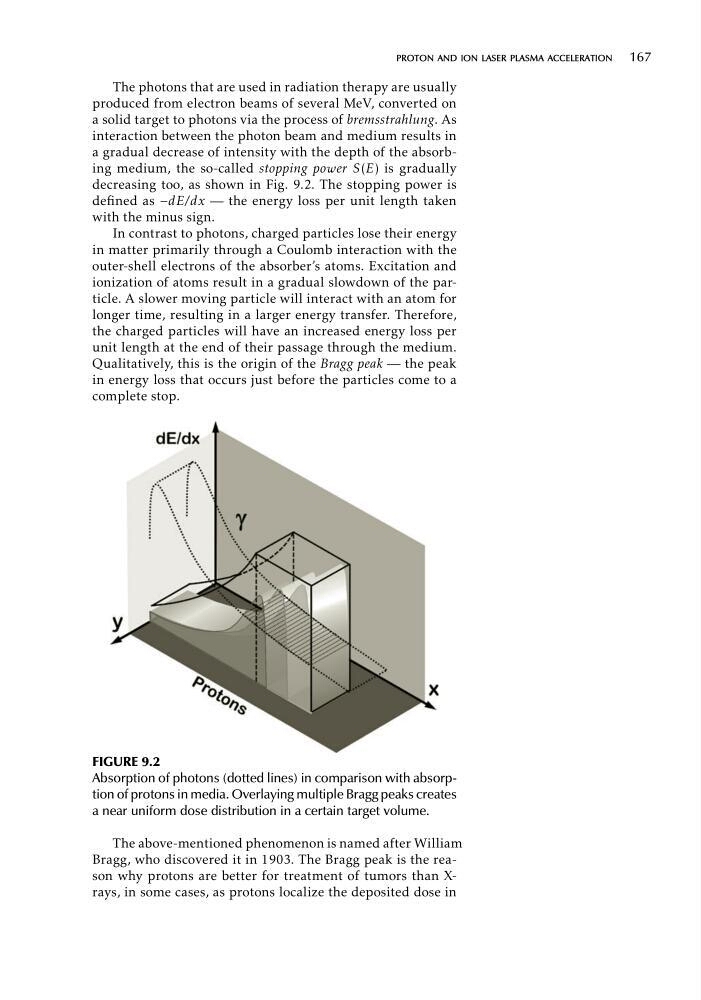
a gradual decrease of intensity with the depth of the absorbing medium, the so-called stopping power S(E) is gradually
decreasing too, as shown in Fig. 9.2. The stopping power is
defined as −dE/dx — the energy loss per unit length taken
with the minus sign.
In contrast to photons, charged particles lose their energy
in matter primarily through a Coulomb interaction with the
outer-shell electrons of the absorber’s atoms. Excitation and
ionization of atoms result in a gradual slowdown of the particle. A slower moving particle will interact with an atom for
longer time, resulting in a larger energy transfer. Therefore,
the charged particles will have an increased energy loss per
unit length at the end of their passage through the medium.
Qualitatively, this is the origin of the Bragg peak — the peak
in energy loss that occurs just before the particles come to a
complete stop.
FIGURE 9.2
Absorption of photons (dotted lines) in comparison with absorption of protons in media. Overlaying multiple Bragg peaks creates
a near uniform dose distribution in a certain target volume.
The above-mentioned phenomenon is named after William
Bragg, who discovered it in 1903. The Bragg peak is the reason why protons are better for treatment of tumors than Xrays, in some cases, as protons localize the deposited dose in
The photons that are used in radiation therapy are usually
produced from electron beams of several MeV, converted on
a solid target to photons via the process of bremsstrahlung. As
interaction between the photon beam and medium results in
a gradual decrease of intensity with the depth of the absorbing medium, the so-called stopping power S(E) is gradually
decreasing too, as shown in Fig. 9.2. The stopping power is
defined as −dE/dx — the energy loss per unit length taken
with the minus sign.
In contrast to photons, charged particles lose their energy
in matter primarily through a Coulomb interaction with the
outer-shell electrons of the absorber’s atoms. Excitation and
ionization of atoms result in a gradual slowdown of the particle. A slower moving particle will interact with an atom for
longer time, resulting in a larger energy transfer. Therefore,
the charged particles will have an increased energy loss per
unit length at the end of their passage through the medium.
Qualitatively, this is the origin of the Bragg peak — the peak
in energy loss that occurs just before the particles come to a
complete stop.
FIGURE 9.2
Absorption of photons (dotted lines) in comparison with absorption of protons in media. Overlaying multiple Bragg peaks creates
a near uniform dose distribution in a certain target volume.
The above-mentioned phenomenon is named after William
Bragg, who discovered it in 1903. The Bragg peak is the reason why protons are better for treatment of tumors than Xrays, in some cases, as protons localize the deposited dose in