

conventional acceleration 81
revolution frequency ω rev
h = ω RF /ω rev
(5.4)
where h is called the harmonic number of the ring: an integer chosen to allow matching the frequency of available RF
generators.
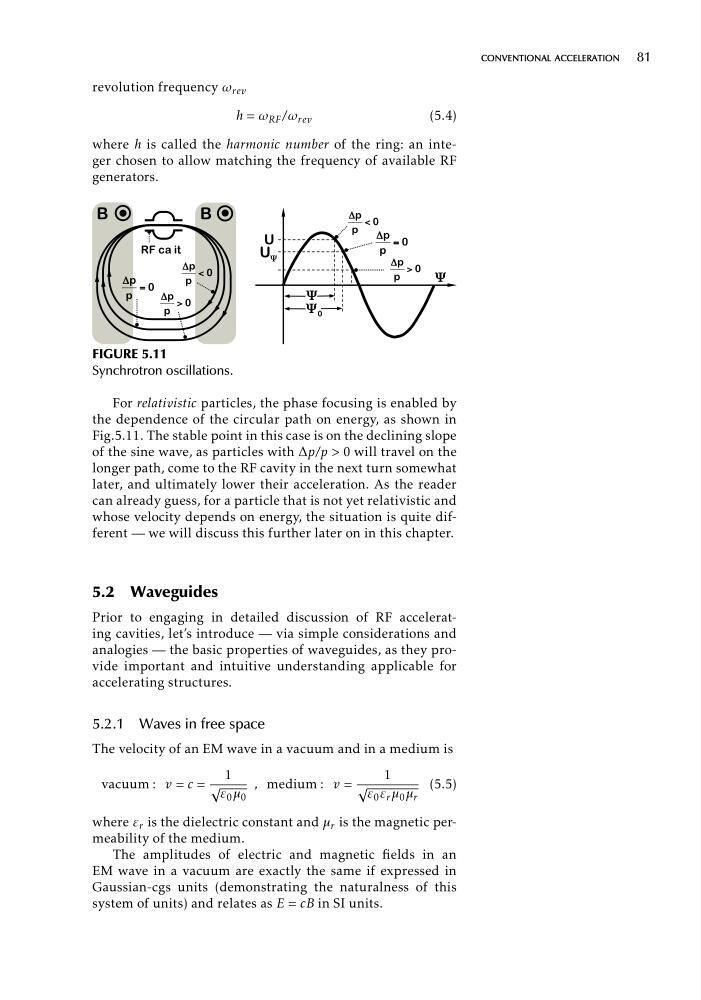
FIGURE 5.11
Synchrotron oscillations.
For relativistic particles, the phase focusing is enabled by
the dependence of the circular path on energy, as shown in
Fig.5.11. The stable point in this case is on the declining slope
of the sine wave, as particles with Δp/p > 0 will travel on the
longer path, come to the RF cavity in the next turn somewhat
later, and ultimately lower their acceleration. As the reader
can already guess, for a particle that is not yet relativistic and
whose velocity depends on energy, the situation is quite different — we will discuss this further later on in this chapter.
5.2 Waveguides
Prior to engaging in detailed discussion of RF accelerating cavities, let’s introduce — via simple considerations and
analogies — the basic properties of waveguides, as they provide important and intuitive understanding applicable for
accelerating structures.
5.2.1 Waves in free space
The velocity of an EM wave in a vacuum and in a medium is
1
1
vacuum : v = c = √
, medium : v = √
(5.5)
ε 0 μ 0
ε 0 ε r μ 0 μ r
where ε r is the dielectric constant and μ r is the magnetic permeability of the medium.
The amplitudes of electric and magnetic fields in an
EM wave in a vacuum are exactly the same if expressed in
Gaussian-cgs units (demonstrating the naturalness of this
system of units) and relates as E = cB in SI units.
revolution frequency ω rev
h = ω RF /ω rev
(5.4)
where h is called the harmonic number of the ring: an integer chosen to allow matching the frequency of available RF
generators.
FIGURE 5.11
Synchrotron oscillations.
For relativistic particles, the phase focusing is enabled by
the dependence of the circular path on energy, as shown in
Fig.5.11. The stable point in this case is on the declining slope
of the sine wave, as particles with Δp/p > 0 will travel on the
longer path, come to the RF cavity in the next turn somewhat
later, and ultimately lower their acceleration. As the reader
can already guess, for a particle that is not yet relativistic and
whose velocity depends on energy, the situation is quite different — we will discuss this further later on in this chapter.
5.2 Waveguides
Prior to engaging in detailed discussion of RF accelerating cavities, let’s introduce — via simple considerations and
analogies — the basic properties of waveguides, as they provide important and intuitive understanding applicable for
accelerating structures.
5.2.1 Waves in free space
The velocity of an EM wave in a vacuum and in a medium is
1
1
vacuum : v = c = √
, medium : v = √
(5.5)
ε 0 μ 0
ε 0 ε r μ 0 μ r
where ε r is the dielectric constant and μ r is the magnetic permeability of the medium.
The amplitudes of electric and magnetic fields in an
EM wave in a vacuum are exactly the same if expressed in
Gaussian-cgs units (demonstrating the naturalness of this
system of units) and relates as E = cB in SI units.