

conventional acceleration 79
The energy of the particle in Wideroe ¨ linac after passing
the i-th drift tube is
E i = iqV max sin Ψ 0
(5.2)
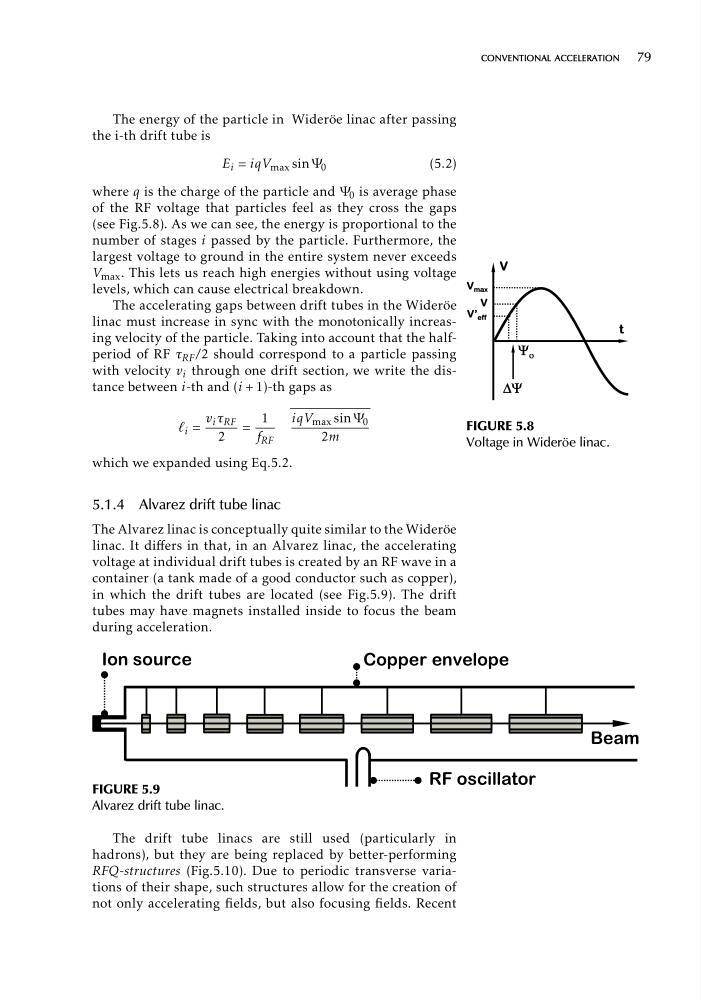
where q is the charge of the particle and Ψ 0 is average phase
of the RF voltage that particles feel as they cross the gaps
(see Fig.5.8). As we can see, the energy is proportional to the
number of stages i passed by the particle. Furthermore, the
largest voltage to ground in the entire system never exceeds
V max . This lets us reach high energies without using voltage
levels, which can cause electrical breakdown.
The accelerating gaps between drift tubes in the Wideroe ¨
linac must increase in sync with the monotonically increasing velocity of the particle. Taking into account that the halfperiod of RF τ RF /2 should correspond to a particle passing
with velocity v i through one drift section, we write the distance between i-th and (i + 1)-th gaps as
v i τ RF
1
iqV max sin Ψ 0
e
FIGURE 5.8
Voltage in Widero ¨e linac.
i =
=
2
f RF
2m
which we expanded using Eq.5.2.
5.1.4 Alvarez drift tube linac
The Alvarez linac is conceptually quite similar to the Wideroe ¨
linac. It differs in that, in an Alvarez linac, the accelerating
voltage at individual drift tubes is created by an RF wave in a
container (a tank made of a good conductor such as copper),
in which the drift tubes are located (see Fig.5.9). The drift
tubes may have magnets installed inside to focus the beam
during acceleration.
,RQVRXUFH
&RSSHUHQYHORSH
%HDP
5)RVFLOODWRU
FIGURE 5.9
Alvarez drift tube linac.
The drift tube linacs are still used (particularly in
hadrons), but they are being replaced by better-performing
RFQ-structures (Fig.5.10). Due to periodic transverse variations of their shape, such structures allow for the creation of
not only accelerating fields, but also focusing fields. Recent
The energy of the particle in Wideroe ¨ linac after passing
the i-th drift tube is
E i = iqV max sin Ψ 0
(5.2)
where q is the charge of the particle and Ψ 0 is average phase
of the RF voltage that particles feel as they cross the gaps
(see Fig.5.8). As we can see, the energy is proportional to the
number of stages i passed by the particle. Furthermore, the
largest voltage to ground in the entire system never exceeds
V max . This lets us reach high energies without using voltage
levels, which can cause electrical breakdown.
The accelerating gaps between drift tubes in the Wideroe ¨
linac must increase in sync with the monotonically increasing velocity of the particle. Taking into account that the halfperiod of RF τ RF /2 should correspond to a particle passing
with velocity v i through one drift section, we write the distance between i-th and (i + 1)-th gaps as
v i τ RF
1
iqV max sin Ψ 0
e
FIGURE 5.8
Voltage in Widero ¨e linac.
i =
=
2
f RF
2m
which we expanded using Eq.5.2.
5.1.4 Alvarez drift tube linac
The Alvarez linac is conceptually quite similar to the Wideroe ¨
linac. It differs in that, in an Alvarez linac, the accelerating
voltage at individual drift tubes is created by an RF wave in a
container (a tank made of a good conductor such as copper),
in which the drift tubes are located (see Fig.5.9). The drift
tubes may have magnets installed inside to focus the beam
during acceleration.
,RQVRXUFH
&RSSHUHQYHORSH
%HDP
5)RVFLOODWRU
FIGURE 5.9
Alvarez drift tube linac.
The drift tube linacs are still used (particularly in
hadrons), but they are being replaced by better-performing
RFQ-structures (Fig.5.10). Due to periodic transverse variations of their shape, such structures allow for the creation of
not only accelerating fields, but also focusing fields. Recent