

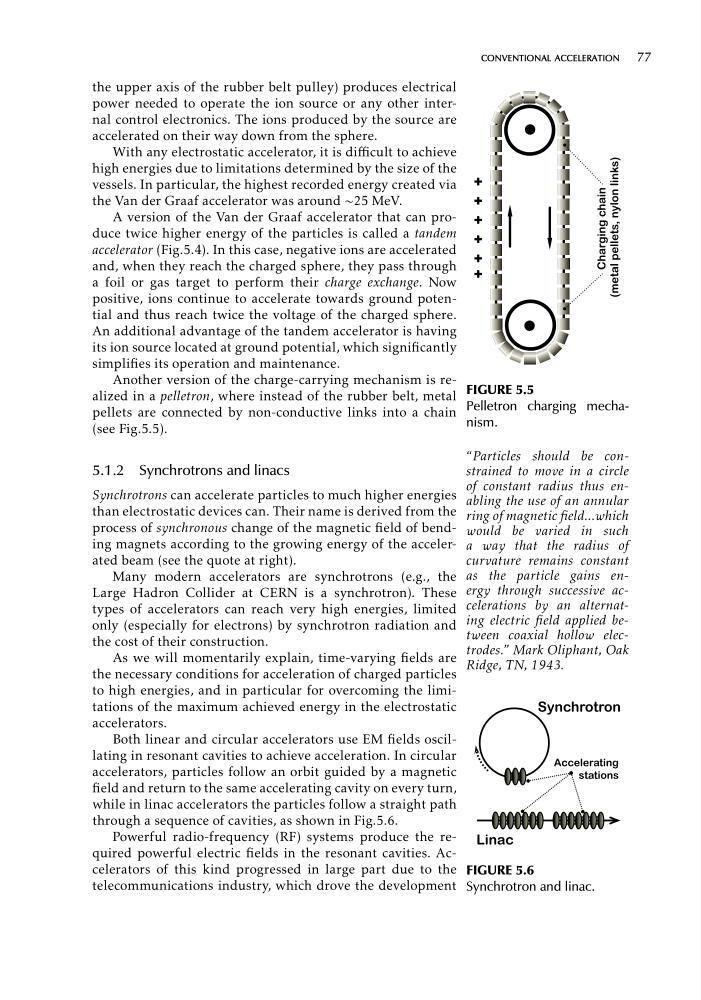
FIGURE 5.6
Synchrotron and linac.
FIGURE 5.5
Pelletron charging mechanism.
conventional acceleration 77
the upper axis of the rubber belt pulley) produces electrical
power needed to operate the ion source or any other internal control electronics. The ions produced by the source are
accelerated on their way down from the sphere.
With any electrostatic accelerator, it is difficult to achieve
high energies due to limitations determined by the size of the
vessels. In particular, the highest recorded energy created via
the Van der Graaf accelerator was around ∼25 MeV.
A version of the Van der Graaf accelerator that can produce twice higher energy of the particles is called a tandem
accelerator (Fig.5.4). In this case, negative ions are accelerated
and, when they reach the charged sphere, they pass through
a foil or gas target to perform their charge exchange. Now
positive, ions continue to accelerate towards ground potential and thus reach twice the voltage of the charged sphere.
An additional advantage of the tandem accelerator is having
its ion source located at ground potential, which significantly
simplifies its operation and maintenance.
Another version of the charge-carrying mechanism is realized in a pelletron, where instead of the rubber belt, metal
pellets are connected by non-conductive links into a chain
(see Fig.5.5).
“Particles should be con5.1.2 Synchrotrons and linacs
strained to move in a circle
of constant radius thus enSynchrotrons can accelerate particles to much higher energies abling the use of an annular
than electrostatic devices can. Their name is derived from the ring of magnetic field...which
process of synchronous change of the magnetic field of bend- would be varied in such
ing magnets according to the growing energy of the acceler- a way that the radius of
ated beam (see the quote at right).
curvature remains constant
Many modern accelerators are synchrotrons (e.g., the as the particle gains enLarge Hadron Collider at CERN is a synchrotron). These ergy through successive actypes of accelerators can reach very high energies, limited celerations by an alternating electric field applied beonly (especially for electrons) by synchrotron radiation and
tween coaxial hollow electhe cost of their construction.
trodes.” Mark Oliphant, Oak
As we will momentarily explain, time-varying fields are Ridge, TN, 1943.
the necessary conditions for acceleration of charged particles
to high energies, and in particular for overcoming the limitations of the maximum achieved energy in the electrostatic
accelerators.
Both linear and circular accelerators use EM fields oscillating in resonant cavities to achieve acceleration. In circular
accelerators, particles follow an orbit guided by a magnetic
field and return to the same accelerating cavity on every turn,
while in linac accelerators the particles follow a straight path
through a sequence of cavities, as shown in Fig.5.6.
Powerful radio-frequency (RF) systems produce the required powerful electric fields in the resonant cavities. Accelerators of this kind progressed in large part due to the
telecommunications industry, which drove the development
Synchrotron and linac.
FIGURE 5.5
Pelletron charging mechanism.
conventional acceleration 77
the upper axis of the rubber belt pulley) produces electrical
power needed to operate the ion source or any other internal control electronics. The ions produced by the source are
accelerated on their way down from the sphere.
With any electrostatic accelerator, it is difficult to achieve
high energies due to limitations determined by the size of the
vessels. In particular, the highest recorded energy created via
the Van der Graaf accelerator was around ∼25 MeV.
A version of the Van der Graaf accelerator that can produce twice higher energy of the particles is called a tandem
accelerator (Fig.5.4). In this case, negative ions are accelerated
and, when they reach the charged sphere, they pass through
a foil or gas target to perform their charge exchange. Now
positive, ions continue to accelerate towards ground potential and thus reach twice the voltage of the charged sphere.
An additional advantage of the tandem accelerator is having
its ion source located at ground potential, which significantly
simplifies its operation and maintenance.
Another version of the charge-carrying mechanism is realized in a pelletron, where instead of the rubber belt, metal
pellets are connected by non-conductive links into a chain
(see Fig.5.5).
“Particles should be con5.1.2 Synchrotrons and linacs
strained to move in a circle
of constant radius thus enSynchrotrons can accelerate particles to much higher energies abling the use of an annular
than electrostatic devices can. Their name is derived from the ring of magnetic field...which
process of synchronous change of the magnetic field of bend- would be varied in such
ing magnets according to the growing energy of the acceler- a way that the radius of
ated beam (see the quote at right).
curvature remains constant
Many modern accelerators are synchrotrons (e.g., the as the particle gains enLarge Hadron Collider at CERN is a synchrotron). These ergy through successive actypes of accelerators can reach very high energies, limited celerations by an alternating electric field applied beonly (especially for electrons) by synchrotron radiation and
tween coaxial hollow electhe cost of their construction.
trodes.” Mark Oliphant, Oak
As we will momentarily explain, time-varying fields are Ridge, TN, 1943.
the necessary conditions for acceleration of charged particles
to high energies, and in particular for overcoming the limitations of the maximum achieved energy in the electrostatic
accelerators.
Both linear and circular accelerators use EM fields oscillating in resonant cavities to achieve acceleration. In circular
accelerators, particles follow an orbit guided by a magnetic
field and return to the same accelerating cavity on every turn,
while in linac accelerators the particles follow a straight path
through a sequence of cavities, as shown in Fig.5.6.
Powerful radio-frequency (RF) systems produce the required powerful electric fields in the resonant cavities. Accelerators of this kind progressed in large part due to the
telecommunications industry, which drove the development