

5
Conventional Acceleration
5.1 Historical
In this chapter we will discuss conventional acceleration. Beintroduction
75 ginning with a historical introduction, we will then touch on
5.2 Waveguides
81 waveguides, resonant cavities fed by RF power generators,
5.3 Cavities
86 and conclude with an overview of the basics of linacs and
5.4 Power sources
90 longitudinal dynamics.
5.5 Longitudinal
dynamics
94
5.1 Historical introduction
The “Livingston plot” presented in Fig.1.6 of Chapter 1 oversees the development of accelerators over the past several
decades. These days, we refer to them as conventional accelerators. These accelerators are also human-made, in contrast
with, for example, a cosmic accelerator, which has the capacity to produce particles with energies exceeding 10 20 eV , or
lightning, which produces fairly minimal acceleration.
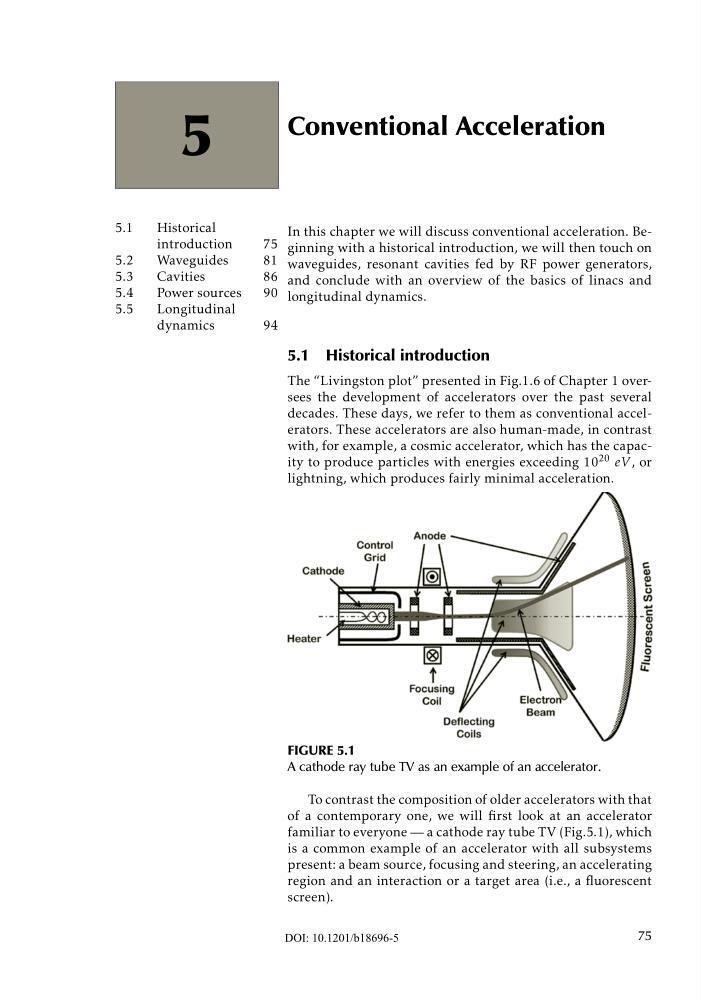
FIGURE 5.1
A cathode ray tube TV as an example of an accelerator.
To contrast the composition of older accelerators with that
of a contemporary one, we will first look at an accelerator
familiar to everyone — a cathode ray tube TV (Fig.5.1), which
is a common example of an accelerator with all subsystems
present: a beam source, focusing and steering, an accelerating
region and an interaction or a target area (i.e., a fluorescent
screen).
75
DOI: 10.1201/b18696-5
Conventional Acceleration
5.1 Historical
In this chapter we will discuss conventional acceleration. Beintroduction
75 ginning with a historical introduction, we will then touch on
5.2 Waveguides
81 waveguides, resonant cavities fed by RF power generators,
5.3 Cavities
86 and conclude with an overview of the basics of linacs and
5.4 Power sources
90 longitudinal dynamics.
5.5 Longitudinal
dynamics
94
5.1 Historical introduction
The “Livingston plot” presented in Fig.1.6 of Chapter 1 oversees the development of accelerators over the past several
decades. These days, we refer to them as conventional accelerators. These accelerators are also human-made, in contrast
with, for example, a cosmic accelerator, which has the capacity to produce particles with energies exceeding 10 20 eV , or
lightning, which produces fairly minimal acceleration.
FIGURE 5.1
A cathode ray tube TV as an example of an accelerator.
To contrast the composition of older accelerators with that
of a contemporary one, we will first look at an accelerator
familiar to everyone — a cathode ray tube TV (Fig.5.1), which
is a common example of an accelerator with all subsystems
present: a beam source, focusing and steering, an accelerating
region and an interaction or a target area (i.e., a fluorescent
screen).
75
DOI: 10.1201/b18696-5