

76
An Introduction to Beam Physics
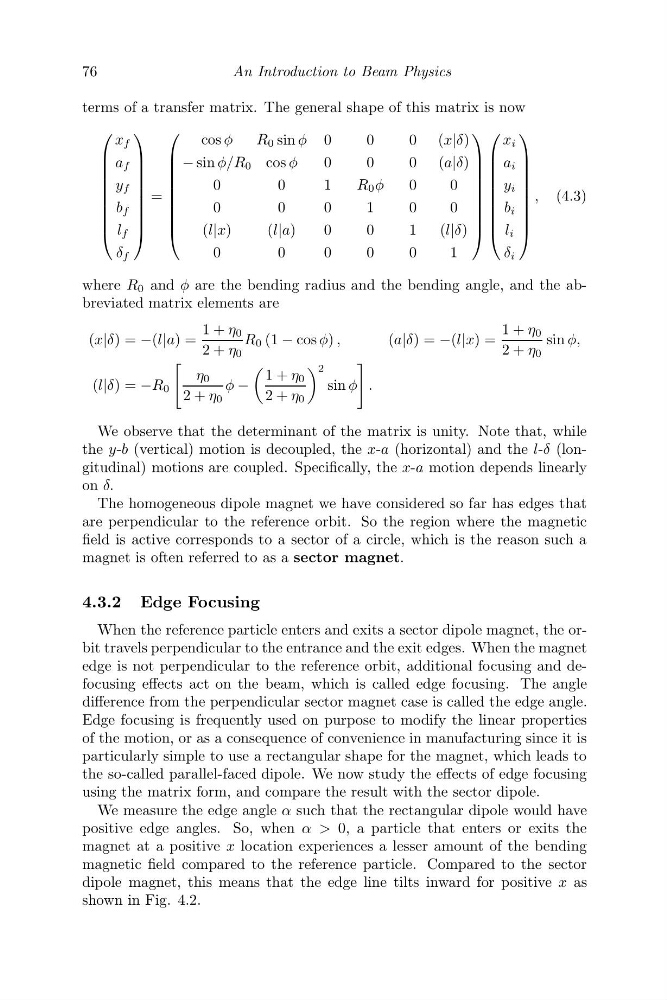
terms of a transfer matrix. The general shape of this matrix is now
⎛
⎜
⎜
⎜
⎜
⎜
⎜
⎜
⎜
⎝
x f
a f
y f
b f
l f
δ f
⎞
⎟
⎟
⎟
⎟
⎟
⎟
⎟
⎟
⎠
=
⎛
⎜
⎜
⎜
⎜
⎜
⎜
⎜
⎜
⎝
cos φ
R 0 sin φ 0
0
0 (x|δ)
− sin φ/R 0 cos φ
0
0
0 (a|δ)
0
0
1
R 0 φ
0
0
0
0
0
1
0
0
(l|x)
(l|a)
0
0
1
(l|δ)
0
0
0
0
0
1
⎞
⎟
⎟
⎟
⎟
⎟
⎟
⎟
⎟
⎠
⎛
⎜
⎜
⎜
⎜
⎜
⎜
⎜
⎜
⎝
x i
a i
y i
b i
l i
δ i
⎞
⎟
⎟
⎟
⎟
⎟
⎟
⎟
⎟
⎠
, (4.3)
where R 0 and φ are the bending radius and the bending angle, and the abbreviated matrix elements are
(x|δ) = −(l|a) =
1 + η 0
2 + η 0
R 0 (1 − cos φ) ,
(a|δ) = −(l|x) =
1 + η 0
2 + η 0
sin φ,
(l|δ) = −R 0
η 0
2 + η 0
φ −
1 + η 0
2 + η 0
2
sin φ
.
We observe that the determinant of the matrix is unity. Note that, while
the y-b (vertical) motion is decoupled, the x-a (horizontal) and the l-δ (longitudinal) motions are coupled. Specifically, the x-a motion depends linearly
on δ.
The homogeneous dipole magnet we have considered so far has edges that
are perpendicular to the reference orbit. So the region where the magnetic
field is active corresponds to a sector of a circle, which is the reason such a
magnet is often referred to as a sector magnet.
4.3.2 Edge Focusing
When the reference particle enters and exits a sector dipole magnet, the orbit travels perpendicular to the entrance and the exit edges. When the magnet
edge is not perpendicular to the reference orbit, additional focusing and defocusing effects act on the beam, which is called edge focusing. The angle
difference from the perpendicular sector magnet case is called the edge angle.
Edge focusing is frequently used on purpose to modify the linear properties
of the motion, or as a consequence of convenience in manufacturing since it is
particularly simple to use a rectangular shape for the magnet, which leads to
the so-called parallel-faced dipole. We now study the effects of edge focusing
using the matrix form, and compare the result with the sector dipole.
We measure the edge angle α such that the rectangular dipole would have
positive edge angles. So, when α > 0, a particle that enters or exits the
magnet at a positive x location experiences a lesser amount of the bending
magnetic field compared to the reference particle. Compared to the sector
dipole magnet, this means that the edge line tilts inward for positive x as
shown in Fig. 4.2.
An Introduction to Beam Physics
terms of a transfer matrix. The general shape of this matrix is now
⎛
⎜
⎜
⎜
⎜
⎜
⎜
⎜
⎜
⎝
x f
a f
y f
b f
l f
δ f
⎞
⎟
⎟
⎟
⎟
⎟
⎟
⎟
⎟
⎠
=
⎛
⎜
⎜
⎜
⎜
⎜
⎜
⎜
⎜
⎝
cos φ
R 0 sin φ 0
0
0 (x|δ)
− sin φ/R 0 cos φ
0
0
0 (a|δ)
0
0
1
R 0 φ
0
0
0
0
0
1
0
0
(l|x)
(l|a)
0
0
1
(l|δ)
0
0
0
0
0
1
⎞
⎟
⎟
⎟
⎟
⎟
⎟
⎟
⎟
⎠
⎛
⎜
⎜
⎜
⎜
⎜
⎜
⎜
⎜
⎝
x i
a i
y i
b i
l i
δ i
⎞
⎟
⎟
⎟
⎟
⎟
⎟
⎟
⎟
⎠
, (4.3)
where R 0 and φ are the bending radius and the bending angle, and the abbreviated matrix elements are
(x|δ) = −(l|a) =
1 + η 0
2 + η 0
R 0 (1 − cos φ) ,
(a|δ) = −(l|x) =
1 + η 0
2 + η 0
sin φ,
(l|δ) = −R 0
η 0
2 + η 0
φ −
1 + η 0
2 + η 0
2
sin φ
.
We observe that the determinant of the matrix is unity. Note that, while
the y-b (vertical) motion is decoupled, the x-a (horizontal) and the l-δ (longitudinal) motions are coupled. Specifically, the x-a motion depends linearly
on δ.
The homogeneous dipole magnet we have considered so far has edges that
are perpendicular to the reference orbit. So the region where the magnetic
field is active corresponds to a sector of a circle, which is the reason such a
magnet is often referred to as a sector magnet.
4.3.2 Edge Focusing
When the reference particle enters and exits a sector dipole magnet, the orbit travels perpendicular to the entrance and the exit edges. When the magnet
edge is not perpendicular to the reference orbit, additional focusing and defocusing effects act on the beam, which is called edge focusing. The angle
difference from the perpendicular sector magnet case is called the edge angle.
Edge focusing is frequently used on purpose to modify the linear properties
of the motion, or as a consequence of convenience in manufacturing since it is
particularly simple to use a rectangular shape for the magnet, which leads to
the so-called parallel-faced dipole. We now study the effects of edge focusing
using the matrix form, and compare the result with the sector dipole.
We measure the edge angle α such that the rectangular dipole would have
positive edge angles. So, when α > 0, a particle that enters or exits the
magnet at a positive x location experiences a lesser amount of the bending
magnetic field compared to the reference particle. Compared to the sector
dipole magnet, this means that the edge line tilts inward for positive x as
shown in Fig. 4.2.