

42
An Introduction to Beam Physics
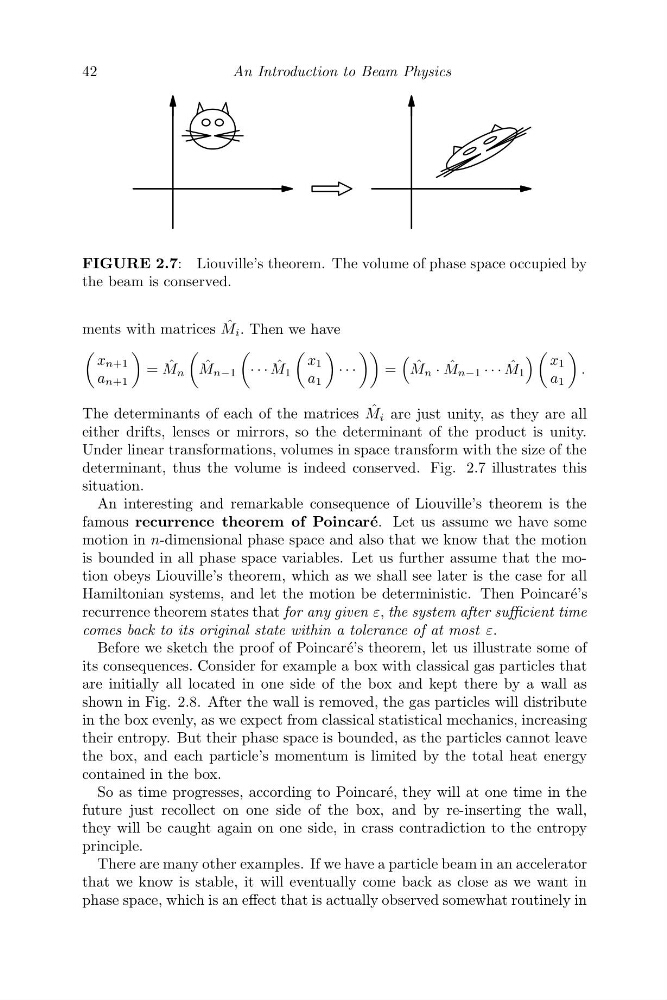
FIGURE 2.7: Liouville’s theorem. The volume of phase space occupied by
the beam is conserved.
ments with matrices ˆ
M i . Then we have
x n+1
a n+1
= ˆ
M n
ˆ
M n−1
· · · ˆ
M 1
x 1
a 1
· · ·
=
ˆ
M n · ˆ
M n−1 · · · ˆ
M 1
x 1
a 1
.
The determinants of each of the matrices ˆ
M i are just unity, as they are all
either drifts, lenses or mirrors, so the determinant of the product is unity.
Under linear transformations, volumes in space transform with the size of the
determinant, thus the volume is indeed conserved. Fig. 2.7 illustrates this
situation.
An interesting and remarkable consequence of Liouville’s theorem is the
famous recurrence theorem of Poincar´ e. Let us assume we have some
motion in n-dimensional phase space and also that we know that the motion
is bounded in all phase space variables. Let us further assume that the motion obeys Liouville’s theorem, which as we shall see later is the case for all
Hamiltonian systems, and let the motion be deterministic. Then Poincar´ e’s
recurrence theorem states that for any given ε, the system after sufficient time
comes back to its original state within a tolerance of at most ε.
Before we sketch the proof of Poincar´ e’s theorem, let us illustrate some of
its consequences. Consider for example a box with classical gas particles that
are initially all located in one side of the box and kept there by a wall as
shown in Fig. 2.8. After the wall is removed, the gas particles will distribute
in the box evenly, as we expect from classical statistical mechanics, increasing
their entropy. But their phase space is bounded, as the particles cannot leave
the box, and each particle’s momentum is limited by the total heat energy
contained in the box.
So as time progresses, according to Poincar´ e, they will at one time in the
future just recollect on one side of the box, and by re-inserting the wall,
they will be caught again on one side, in crass contradiction to the entropy
principle.
There are many other examples. If we have a particle beam in an accelerator
that we know is stable, it will eventually come back as close as we want in
phase space, which is an effect that is actually observed somewhat routinely in
An Introduction to Beam Physics
FIGURE 2.7: Liouville’s theorem. The volume of phase space occupied by
the beam is conserved.
ments with matrices ˆ
M i . Then we have
x n+1
a n+1
= ˆ
M n
ˆ
M n−1
· · · ˆ
M 1
x 1
a 1
· · ·
=
ˆ
M n · ˆ
M n−1 · · · ˆ
M 1
x 1
a 1
.
The determinants of each of the matrices ˆ
M i are just unity, as they are all
either drifts, lenses or mirrors, so the determinant of the product is unity.
Under linear transformations, volumes in space transform with the size of the
determinant, thus the volume is indeed conserved. Fig. 2.7 illustrates this
situation.
An interesting and remarkable consequence of Liouville’s theorem is the
famous recurrence theorem of Poincar´ e. Let us assume we have some
motion in n-dimensional phase space and also that we know that the motion
is bounded in all phase space variables. Let us further assume that the motion obeys Liouville’s theorem, which as we shall see later is the case for all
Hamiltonian systems, and let the motion be deterministic. Then Poincar´ e’s
recurrence theorem states that for any given ε, the system after sufficient time
comes back to its original state within a tolerance of at most ε.
Before we sketch the proof of Poincar´ e’s theorem, let us illustrate some of
its consequences. Consider for example a box with classical gas particles that
are initially all located in one side of the box and kept there by a wall as
shown in Fig. 2.8. After the wall is removed, the gas particles will distribute
in the box evenly, as we expect from classical statistical mechanics, increasing
their entropy. But their phase space is bounded, as the particles cannot leave
the box, and each particle’s momentum is limited by the total heat energy
contained in the box.
So as time progresses, according to Poincar´ e, they will at one time in the
future just recollect on one side of the box, and by re-inserting the wall,
they will be caught again on one side, in crass contradiction to the entropy
principle.
There are many other examples. If we have a particle beam in an accelerator
that we know is stable, it will eventually come back as close as we want in
phase space, which is an effect that is actually observed somewhat routinely in