

Linear Beam Optics
39
I
3
OHQV
[D
[D
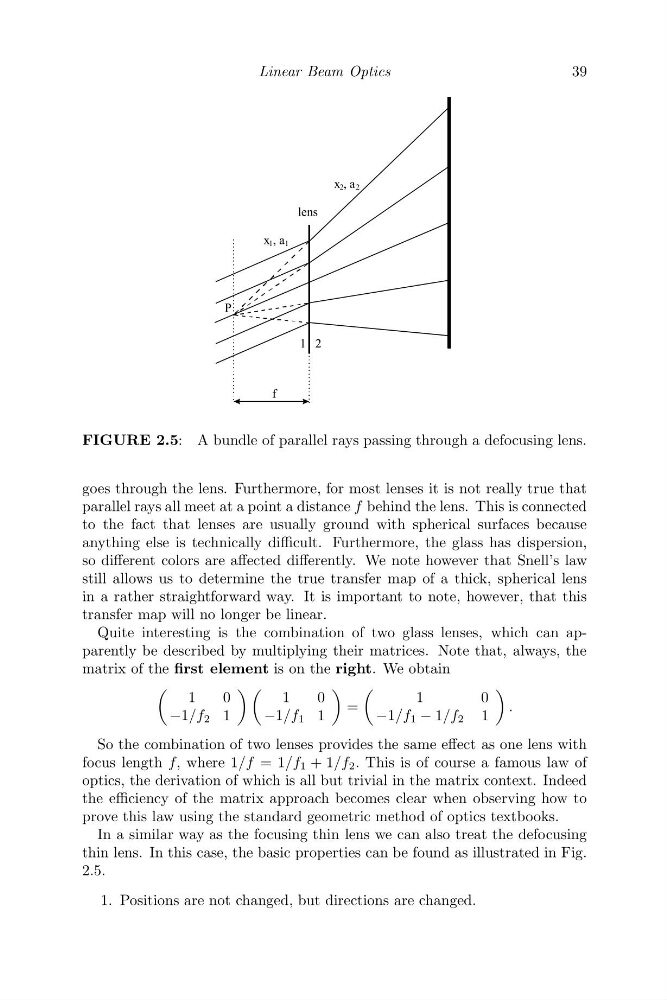
FIGURE 2.5: A bundle of parallel rays passing through a defocusing lens.
goes through the lens. Furthermore, for most lenses it is not really true that
parallel rays all meet at a point a distance f behind the lens. This is connected
to the fact that lenses are usually ground with spherical surfaces because
anything else is technically difficult. Furthermore, the glass has dispersion,
so different colors are affected differently. We note however that Snell’s law
still allows us to determine the true transfer map of a thick, spherical lens
in a rather straightforward way. It is important to note, however, that this
transfer map will no longer be linear.
Quite interesting is the combination of two glass lenses, which can apparently be described by multiplying their matrices. Note that, always, the
matrix of the first element is on the right. We obtain
1
0
−1/f 2 1
1
0
−1/f 1 1
=
1
0
−1/f 1 − 1/f 2 1
.
So the combination of two lenses provides the same effect as one lens with
focus length f, where 1/f = 1/f 1 + 1/f 2 . This is of course a famous law of
optics, the derivation of which is all but trivial in the matrix context. Indeed
the efficiency of the matrix approach becomes clear when observing how to
prove this law using the standard geometric method of optics textbooks.
In a similar way as the focusing thin lens we can also treat the defocusing
thin lens. In this case, the basic properties can be found as illustrated in Fig.
2.5.
1. Positions are not changed, but directions are changed.
39
I
3
OHQV
[D
[D
FIGURE 2.5: A bundle of parallel rays passing through a defocusing lens.
goes through the lens. Furthermore, for most lenses it is not really true that
parallel rays all meet at a point a distance f behind the lens. This is connected
to the fact that lenses are usually ground with spherical surfaces because
anything else is technically difficult. Furthermore, the glass has dispersion,
so different colors are affected differently. We note however that Snell’s law
still allows us to determine the true transfer map of a thick, spherical lens
in a rather straightforward way. It is important to note, however, that this
transfer map will no longer be linear.
Quite interesting is the combination of two glass lenses, which can apparently be described by multiplying their matrices. Note that, always, the
matrix of the first element is on the right. We obtain
1
0
−1/f 2 1
1
0
−1/f 1 1
=
1
0
−1/f 1 − 1/f 2 1
.
So the combination of two lenses provides the same effect as one lens with
focus length f, where 1/f = 1/f 1 + 1/f 2 . This is of course a famous law of
optics, the derivation of which is all but trivial in the matrix context. Indeed
the efficiency of the matrix approach becomes clear when observing how to
prove this law using the standard geometric method of optics textbooks.
In a similar way as the focusing thin lens we can also treat the defocusing
thin lens. In this case, the basic properties can be found as illustrated in Fig.
2.5.
1. Positions are not changed, but directions are changed.