

Linear Beam Optics
37
O
[
D
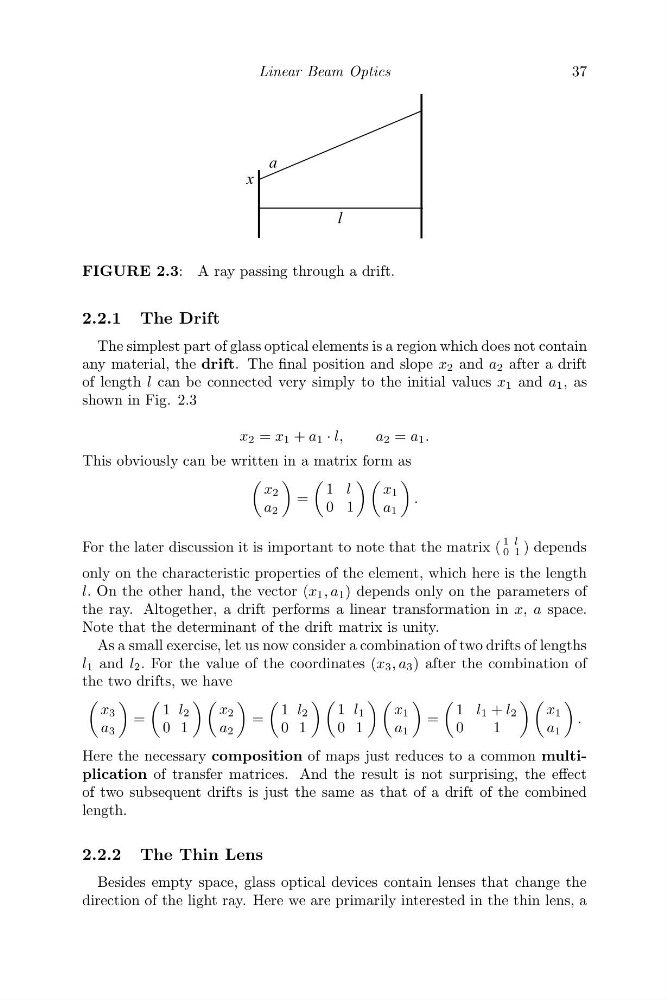
FIGURE 2.3: A ray passing through a drift.
2.2.1 The Drift
The simplest part of glass optical elements is a region which does not contain
any material, the drift. The final position and slope x 2 and a 2 after a drift
of length l can be connected very simply to the initial values x 1 and a 1 , as
shown in Fig. 2.3
x 2 = x 1 + a 1 · l,
a 2 = a 1 .
This obviously can be written in a matrix form as
x 2
a 2
=
1 l
0 1
x 1
a 1
.
For the later discussion it is important to note that the matrix (
1 l
0 1 ) depends
only on the characteristic properties of the element, which here is the length
l. On the other hand, the vector (x 1 , a 1 ) depends only on the parameters of
the ray. Altogether, a drift performs a linear transformation in x, a space.
Note that the determinant of the drift matrix is unity.
As a small exercise, let us now consider a combination of two drifts of lengths
l 1 and l 2 . For the value of the coordinates (x 3 , a 3 ) after the combination of
the two drifts, we have
x 3
a 3
=
1 l 2
0 1
x 2
a 2
=
1 l 2
0 1
1 l 1
0 1
x 1
a 1
=
1 l 1 + l 2
0
1
x 1
a 1
.
Here the necessary composition of maps just reduces to a common multiplication of transfer matrices. And the result is not surprising, the effect
of two subsequent drifts is just the same as that of a drift of the combined
length.
2.2.2 The Thin Lens
Besides empty space, glass optical devices contain lenses that change the
direction of the light ray. Here we are primarily interested in the thin lens, a
37
O
[
D
FIGURE 2.3: A ray passing through a drift.
2.2.1 The Drift
The simplest part of glass optical elements is a region which does not contain
any material, the drift. The final position and slope x 2 and a 2 after a drift
of length l can be connected very simply to the initial values x 1 and a 1 , as
shown in Fig. 2.3
x 2 = x 1 + a 1 · l,
a 2 = a 1 .
This obviously can be written in a matrix form as
x 2
a 2
=
1 l
0 1
x 1
a 1
.
For the later discussion it is important to note that the matrix (
1 l
0 1 ) depends
only on the characteristic properties of the element, which here is the length
l. On the other hand, the vector (x 1 , a 1 ) depends only on the parameters of
the ray. Altogether, a drift performs a linear transformation in x, a space.
Note that the determinant of the drift matrix is unity.
As a small exercise, let us now consider a combination of two drifts of lengths
l 1 and l 2 . For the value of the coordinates (x 3 , a 3 ) after the combination of
the two drifts, we have
x 3
a 3
=
1 l 2
0 1
x 2
a 2
=
1 l 2
0 1
1 l 1
0 1
x 1
a 1
=
1 l 1 + l 2
0
1
x 1
a 1
.
Here the necessary composition of maps just reduces to a common multiplication of transfer matrices. And the result is not surprising, the effect
of two subsequent drifts is just the same as that of a drift of the combined
length.
2.2.2 The Thin Lens
Besides empty space, glass optical devices contain lenses that change the
direction of the light ray. Here we are primarily interested in the thin lens, a