

Linear Beam Optics
33
U
U WXEH
V
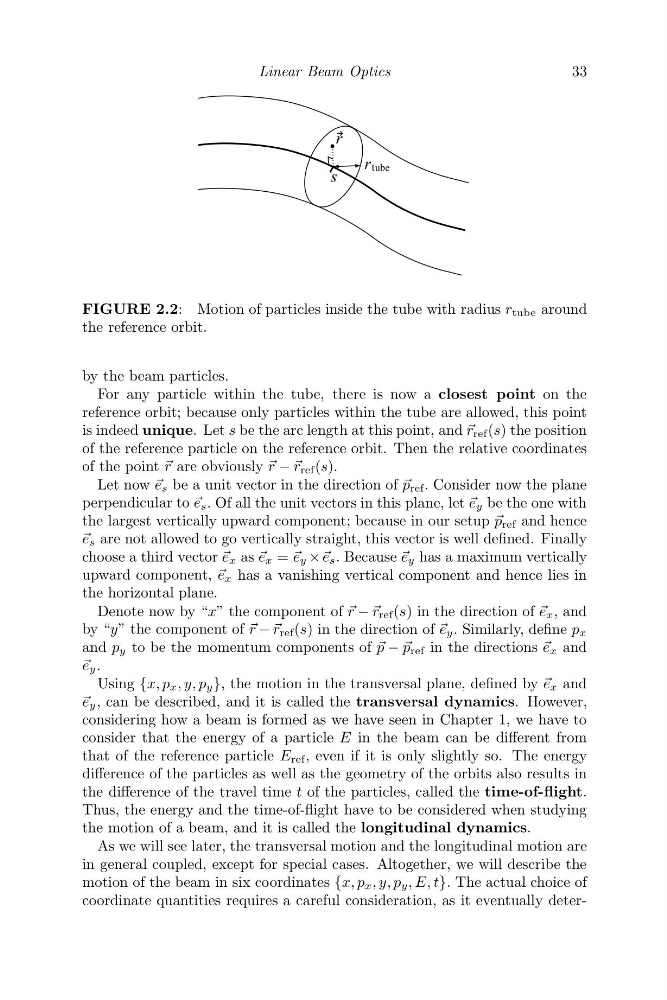
FIGURE 2.2: Motion of particles inside the tube with radius r tube around
the reference orbit.
by the beam particles.
For any particle within the tube, there is now a closest point on the
reference orbit; because only particles within the tube are allowed, this point
is indeed unique. Let s be the arc length at this point, and r ref (s) the position
of the reference particle on the reference orbit. Then the relative coordinates
of the point r are obviously r − r ref (s).
Let now e s be a unit vector in the direction of p ref . Consider now the plane
perpendicular to e s . Of all the unit vectors in this plane, let e y be the one with
the largest vertically upward component; because in our setup
p ref and hence
e s are not allowed to go vertically straight, this vector is well defined. Finally
choose a third vector e x as e x = e y × e s . Because e y has a maximum vertically
upward component, e x has a vanishing vertical component and hence lies in
the horizontal plane.
Denote now by “x” the component of r − r ref (s) in the direction of e x , and
by “y” the component of r − r ref (s) in the direction of e y . Similarly, define p x
and p y to be the momentum components of
p −
p ref in the directions e x and
e y .
Using {x, p x , y, p y }, the motion in the transversal plane, defined by e x and
e y , can be described, and it is called the transversal dynamics. However,
considering how a beam is formed as we have seen in Chapter 1, we have to
consider that the energy of a particle E in the beam can be different from
that of the reference particle E ref , even if it is only slightly so. The energy
difference of the particles as well as the geometry of the orbits also results in
the difference of the travel time t of the particles, called the time-of-flight.
Thus, the energy and the time-of-flight have to be considered when studying
the motion of a beam, and it is called the longitudinal dynamics.
As we will see later, the transversal motion and the longitudinal motion are
in general coupled, except for special cases. Altogether, we will describe the
motion of the beam in six coordinates {x, p x , y, p y , E, t}. The actual choice of
coordinate quantities requires a careful consideration, as it eventually deter-
33
U
U WXEH
V
FIGURE 2.2: Motion of particles inside the tube with radius r tube around
the reference orbit.
by the beam particles.
For any particle within the tube, there is now a closest point on the
reference orbit; because only particles within the tube are allowed, this point
is indeed unique. Let s be the arc length at this point, and r ref (s) the position
of the reference particle on the reference orbit. Then the relative coordinates
of the point r are obviously r − r ref (s).
Let now e s be a unit vector in the direction of p ref . Consider now the plane
perpendicular to e s . Of all the unit vectors in this plane, let e y be the one with
the largest vertically upward component; because in our setup
p ref and hence
e s are not allowed to go vertically straight, this vector is well defined. Finally
choose a third vector e x as e x = e y × e s . Because e y has a maximum vertically
upward component, e x has a vanishing vertical component and hence lies in
the horizontal plane.
Denote now by “x” the component of r − r ref (s) in the direction of e x , and
by “y” the component of r − r ref (s) in the direction of e y . Similarly, define p x
and p y to be the momentum components of
p −
p ref in the directions e x and
e y .
Using {x, p x , y, p y }, the motion in the transversal plane, defined by e x and
e y , can be described, and it is called the transversal dynamics. However,
considering how a beam is formed as we have seen in Chapter 1, we have to
consider that the energy of a particle E in the beam can be different from
that of the reference particle E ref , even if it is only slightly so. The energy
difference of the particles as well as the geometry of the orbits also results in
the difference of the travel time t of the particles, called the time-of-flight.
Thus, the energy and the time-of-flight have to be considered when studying
the motion of a beam, and it is called the longitudinal dynamics.
As we will see later, the transversal motion and the longitudinal motion are
in general coupled, except for special cases. Altogether, we will describe the
motion of the beam in six coordinates {x, p x , y, p y , E, t}. The actual choice of
coordinate quantities requires a careful consideration, as it eventually deter-