

Chapter 2
Linear Beam Optics
In the discussion of the basic physical principles of the various types of accelerators, we casually neglected the fact that it is necessary to take care of
more than one particle. In fact, all the above accelerators have to be able
to simultaneously deal with an ensemble of particles with similar phase space
coordinates, which is what the sources deliver, and hence with a beam. As
outlined above, a detailed understanding of the motion of the beam requires
the study of the motion of the reference particle as well as the motion of
the relative coordinates.
In the case of accelerators, our demands on the relative motion are mostly
that the beam does not become unreasonably large, and hence that the motion
is somehow bounded within a suitable volume of phase space. While this
appears to be a modest wish for long single pass accelerators, and more so for
repetitive systems, this problem actually turns out to be rather nontrivial.
For other types of systems, more specific requirements have to be made for
the beam. For example, to maximize the number of collisions at an interaction region of a collider, it is important to “squeeze” together the spatial
coordinates of the beam, which under conservation of phase space volume
then requires the momentum coordinates becoming large. Devices like particle spectrographs or electron microscopes have different and often even more
involved requirements.
In all of these cases, it is important to study the relative motion carefully.
As a first step, the motion is linearized, and for higher precision, the nonlinear
effects of the motion have to be studied. Because the volume in phase space
occupied by a beam is small, these nonlinear effects are often treated in a
perturbative way, in which the first order corresponds to linear motion,
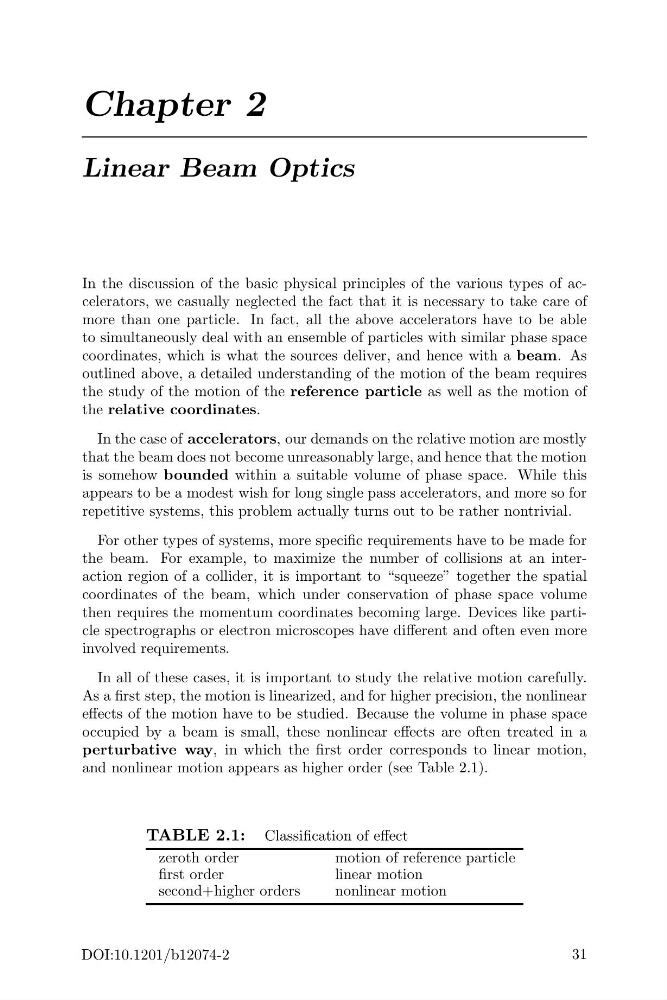
and nonlinear motion appears as higher order (see Table 2.1).
TABLE 2.1: Classification of effect
zeroth order
motion of reference particle
first order
linear motion
second+higher orders
nonlinear motion
31
DOI:10.1201/b12074-2
Linear Beam Optics
In the discussion of the basic physical principles of the various types of accelerators, we casually neglected the fact that it is necessary to take care of
more than one particle. In fact, all the above accelerators have to be able
to simultaneously deal with an ensemble of particles with similar phase space
coordinates, which is what the sources deliver, and hence with a beam. As
outlined above, a detailed understanding of the motion of the beam requires
the study of the motion of the reference particle as well as the motion of
the relative coordinates.
In the case of accelerators, our demands on the relative motion are mostly
that the beam does not become unreasonably large, and hence that the motion
is somehow bounded within a suitable volume of phase space. While this
appears to be a modest wish for long single pass accelerators, and more so for
repetitive systems, this problem actually turns out to be rather nontrivial.
For other types of systems, more specific requirements have to be made for
the beam. For example, to maximize the number of collisions at an interaction region of a collider, it is important to “squeeze” together the spatial
coordinates of the beam, which under conservation of phase space volume
then requires the momentum coordinates becoming large. Devices like particle spectrographs or electron microscopes have different and often even more
involved requirements.
In all of these cases, it is important to study the relative motion carefully.
As a first step, the motion is linearized, and for higher precision, the nonlinear
effects of the motion have to be studied. Because the volume in phase space
occupied by a beam is small, these nonlinear effects are often treated in a
perturbative way, in which the first order corresponds to linear motion,
and nonlinear motion appears as higher order (see Table 2.1).
TABLE 2.1: Classification of effect
zeroth order
motion of reference particle
first order
linear motion
second+higher orders
nonlinear motion
31
DOI:10.1201/b12074-2