

Resonances in Repetitive Systems
293
Furthermore, we have
1
4
S
−
32 + S
+
31
=
1
8
( 3A 111 + B 112 + A 122 + 3B 222 ) ,
i
4
S
−
32 − S
+
31
=
1
8
(−3B 111 + A 112 − B 122 + 3A 222 ) .
From eqs. (11.9) and (11.10), we obtain
1
4
S
−
32 + S
+
31
=
3
8
k
2
s β
3 cos (μ/2) sin μ cos μ
sin (3μ/2)
,
i
4
S
−
32 − S
+
31
= −
3
8
k
2
s β
3 cos (μ/2) cos
2 μ
sin (3μ/2)
.
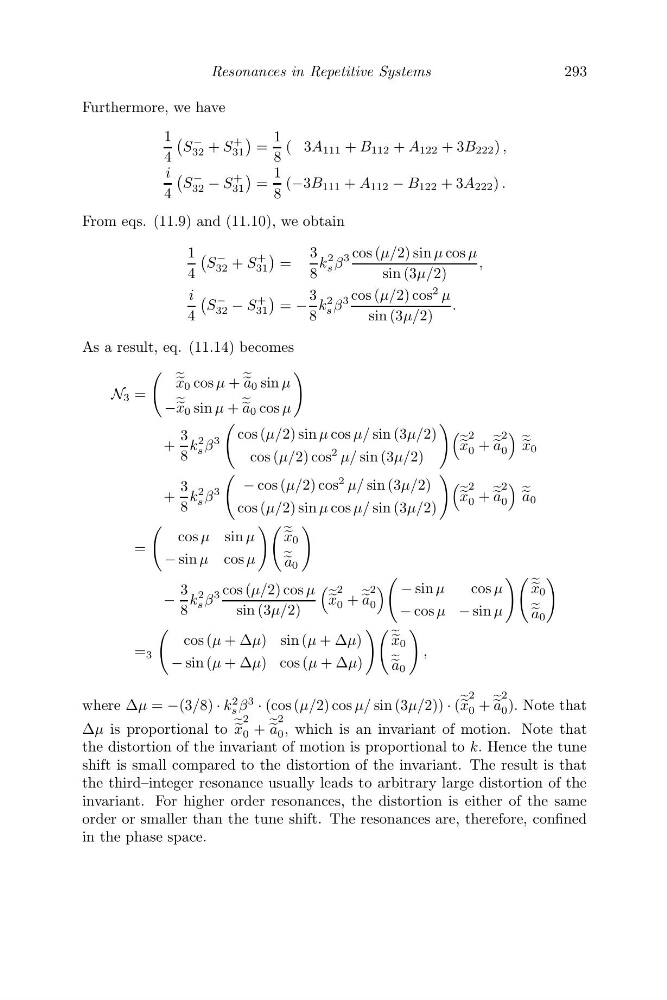
As a result, eq. (11.14) becomes
N 3 =
x 0 cos μ + a 0 sin μ
−
x 0 sin μ + a 0 cos μ
+
3
8
k
2
s β
3
cos (μ/2) sin μ cos μ/ sin (3μ/2)
cos (μ/2) cos
2 μ/ sin (3μ/2)
x
2
0 + a
2
0
x 0
+
3
8
k
2
s β
3
− cos (μ/2) cos
2 μ/ sin (3μ/2)
cos (μ/2) sin μ cos μ/ sin (3μ/2)
x
2
0 + a
2
0
a 0
=
cos μ sin μ
− sin μ cos μ
x 0
a 0
−
3
8
k
2
s β
3 cos (μ/2) cos μ
sin (3μ/2)
x
2
0 + a
2
0
− sin μ
cos μ
− cos μ − sin μ
x 0
a 0
= 3
cos (μ + Δμ) sin (μ + Δμ)
− sin (μ + Δμ) cos(μ + Δμ)
x 0
a 0
,
where Δμ = −(3/8) · k
2
s β
3
· (cos (μ/2) cos μ/ sin (3μ/2)) · (
x
2
0 + a
2
0 ). Note that
Δμ is proportional to
x
2
0 + a
2
0 , which is an invariant of motion. Note that
the distortion of the invariant of motion is proportional to k. Hence the tune
shift is small compared to the distortion of the invariant. The result is that
the third–integer resonance usually leads to arbitrary large distortion of the
invariant. For higher order resonances, the distortion is either of the same
order or smaller than the tune shift. The resonances are, therefore, confined
in the phase space.
293
Furthermore, we have
1
4
S
−
32 + S
+
31
=
1
8
( 3A 111 + B 112 + A 122 + 3B 222 ) ,
i
4
S
−
32 − S
+
31
=
1
8
(−3B 111 + A 112 − B 122 + 3A 222 ) .
From eqs. (11.9) and (11.10), we obtain
1
4
S
−
32 + S
+
31
=
3
8
k
2
s β
3 cos (μ/2) sin μ cos μ
sin (3μ/2)
,
i
4
S
−
32 − S
+
31
= −
3
8
k
2
s β
3 cos (μ/2) cos
2 μ
sin (3μ/2)
.
As a result, eq. (11.14) becomes
N 3 =
x 0 cos μ + a 0 sin μ
−
x 0 sin μ + a 0 cos μ
+
3
8
k
2
s β
3
cos (μ/2) sin μ cos μ/ sin (3μ/2)
cos (μ/2) cos
2 μ/ sin (3μ/2)
x
2
0 + a
2
0
x 0
+
3
8
k
2
s β
3
− cos (μ/2) cos
2 μ/ sin (3μ/2)
cos (μ/2) sin μ cos μ/ sin (3μ/2)
x
2
0 + a
2
0
a 0
=
cos μ sin μ
− sin μ cos μ
x 0
a 0
−
3
8
k
2
s β
3 cos (μ/2) cos μ
sin (3μ/2)
x
2
0 + a
2
0
− sin μ
cos μ
− cos μ − sin μ
x 0
a 0
= 3
cos (μ + Δμ) sin (μ + Δμ)
− sin (μ + Δμ) cos(μ + Δμ)
x 0
a 0
,
where Δμ = −(3/8) · k
2
s β
3
· (cos (μ/2) cos μ/ sin (3μ/2)) · (
x
2
0 + a
2
0 ). Note that
Δμ is proportional to
x
2
0 + a
2
0 , which is an invariant of motion. Note that
the distortion of the invariant of motion is proportional to k. Hence the tune
shift is small compared to the distortion of the invariant. The result is that
the third–integer resonance usually leads to arbitrary large distortion of the
invariant. For higher order resonances, the distortion is either of the same
order or smaller than the tune shift. The resonances are, therefore, confined
in the phase space.