

286
An Introduction to Beam Physics
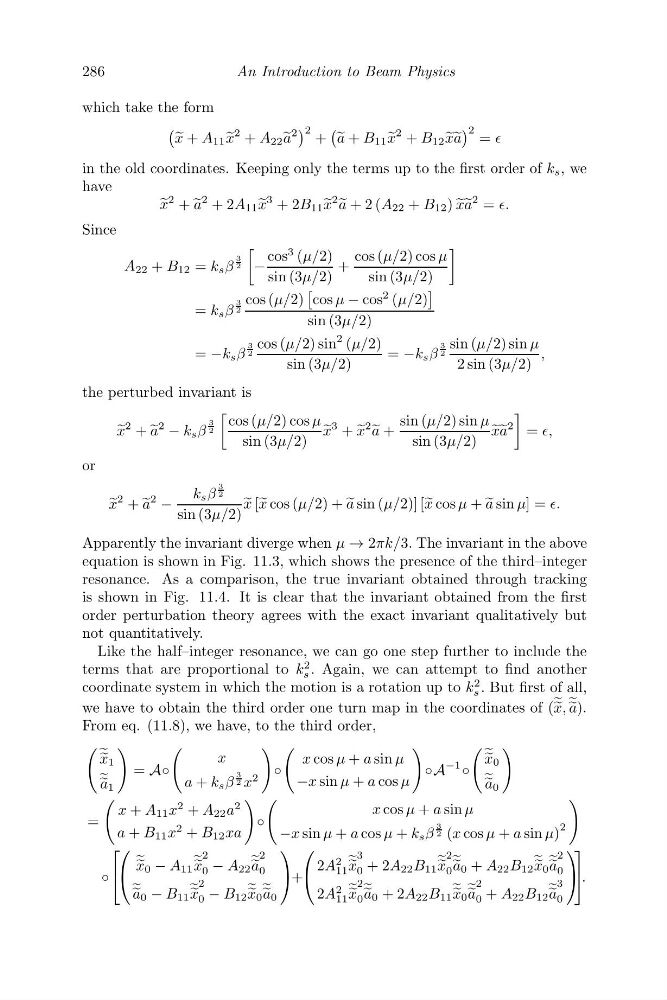
which take the form
x + A 11
x
2 + A 22 a
2
2 +
a + B 11
x
2 + B 12
x a
2 =
in the old coordinates. Keeping only the terms up to the first order of k s , we
have
x
2 + a
2 + 2A 11
x
3 + 2B 11
x
2
a + 2 (A 22 + B 12 )
x a
2 = .
Since
A 22 + B 12 = k s β
3
2
−
cos
3 (μ/2)
sin (3μ/2)
+
cos (μ/2) cos μ
sin (3μ/2)
= k s β
3
2
cos (μ/2)
cos μ − cos
2 (μ/2)
sin (3μ/2)
= −k s β
3
2
cos (μ/2) sin
2 (μ/2)
sin (3μ/2)
= −k s β
3
2
sin (μ/2) sin μ
2 sin (3μ/2)
,
the perturbed invariant is
x
2 + a
2
− k s β
3
2
cos (μ/2) cos μ
sin (3μ/2)
x
3 +
x
2
a +
sin (μ/2) sin μ
sin (3μ/2)
x a
2
= ,
or
x
2 + a
2
−
k s β
3
2
sin (3μ/2)
x [ x cos (μ/2) + a sin (μ/2)] [ x cos μ + a sin μ] = .
Apparently the invariant diverge when μ → 2πk/3. The invariant in the above
equation is shown in Fig. 11.3, which shows the presence of the third–integer
resonance. As a comparison, the true invariant obtained through tracking
is shown in Fig. 11.4. It is clear that the invariant obtained from the first
order perturbation theory agrees with the exact invariant qualitatively but
not quantitatively.
Like the half–integer resonance, we can go one step further to include the
terms that are proportional to k
2
s . Again, we can attempt to find another
coordinate system in which the motion is a rotation up to k
2
s . But first of all,
we have to obtain the third order one turn map in the coordinates of (
x, a).
From eq. (11.8), we have, to the third order,
x 1
a 1
= A◦
x
a + k s β
3
2 x
2
◦
x cos μ + a sin μ
−x sin μ + a cos μ
◦A
−1
◦
x 0
a 0
=
x + A 11 x
2 + A 22 a
2
a + B 11 x
2 + B 12 xa
◦
x cos μ + a sin μ
−x sin μ + a cos μ + k s β
3
2 (x cos μ + a sin μ)
2
◦
⎡
⎣
⎛
⎝
x 0 − A 11
x
2
0 − A 22 a
2
0
a 0 − B 11
x
2
0 − B 12
x 0 a 0
⎞
⎠ +
⎛
⎝
2A
2
11
x
3
0 + 2A 22 B 11
x
2
0
a 0 + A 22 B 12
x 0 a
2
0
2A
2
11
x
2
0
a 0 + 2A 22 B 11
x 0 a
2
0 + A 22 B 12 a
3
0
⎞
⎠
⎤
⎦ .
An Introduction to Beam Physics
which take the form
x + A 11
x
2 + A 22 a
2
2 +
a + B 11
x
2 + B 12
x a
2 =
in the old coordinates. Keeping only the terms up to the first order of k s , we
have
x
2 + a
2 + 2A 11
x
3 + 2B 11
x
2
a + 2 (A 22 + B 12 )
x a
2 = .
Since
A 22 + B 12 = k s β
3
2
−
cos
3 (μ/2)
sin (3μ/2)
+
cos (μ/2) cos μ
sin (3μ/2)
= k s β
3
2
cos (μ/2)
cos μ − cos
2 (μ/2)
sin (3μ/2)
= −k s β
3
2
cos (μ/2) sin
2 (μ/2)
sin (3μ/2)
= −k s β
3
2
sin (μ/2) sin μ
2 sin (3μ/2)
,
the perturbed invariant is
x
2 + a
2
− k s β
3
2
cos (μ/2) cos μ
sin (3μ/2)
x
3 +
x
2
a +
sin (μ/2) sin μ
sin (3μ/2)
x a
2
= ,
or
x
2 + a
2
−
k s β
3
2
sin (3μ/2)
x [ x cos (μ/2) + a sin (μ/2)] [ x cos μ + a sin μ] = .
Apparently the invariant diverge when μ → 2πk/3. The invariant in the above
equation is shown in Fig. 11.3, which shows the presence of the third–integer
resonance. As a comparison, the true invariant obtained through tracking
is shown in Fig. 11.4. It is clear that the invariant obtained from the first
order perturbation theory agrees with the exact invariant qualitatively but
not quantitatively.
Like the half–integer resonance, we can go one step further to include the
terms that are proportional to k
2
s . Again, we can attempt to find another
coordinate system in which the motion is a rotation up to k
2
s . But first of all,
we have to obtain the third order one turn map in the coordinates of (
x, a).
From eq. (11.8), we have, to the third order,
x 1
a 1
= A◦
x
a + k s β
3
2 x
2
◦
x cos μ + a sin μ
−x sin μ + a cos μ
◦A
−1
◦
x 0
a 0
=
x + A 11 x
2 + A 22 a
2
a + B 11 x
2 + B 12 xa
◦
x cos μ + a sin μ
−x sin μ + a cos μ + k s β
3
2 (x cos μ + a sin μ)
2
◦
⎡
⎣
⎛
⎝
x 0 − A 11
x
2
0 − A 22 a
2
0
a 0 − B 11
x
2
0 − B 12
x 0 a 0
⎞
⎠ +
⎛
⎝
2A
2
11
x
3
0 + 2A 22 B 11
x
2
0
a 0 + A 22 B 12
x 0 a
2
0
2A
2
11
x
2
0
a 0 + 2A 22 B 11
x 0 a
2
0 + A 22 B 12 a
3
0
⎞
⎠
⎤
⎦ .