

284
An Introduction to Beam Physics
which shows that the position and angle become arbitrarily large when μ →
2πk or 2π(k ± 1/3).
Next, we will study the deformation of the invariant. Since the sextupole
affect only the nonlinear part of the motion, the perturbation of the invariant
is of the third order and higher. One way to obtain the new invariant is to find
a new coordinate system in which the motion is a circle. The new invariant
can be found via the relation between the new and the old coordinates. This
method is called the normal form theory. In general, there is no analytical
solution to the perturbed invariant. We can only obtain it perturbatively. In
order to demonstrate the essence of the method, the lowest order perturbation
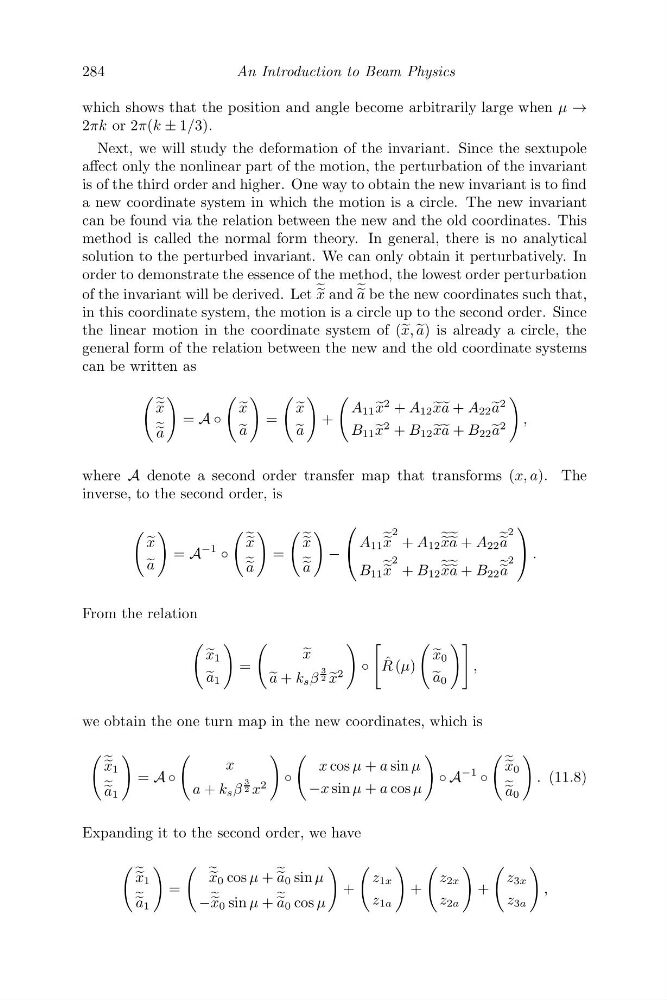
of the invariant will be derived. Let
x and a be the new coordinates such that,
in this coordinate system, the motion is a circle up to the second order. Since
the linear motion in the coordinate system of ( x, a) is already a circle, the
general form of the relation between the new and the old coordinate systems
can be written as
x
a
= A ◦
x
a
=
x
a
+
A 11
x
2 + A 12
x a + A 22 a
2
B 11
x
2 + B 12
x a + B 22 a
2
,
where A denote a second order transfer map that transforms (x, a). The
inverse, to the second order, is
x
a
= A
−1
◦
x
a
=
x
a
−
⎛
⎝
A 11
x
2
+ A 12
x a + A 22 a
2
B 11
x
2
+ B 12
x a + B 22 a
2
⎞
⎠ .
From the relation
x 1
a 1
=
x
a + k s β
3
2
x
2
◦
ˆ
R (μ)
x 0
a 0
,
we obtain the one turn map in the new coordinates, which is
x 1
a 1
= A ◦
x
a + k s β
3
2 x
2
◦
x cos μ + a sin μ
−x sin μ + a cos μ
◦ A
−1
◦
x 0
a 0
. (11.8)
Expanding it to the second order, we have
x 1
a 1
=
x 0 cos μ + a 0 sin μ
−
x 0 sin μ + a 0 cos μ
+
z 1x
z 1a
+
z 2x
z 2a
+
z 3x
z 3a
,
An Introduction to Beam Physics
which shows that the position and angle become arbitrarily large when μ →
2πk or 2π(k ± 1/3).
Next, we will study the deformation of the invariant. Since the sextupole
affect only the nonlinear part of the motion, the perturbation of the invariant
is of the third order and higher. One way to obtain the new invariant is to find
a new coordinate system in which the motion is a circle. The new invariant
can be found via the relation between the new and the old coordinates. This
method is called the normal form theory. In general, there is no analytical
solution to the perturbed invariant. We can only obtain it perturbatively. In
order to demonstrate the essence of the method, the lowest order perturbation
of the invariant will be derived. Let
x and a be the new coordinates such that,
in this coordinate system, the motion is a circle up to the second order. Since
the linear motion in the coordinate system of ( x, a) is already a circle, the
general form of the relation between the new and the old coordinate systems
can be written as
x
a
= A ◦
x
a
=
x
a
+
A 11
x
2 + A 12
x a + A 22 a
2
B 11
x
2 + B 12
x a + B 22 a
2
,
where A denote a second order transfer map that transforms (x, a). The
inverse, to the second order, is
x
a
= A
−1
◦
x
a
=
x
a
−
⎛
⎝
A 11
x
2
+ A 12
x a + A 22 a
2
B 11
x
2
+ B 12
x a + B 22 a
2
⎞
⎠ .
From the relation
x 1
a 1
=
x
a + k s β
3
2
x
2
◦
ˆ
R (μ)
x 0
a 0
,
we obtain the one turn map in the new coordinates, which is
x 1
a 1
= A ◦
x
a + k s β
3
2 x
2
◦
x cos μ + a sin μ
−x sin μ + a cos μ
◦ A
−1
◦
x 0
a 0
. (11.8)
Expanding it to the second order, we have
x 1
a 1
=
x 0 cos μ + a 0 sin μ
−
x 0 sin μ + a 0 cos μ
+
z 1x
z 1a
+
z 2x
z 2a
+
z 3x
z 3a
,