

270
An Introduction to Beam Physics
Denoting
Δμ =
n
m=1
ΔK m cos (2Ψ m )
2
+
n
m=1
ΔK m sin (2Ψ m )
2
,
we see the unstable interval of the tune is
2ππ +
1
2
n
m=1
ΔK m
<
Δμ
2
,
and Δμ is called the integer stop band. Similar calculation shows that the
same expression also gives the half–integer stop band [16].
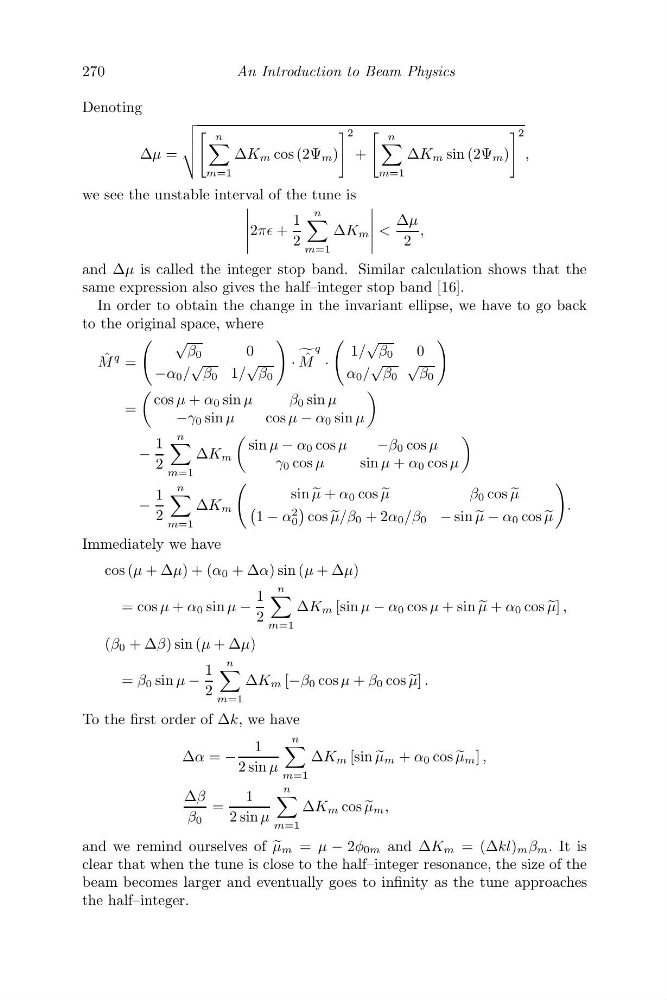
In order to obtain the change in the invariant ellipse, we have to go back
to the original space, where
ˆ
M
q =
√
β 0
0
−α 0 /
√
β 0 1/
√
β 0
·
ˆ
M
q
·
1/
√
β 0
0
α 0 /
√
β 0
√
β 0
=
cos μ + α 0 sin μ
β 0 sin μ
−γ 0 sin μ
cos μ − α 0 sin μ
−
1
2
n
m=1
ΔK m
sin μ − α 0 cos μ
−β 0 cos μ
γ 0 cos μ
sin μ + α 0 cos μ
−
1
2
n
m=1
ΔK m
sin
μ + α 0 cos
μ
β 0 cos
μ
1 − α
2
0
cos
μ/β 0 + 2α 0 /β 0 − sin
μ − α 0 cos
μ
.
Immediately we have
cos (μ + Δμ) + (α 0 + Δα) sin (μ + Δμ)
= cos μ + α 0 sin μ −
1
2
n
m=1
ΔK m [sin μ − α 0 cos μ + sin
μ + α 0 cos
μ] ,
(β 0 + Δβ) sin (μ + Δμ)
= β 0 sin μ −
1
2
n
m=1
ΔK m [−β 0 cos μ + β 0 cos
μ] .
To the first order of Δk, we have
Δα = −
1
2 sin μ
n
m=1
ΔK m [sin
μ m + α 0 cos
μ m ] ,
Δβ
β 0
=
1
2 sin μ
n
m=1
ΔK m cos
μ m ,
and we remind ourselves of
μ m = μ − 2φ 0m and ΔK m = (Δkl) m β m . It is
clear that when the tune is close to the half–integer resonance, the size of the
beam becomes larger and eventually goes to infinity as the tune approaches
the half–integer.
An Introduction to Beam Physics
Denoting
Δμ =
n
m=1
ΔK m cos (2Ψ m )
2
+
n
m=1
ΔK m sin (2Ψ m )
2
,
we see the unstable interval of the tune is
2ππ +
1
2
n
m=1
ΔK m
<
Δμ
2
,
and Δμ is called the integer stop band. Similar calculation shows that the
same expression also gives the half–integer stop band [16].
In order to obtain the change in the invariant ellipse, we have to go back
to the original space, where
ˆ
M
q =
√
β 0
0
−α 0 /
√
β 0 1/
√
β 0
·
ˆ
M
q
·
1/
√
β 0
0
α 0 /
√
β 0
√
β 0
=
cos μ + α 0 sin μ
β 0 sin μ
−γ 0 sin μ
cos μ − α 0 sin μ
−
1
2
n
m=1
ΔK m
sin μ − α 0 cos μ
−β 0 cos μ
γ 0 cos μ
sin μ + α 0 cos μ
−
1
2
n
m=1
ΔK m
sin
μ + α 0 cos
μ
β 0 cos
μ
1 − α
2
0
cos
μ/β 0 + 2α 0 /β 0 − sin
μ − α 0 cos
μ
.
Immediately we have
cos (μ + Δμ) + (α 0 + Δα) sin (μ + Δμ)
= cos μ + α 0 sin μ −
1
2
n
m=1
ΔK m [sin μ − α 0 cos μ + sin
μ + α 0 cos
μ] ,
(β 0 + Δβ) sin (μ + Δμ)
= β 0 sin μ −
1
2
n
m=1
ΔK m [−β 0 cos μ + β 0 cos
μ] .
To the first order of Δk, we have
Δα = −
1
2 sin μ
n
m=1
ΔK m [sin
μ m + α 0 cos
μ m ] ,
Δβ
β 0
=
1
2 sin μ
n
m=1
ΔK m cos
μ m ,
and we remind ourselves of
μ m = μ − 2φ 0m and ΔK m = (Δkl) m β m . It is
clear that when the tune is close to the half–integer resonance, the size of the
beam becomes larger and eventually goes to infinity as the tune approaches
the half–integer.