

Beams and Beam Physics
13
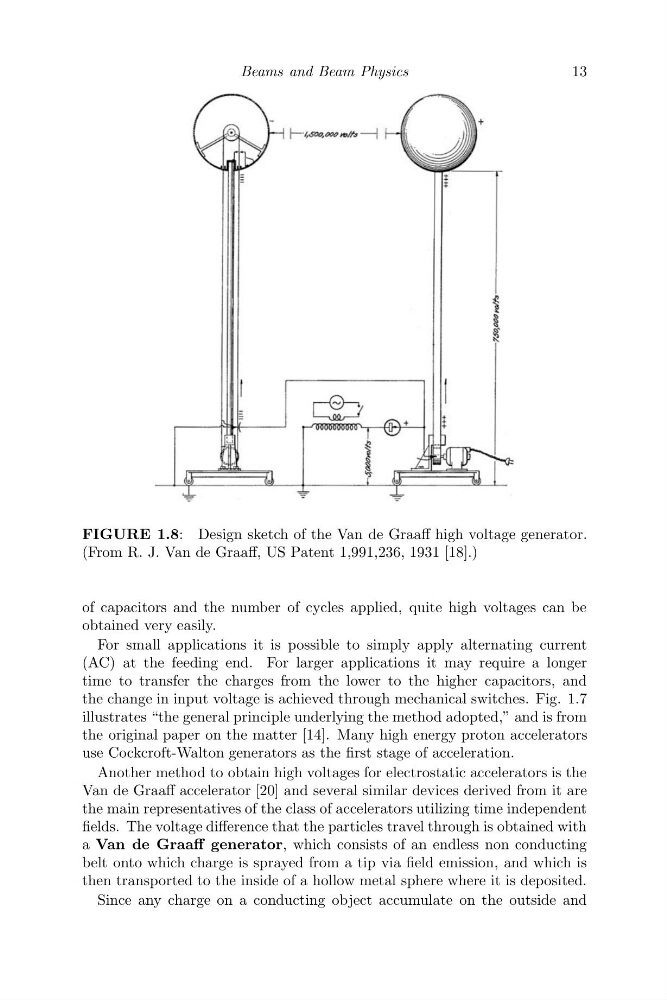
FIGURE 1.8: Design sketch of the Van de Graaff high voltage generator.
(From R. J. Van de Graaff, US Patent 1,991,236, 1931 [18].)
of capacitors and the number of cycles applied, quite high voltages can be
obtained very easily.
For small applications it is possible to simply apply alternating current
(AC) at the feeding end. For larger applications it may require a longer
time to transfer the charges from the lower to the higher capacitors, and
the change in input voltage is achieved through mechanical switches. Fig. 1.7
illustrates “the general principle underlying the method adopted,” and is from
the original paper on the matter [14]. Many high energy proton accelerators
use Cockcroft-Walton generators as the first stage of acceleration.
Another method to obtain high voltages for electrostatic accelerators is the
Van de Graaff accelerator [20] and several similar devices derived from it are
the main representatives of the class of accelerators utilizing time independent
fields. The voltage difference that the particles travel through is obtained with
a Van de Graaff generator, which consists of an endless non conducting
belt onto which charge is sprayed from a tip via field emission, and which is
then transported to the inside of a hollow metal sphere where it is deposited.
Since any charge on a conducting object accumulate on the outside and
13
FIGURE 1.8: Design sketch of the Van de Graaff high voltage generator.
(From R. J. Van de Graaff, US Patent 1,991,236, 1931 [18].)
of capacitors and the number of cycles applied, quite high voltages can be
obtained very easily.
For small applications it is possible to simply apply alternating current
(AC) at the feeding end. For larger applications it may require a longer
time to transfer the charges from the lower to the higher capacitors, and
the change in input voltage is achieved through mechanical switches. Fig. 1.7
illustrates “the general principle underlying the method adopted,” and is from
the original paper on the matter [14]. Many high energy proton accelerators
use Cockcroft-Walton generators as the first stage of acceleration.
Another method to obtain high voltages for electrostatic accelerators is the
Van de Graaff accelerator [20] and several similar devices derived from it are
the main representatives of the class of accelerators utilizing time independent
fields. The voltage difference that the particles travel through is obtained with
a Van de Graaff generator, which consists of an endless non conducting
belt onto which charge is sprayed from a tip via field emission, and which is
then transported to the inside of a hollow metal sphere where it is deposited.
Since any charge on a conducting object accumulate on the outside and